Part One — The Bouquet
My parents had been married for forty-three years. I was their only son, and I grew up in the kind of home people sometimes assume only exists in old television shows. My father brought my mother coffee every morning. She still tucked notes into his lunch when he worked part-time at the hardware store. They argued, of course, but I had never once wondered whether they loved each other.
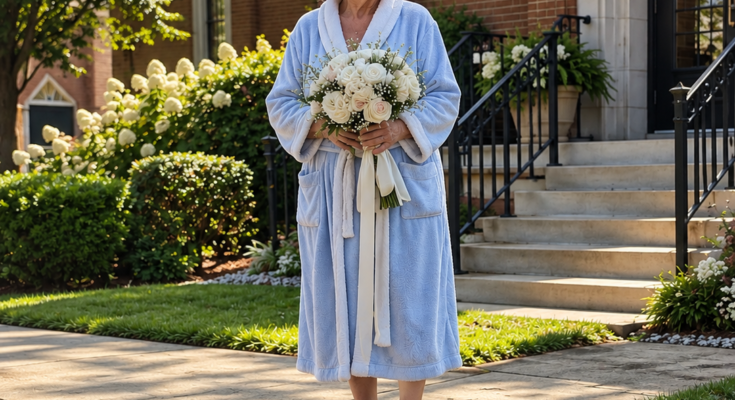
That was why seeing my mother standing outside a church at seven in the morning wearing a blue bathrobe, bedroom slippers, and holding what looked unmistakably like a bridal bouquet frightened me more than I can explain.
I was driving to work when I spotted her. At first, I thought I had mistaken another woman for her. Then she turned her head, and I saw her face. I pulled over so quickly the driver behind me leaned on his horn.
“Mom?”
She looked at me.
Her hair was uncombed and her face was pale, but her eyes were clear.
That almost made it worse.
She knew where she was.
She knew what she was wearing.
And she was clutching those flowers as if somebody might try to take them.
“What are you doing here?”
“I’m fine.”
“You’re standing outside Saint Matthew’s in your bathrobe.”
“I know what I’m wearing, Michael.”
“Where’s Dad?”
“At home.”
“Does he know you’re here?”
Her expression changed.
She glanced toward the church entrance, checked the time on her phone, then grabbed my arm.
“Your father can never know I was here.”
I stared at her.
“What?”
“Promise me.”
“No. Not until you tell me what’s happening.”
Her fingers tightened around my sleeve.
“Michael, please.”
Then I finally looked properly at the bouquet.
White roses.
Baby’s breath.
Three pale blue ribbons tied around the stems.
I had seen those flowers before.
There was a framed wedding photograph in my parents’ hallway. Mom was twenty-two in it, Dad twenty-four. She was holding almost exactly the same bouquet.
My stomach dropped.
“Mom… why are you holding your wedding flowers?”
Her eyes filled with tears.
“I had them recreated.”
“For what?”
She looked toward the church.
“To get married.”
I actually stepped backward.
“What?”
“Not to somebody else.”
Apparently my face had said everything.
“Then what are you talking about?”
She took a shaky breath.
“Your father and I may not actually be married.”
For several seconds, I could only stare at her.
“That isn’t funny.”
“I’m not joking.”
She reached into the pocket of her robe and pulled out a folded piece of paper.
It was a letter from the county clerk’s office.
My parents had recently been meeting with an estate attorney because Dad wanted to simplify everything before they got older. During that process, the attorney requested a certified copy of their marriage record.
There wasn’t one.
The church had records showing that Thomas and Evelyn Carter had participated in a wedding ceremony forty-three years earlier.
There were photographs.
Witnesses.
A priest’s handwritten entry in an old parish register.
But the county could not locate a filed marriage license.
“At first we thought it was a mistake,” Mom said. “Then the attorney checked again.”
“What does Dad think?”
“He doesn’t know.”
“How could he not know?”
“Because I opened the letter yesterday.”
I looked at her.
“You hid this from him?”
“For one night.”
“Why?”
That was when she started crying.
Not loudly.
My mother almost never cried loudly.
She pressed the bouquet against herself and whispered, “Because your father has spent forty-three years believing the happiest thing he ever did was marry me.”
I softened immediately.
“Mom.”
“If I go home and tell him some piece of paper might say it didn’t count, do you know what he’ll do?”
“What?”
“He’ll blame himself.”
I knew she was right.
My father could turn a burned piece of toast into a personal moral failure.
“He’ll say he should have checked. He’ll spend the next six months apologizing for something that happened when we were practically children.”
“So why are you here?”
She looked toward Saint Matthew’s.
“Father Paul found the old parish book last night. He called me at six this morning.”
“Okay.”
“He also found someone.”
The church door opened.
An elderly man stepped outside.
He was very thin, walking with a cane, accompanied by a younger priest.
Mom stopped breathing for a moment.
The older man looked at her.
Then at the flowers.
And smiled.
“Evelyn.”
My mother whispered, “Father Michael.”
I recognized the name from family stories.
He was the priest who had married my parents forty-three years earlier.
And apparently he had been searching for my mother too.
━━━━━━━━━━━━━━━━━━━━
Part Two — The Wedding That Disappeared
We sat inside the empty church.
Mom refused to take off her bathrobe.
At that point, I stopped asking.
Father Michael was ninety-one years old and living in a retirement community nearly two hours away. When Father Paul contacted him about the missing marriage record, he remembered my parents immediately.
“You two were the wedding with the blue ribbons,” he told Mom.
She laughed through her tears.
“My mother hated those ribbons.”
“I remember.”
Then Father Michael’s expression became serious.
He explained that the parish had experienced an administrative mess during the summer my parents married. The parish secretary had become ill. Several documents were delayed, and there had apparently been confusion over which marriage licenses had been mailed to the county.
He had no way of knowing exactly what happened to my parents’ paperwork.
But he remembered performing the ceremony.
The church register confirmed it.
My parents had lived for forty-three years believing everything had been properly filed.
I asked the obvious question.
“So are they married or not?”
Father Paul answered carefully.
“That’s something their attorney and the county need to sort through legally. We shouldn’t make assumptions based only on a missing record.”
That distinction mattered.
A missing certificate did not automatically erase forty-three years.
Their attorney was already working on resolving the documentation.
But my mother had apparently heard only one thing when she opened that letter:
No marriage record found.
And then she panicked.
“What were you planning to do?” I asked.
Mom looked embarrassed.
“I thought we could just do it again.”
“What?”
“Today.”
“In a bathrobe?”
“I was going home to change.”
That was the first time I laughed.
She glared at me.
“I left before your father woke up because I wanted to talk to Father Michael.”
“And the bouquet?”
“I picked it up yesterday.”
“Before you knew whether there was even a ceremony?”
“Michael, I was upset.”
“Yes, clearly.”
Father Michael laughed.
Then my mother said something that stopped all of us.
“I wanted to marry him again before he ever had to know the first one might have a problem.”
I looked at her.
“You were going to surprise Dad with a wedding?”
“Yes.”
“Today?”
“Yes.”
“After forty-three years?”
She straightened her robe.
“I don’t see why everybody keeps repeating the number like there’s an expiration date.”
That was my mother.
But there was another reason she was rushing.
She had not told me that part yet.
Two months earlier, Dad had begun forgetting small things.
At first, nothing alarming.
Where he left his reading glasses.
Whether he had locked the back door.
The name of a neighbor they had known for years.
Mom convinced him to see a doctor.
There had been appointments.
Tests.
The final specialist visit was scheduled for the following week.
“You thought something was wrong with Mom,” she told me. “You’re worried about the wrong parent.”
My stomach tightened.
“Why didn’t either of you tell me?”
“Because there was nothing definite to tell.”
“Mom.”
“I know.”
She looked down at the bouquet.
“Yesterday morning your father asked me what year we got married.”
I felt something cold move through me.
“He knew the answer a minute later. He laughed about it. But then that county letter arrived.”
Now I understood.
This wasn’t really about paperwork.
My mother had become terrified that time was narrowing.
If Dad’s memory was beginning to change, she wanted one thing settled beyond question.
She wanted him to remember marrying her.
Even if she had to give him a second wedding to do it.
Father Michael reached across the pew and touched her hand.
“Evelyn, you don’t need to protect Thomas from everything.”
Mom looked at him.
“I promised I would.”
“No,” he said gently. “You promised to walk beside him.”
My mother started crying again.
Father Michael continued.
“Those are different promises.”
I thought about that for a long time.
Then I asked Mom, “What exactly were you going to tell Dad when you showed up in a wedding dress at breakfast?”
She wiped her eyes.
“I hadn’t gotten that far.”
“Finally, a flaw in the plan.”
She hit my arm with the bouquet.
That was when my phone rang.
Dad.
Mom’s face went white.
“Don’t answer.”
“Mom.”
“He’ll know.”
“He already knows you’re missing.”
The phone stopped.
Then immediately rang again.
I answered.
“Michael?”
Dad sounded worried.
“Have you seen your mother?”
I looked at Mom.
She shook her head violently.
“She isn’t home,” Dad continued. “Her car’s gone, and she left the coffee pot on.”
I took a breath.
“Dad, she’s with me.”
Silence.
Then:
“Is she okay?”
“Yes.”
“Where are you?”
Mom closed her eyes.
I told him.
There was a longer silence.
“Saint Matthew’s?”
“Yes.”
Dad’s voice changed.
“Why?”
Mom looked at me.
I handed her the phone.
For almost a minute, she simply held it.
Then she whispered:
“Thomas, I need you to come marry me.”
━━━━━━━━━━━━━━━━━━━━
Part Three — Forty-Three Years and One Morning
Dad arrived thirty-seven minutes later.
He was wearing khaki pants, one brown shoe, and one black shoe.
Nobody mentioned it.
He entered Saint Matthew’s looking terrified until he saw Mom sitting in the second pew.
Then he stopped.
His eyes went to the bouquet.
“Evelyn?”
Mom stood.
Still in her bathrobe.
Dad looked at me.
I lifted both hands.
“Don’t involve me.”
He looked back at her.
“What happened?”
Mom walked toward him and handed him the county letter.
I watched my father read it.
His expression changed exactly the way Mom had predicted.
Confusion.
Disbelief.
Then guilt.
“I should have checked.”
Mom immediately said, “Thomas.”
“I should have made sure they filed it.”
“Thomas.”
“I kept the license in my jacket that morning. Maybe I—”
She put both hands against his face.
“Stop.”
Dad stared at her.
“You were twenty-four years old. You showed up. You said your vows. You spent forty-three years keeping them. I am not allowing you to apologize because somebody lost a piece of paper.”
His eyes filled.
“What are the flowers for?”
Mom looked embarrassed now.
“I had an idea.”
I coughed.
“A very normal idea.”
She ignored me.
“I thought we could get married again.”
Dad stared at her.
“Today?”
“Yes.”
“You’re wearing a bathrobe.”
“So everybody keeps telling me.”
Father Michael stood.
Dad’s face changed when he recognized him.
For a second, the years disappeared from my father’s expression.
“Father Michael?”
“Hello, Thomas.”
My father covered his mouth.
Then Father Michael said, “Your wife seems concerned that one wedding wasn’t sufficient.”
Dad looked at Mom.
“She always was an overachiever.”
Mom laughed.
And just like that, some of the fear left the room.
They did not legally remarry that morning.
Their attorney later explained that the missing record needed to be addressed properly, and the county eventually accepted supporting documentation that helped establish their long-standing marriage. There were affidavits, church records, tax returns, old insurance documents, and enough paperwork to make Dad complain that getting married the second time might have been easier.
But that morning, the legal question almost became secondary.
Father Michael offered them something simpler.
A blessing.
Mom called me from the church restroom ten minutes before it began.
“Michael.”
“What?”
“Go home.”
“What?”
“Bring me clothes.”
So I drove to my parents’ house.
On the bed was the cream-colored dress Mom had worn to their fortieth-anniversary dinner.
Dad’s navy suit was hanging in the closet.
I brought both.
An hour later, my parents stood at the front of Saint Matthew’s.
No guests.
No photographer.
No reception.
Just me, Father Paul, Father Michael, and a church secretary who cried through almost the entire thing.
Mom held the white roses with the blue ribbons.
Dad held her hands.
Father Michael asked whether they wished to renew the promises they had made forty-three years before.
Dad said, “Absolutely.”
Mom said, “Yes.”
Then Father Michael asked Dad if he had anything he wanted to say.
My father looked at my mother for a long time.
“I remember the first morning after we got married.”
Mom smiled.
“You burned the eggs.”
“They were terrible.”
“They were.”
“You ate them.”
“You looked nervous.”
Dad laughed.
Then he said, “If someday I forget that morning, or the wedding, or the house on Willow Street, I need you to know something.”
The church became completely still.
“I don’t think loving you lives only in the part of my brain that remembers dates.”
My mother started crying.
Dad continued.
“I’ve loved you long enough that I think some of it moved into my bones.”
I turned away.
I have no shame admitting I cried harder than either of them.
The following week, Dad received his diagnosis.
Early-stage cognitive impairment.
Not the catastrophic answer we had feared, but not something to ignore either. His doctors explained that progression varies and that they would monitor him closely.
My parents told me everything after that.
No more protecting me with silence.
We organized documents.
Simplified accounts.
Added calendars and medication reminders.
Dad stopped driving at night voluntarily.
Mom finally accepted help instead of treating assistance like evidence that she had failed him.
And the strangest part was that Dad remembered the second ceremony extremely well.
For months afterward, he told almost everyone:
“I married Evelyn again.”
Cashiers.
Neighbors.
His cardiologist.
A man repairing their refrigerator.
Mom would roll her eyes.
“You didn’t technically marry me again.”
Dad would shrug.
“Close enough.”
About a year later, I was having coffee with him when he suddenly asked:
“Michael, why did your mother marry me twice?”
I froze.
There are moments when you realize memory is not fading like a light being switched off.
It changes unevenly.
One detail disappears while something from forty years ago remains sharp.
I said, “Because she really likes you.”
Dad laughed.
“Poor judgment.”
Then he became serious.
“Was I sick?”
I didn’t lie.
“We were starting to worry.”
He nodded.
“And she did all that because she thought I’d forget?”
“Yes.”
Dad looked toward the kitchen, where Mom was arguing with the dishwasher.
“She worries too much.”
“Yes.”
He watched her for another moment.
Then he smiled.
“I know her.”
Three words.
That was all.
But I had to look down at my coffee.
My father is seventy-two now.
Mom is seventy.
They have been married forty-five years, according to the family calendar.
According to Dad, it is forty-five plus one bonus wedding.
His memory is not what it used to be.
Some days are completely ordinary.
Some aren’t.
Once, he called me by his brother’s name.
Another time, he couldn’t remember the restaurant where he and Mom celebrated every anniversary for twenty years.
But he still reaches for her hand when they cross a street.
He still makes her coffee most mornings.
And whenever they pass Saint Matthew’s, Dad points toward it and says, “That’s where I married your mother.”
Sometimes he means the first ceremony.
Sometimes the second.
I don’t correct him anymore.
The county eventually sorted out the old documentation, but the certificate is not what my mother keeps framed in their bedroom.
She framed something else.
It is a photograph I took during the blessing.
Dad is wearing his navy suit.
Mom is holding her recreated bouquet.
Father Michael is behind them.
And if you look carefully near the bottom of the picture, you can see Mom’s blue bedroom slippers peeking out beneath her cream dress.
She forgot to change them.
I offered to crop the photograph.
She refused.
“No.”
“Why?”
“Because that’s the truth of the day.”
She was right.
The photograph wasn’t about perfection.
It was about a frightened woman leaving home at sunrise in a bathrobe because she was terrified that the man she loved might someday forget the day he chose her.
She thought she needed to recreate a wedding.
What she really needed was to stop carrying the fear alone.
That morning, when Mom grabbed my arm and whispered, “Your father can never know I was here,” I thought I was about to discover a family secret that would destroy their marriage.
Instead, I discovered the secret they had both been hiding from me.
They were scared.
Not of each other.
Of time.
And the thing I’ve learned from watching them since is that love doesn’t defeat time by preserving every memory perfectly.
Sometimes it survives in smaller things.
A cup of coffee made without asking.
A hand reached for automatically.
An old church.
A pair of blue slippers.
And a man who may forget the year, the paperwork, or even which wedding he’s remembering, but still looks across the room at the same woman and says:
“I know her.”