Part One — What Lisa Said When She Thought I Couldn’t Hear
When I opened my eyes, I had no idea where I was. There were tubes attached to my arm, a monitor blinking beside me, and a dull pain behind my ribs. Later, the doctor explained that I had been unconscious for eleven days after a car accident.
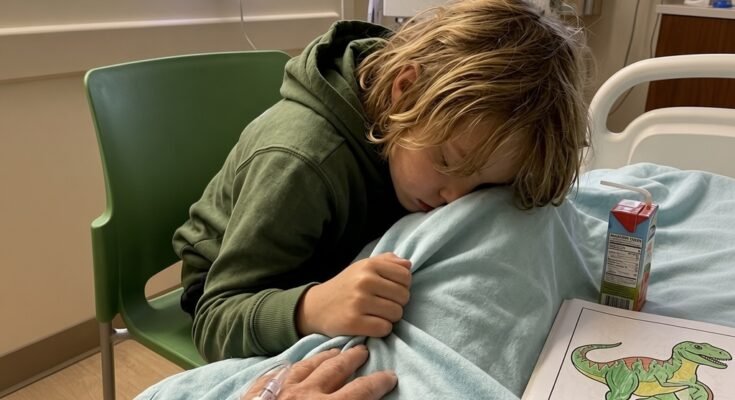
Then I noticed the small figure curled up in the chair beside my bed.
My nine-year-old grandson, Walter.
His backpack sat beneath his feet. His cheek rested against his jacket, and one little hand still held the edge of my blanket. Walter had lived with me since my son David died four years earlier. I packed his lunches, walked him to school, knew which cereal he refused to eat once it became soggy, and knew exactly which night-light had to stay on when he couldn’t sleep.
“Walter?”
His eyes opened instantly.
For one second, he simply stared at me. Then he threw himself against my chest. “Granny!” He cried so hard I could barely understand him. A nurse hurried in and smiled. “He’s been waiting for this. That boy has hardly wanted to leave your side.”
I stroked his hair. “Sweetheart, you’ve been sleeping here?”
He nodded.
“Why aren’t you at home with Aunt Lisa?”
The moment I said my daughter’s name, Walter went stiff. He glanced toward the hallway, moved closer, and whispered directly into my ear.
“Granny, if Aunt Lisa comes in, close your eyes. Pretend you never woke up.”
I stared at him.
“Why?”
He squeezed my hand painfully tight.
“Please. That’s why I’ve been staying here every night. You need to hear what she says when she thinks you’re asleep.”
Before I could ask anything else, footsteps stopped outside my room.
Walter’s eyes widened.
“Granny. She’s coming.”
I barely had enough time to close my eyes.
The door opened.
Lisa walked in.
For several seconds, nobody spoke. Then I heard her give a small laugh.
“Still waiting for her to wake up? That’s pathetic, Walter. You really don’t know when to give up, do you?”
Walter stayed silent.
Lisa came closer to my bed.
“Fine. Since you’re so determined to sit here, let me tell you a little secret about your grandma.”
My fingers tightened beneath the blanket.
“She isn’t taking you home even if she wakes up.”
Walter’s voice came out small.
“She will.”
“No, she won’t.”
“She promised.”
“Walter, she’s sixty-seven years old and just spent eleven days unconscious. Do you honestly think a judge is going to let her keep raising you?”
My heart began pounding against the monitor leads.
Walter said, “Granny said I’m staying with her until I’m grown.”
Lisa laughed.
“Your grandmother says a lot of things.”
Then her voice dropped.
“I already talked to the hospital social worker. I’m filing for temporary guardianship. Once you’re living with me, we can finally deal with that house.”
The room seemed to tilt beneath me.
Walter said nothing.
Lisa continued.
“And stop telling people about the blue folder.”
My blood went cold.
There was a blue folder in my home office.
Inside were copies of my estate documents, Walter’s guardianship records, my insurance information, and the trust I had created after David died.
Walter whispered, “Dad’s money is in there.”
“Your father is dead.”
I almost opened my eyes.
Lisa continued before I could move.
“That house should never have been set aside for you. Mom has spent four years acting like you’re the only person in this family who matters.”
“That’s not true.”
“It is true. She paid for your school. Your therapy. Your clothes. Everything. Meanwhile I’ve been the one trying to keep my own life together with no help.”
Walter’s voice trembled.
“Granny loves you.”
“That isn’t the point.”
I heard Lisa move closer.
“When she dies, I’m supposed to get scraps while you get the house. Do you understand how ridiculous that is?”
Walter answered quietly.
“Granny isn’t dead.”
Lisa sighed.
“Not yet.”
The monitor beside me sped up.
Lisa stopped talking.
For a second, I thought she had noticed.
Then Walter said, “Don’t touch her bag.”
My eyes remained closed.
“What?”
“You keep looking in Granny’s bag.”
“I was looking for her house keys.”
“Why?”
“Because I need to get documents.”
“The blue folder?”
Silence.
Then Lisa said, “Walter, you are nine. You don’t understand any of this.”
“I understand you told Uncle Mark on the phone that if Granny doesn’t wake up, you can sell the house.”
My daughter inhaled sharply.
“You were listening?”
“I was sitting right here.”
Another silence.
Then Lisa said something that hurt more than everything else.
“She has always chosen him over me.”
I knew she meant Walter.
My grandson.
A child who had already buried his father.
I opened my eyes.
Lisa was standing beside my hospital bed.
Her face went completely white.
Walter looked at me.
I turned toward my daughter.
“I heard everything.”
She stumbled backward.
“Mom…”
“I heard every word.”
“I can explain.”
“No.”
My voice was weak, but it was mine.
“First you’re going to get the nurse.”
Lisa stared at me.
“Mom, please.”
“Then you’re going to leave.”
Walter climbed onto the edge of my bed and held my hand.
Lisa’s eyes filled.
“You don’t understand what’s happening.”
I looked directly at her.
“No, Lisa.”
“I think Walter made sure I finally did.”
━━━━━━━━━━━━━━━━━━━━
Part Two — The Blue Folder
Lisa tried to stay.
She said I was confused from medication. She said Walter had misunderstood adult conversations. She said she had only been trying to protect both of us.
The nurse heard enough to ask her to step outside.
Then my doctor came.
Then the hospital social worker.
I told them exactly what I had heard.
Nobody arrested Lisa. Nobody dragged her from the hospital in handcuffs. Real family disputes do not resolve themselves that neatly.
But something important happened.
People started documenting.
The social worker already had notes from previous conversations with Lisa. While I was unconscious, Lisa had described herself as the only available family member and said Walter would “obviously” come to live with her if I remained incapacitated.
She had also asked several times when my personal belongings—including my keys and phone—could be released to family.
Walter had noticed.
That was why he stayed.
“I thought if I went home,” he told me later, “she’d take your keys.”
My heart broke.
“You’ve been sitting here for eleven days because you thought you had to guard me?”
He looked embarrassed.
“Not all eleven. Mrs. Carter took me to school.”
Mrs. Carter was Walter’s best friend’s mother.
Apparently she had been collecting him every morning, taking him to school, then bringing him back to the hospital after class because he refused to sleep anywhere except near me.
I squeezed his hand.
“You are nine years old. Protecting my house is not your job.”
“I know.”
“No, sweetheart. I need you to really know.”
He looked down.
“I just didn’t want to lose our house too.”
That sentence hurt worse than my broken ribs.
David’s death had already taught Walter that people could disappear without warning.
Now my accident had taught him homes could disappear too.
The following morning, I called my attorney.
Her name was Janet Rosen, and she had prepared the documents in the blue folder two years earlier.
When I told her what Lisa had said, Janet became very quiet.
“Did Lisa get into your house?”
“I don’t know.”
“I’ll find out.”
She contacted Mrs. Carter, who still had the spare key I had given her years earlier. Mrs. Carter confirmed that Lisa had asked twice to be let inside. She refused both times because Lisa could not explain why she needed access.
My attorney then explained something that immediately calmed me.
Lisa could not simply sell my house because I was unconscious.
She had no financial power of attorney.
She had no ownership interest.
And even if she successfully petitioned a court for authority to handle my affairs during incapacity, major transactions involving my property would be subject to legal duties and, depending on the authority granted, court oversight.
The plan Lisa had apparently imagined was much simpler than reality.
The blue folder made it simpler still.
Years earlier, after David died, I had updated everything.
Walter’s father had left a modest life-insurance benefit for him. I had never treated that money as mine. It was held for Walter according to the arrangements we had made with professionals.
My house was mine during my lifetime, but my estate plan directed that it eventually pass into a trust for Walter.
Lisa had not been disinherited.
She was to receive other assets.
But she was not getting the house.
There was also something she apparently had forgotten.
When I became Walter’s legal guardian after David’s death, I had nominated a backup caregiver in case I died or became unable to care for him.
It wasn’t Lisa.
It was my niece, Rebecca.
Rebecca was forty-two, married, lived fifteen minutes away, and had known Walter since birth.
A court would still determine what arrangement served Walter’s best interests if something happened to me, but my documented wishes were very clear.
When Janet told Lisa that, my daughter called my hospital room seventeen times.
I answered once.
“Mom, you made Rebecca Walter’s backup?”
“Yes.”
“Your niece?”
“Yes.”
“Instead of your own daughter?”
“You told me repeatedly that you never wanted children.”
“That was years ago.”
“You also told me after David died that you couldn’t possibly take responsibility for a grieving five-year-old.”
Silence.
Then she said, “People change.”
“Yes.”
I looked at Walter coloring quietly beside the window.
“They do.”
Lisa started crying.
“You’ve always loved David more.”
There it was.
Something much older than the house.
Much older than Walter.
“Lisa…”
“No. Don’t pretend. David was easy. David was responsible. David gave you a grandson. I was always the difficult one.”
I closed my eyes.
For the first time, I heard something beneath her anger that I recognized.
Pain.
That did not excuse what she had done.
But I recognized it.
“Lisa, your brother has been dead four years.”
“I know.”
“Walter is not David.”
She said nothing.
“Every time you resent that child for receiving something, you’re fighting with a dead man through his nine-year-old son.”
Lisa began sobbing.
I continued.
“And I will not let you do that.”
She hung up.
My recovery took nearly three months.
For the first several weeks, I could not safely care for Walter alone. Rebecca moved into my house temporarily instead of uprooting him. Mrs. Carter handled school pickups. Friends brought meals.
Walter hated every bit of it at first.
He kept asking whether I was coming home.
Then whether I was staying home.
Then whether anyone could “change the papers.”
Finally Janet came to the house, sat at our kitchen table, and explained things in language a nine-year-old could understand.
“Your grandmother has a plan.”
Walter looked at me.
“A real one?”
“A very real one.”
“Even if something happens?”
“Yes.”
He thought about that.
Then he asked the question I realized had been tormenting him for weeks.
“Can Aunt Lisa sell my bedroom?”
I had to turn away for a moment.
Janet answered gently.
“No one can simply decide to sell your grandmother’s house because they want to. Adults have rules too.”
Walter nodded solemnly.
That evening, he slept in his own bed for the first time since my accident.
━━━━━━━━━━━━━━━━━━━━
Part Three — Why Walter Stayed
Lisa and I did not speak for almost six months.
That was my choice.
I loved my daughter.
I also did not trust her.
Those two truths had to learn how to exist together.
During those months, Walter slowly became a child again instead of the tiny security guard he had turned himself into at the hospital.
He stopped checking whether my keys were hanging beside the door.
He stopped asking who would get the house if I died.
He stopped carrying his backpack everywhere.
That backpack nearly destroyed me when I finally emptied it.
Inside were two schoolbooks, three granola bars, a flashlight, one pair of socks, a photograph of David, and a folded piece of notebook paper.
At the top Walter had written:
THINGS GRANNY SAID ARE IMPORTANT
Underneath:
Blue folder.
House key.
Call Mrs. Rosen.
Dad’s papers.
Don’t let Aunt take Granny’s phone.
My nine-year-old grandson had made himself an emergency plan because the adults around him had made him afraid.
I sat on his bedroom floor and cried.
That night, I told him something I should have said long before.
“Walter, if I ever get sick again, you do not have to protect my money.”
He stared at me.
“You do not have to protect the house.”
“What if—”
“No.”
I took his hands.
“Your job is to tell a safe adult when you’re scared. That’s all.”
“What if they don’t listen?”
“Then tell another one.”
He thought for a moment.
“What if nobody listens?”
“Then keep telling.”
That answer seemed to satisfy him.
Eight months after my accident, Lisa wrote me a letter.
Not a text.
A letter.
The first line said:
I am not writing this to get back into the house.
That was a good start.
She admitted that she had been drowning financially. Her divorce two years earlier had left her with debt she had hidden from everyone. Credit cards. Personal loans. Tax problems.
When she realized I might not survive the accident, she panicked.
Then panic became calculation.
She knew about the house.
She knew Walter would inherit it eventually.
She convinced herself that because she was my daughter, she had been treated unfairly.
In the letter, she wrote:
I turned your accident into an opportunity in my head, and then I tried to make a nine-year-old feel like he was standing between me and what I deserved. There is no explanation that makes that acceptable.
I read that sentence several times.
Then:
I told myself I was angry at you. The truth is I was jealous of a child whose father is dead. Writing that makes me ashamed. It should.
That was the first apology I believed.
Not because it erased anything.
Because it didn’t ask me to erase anything.
Lisa had begun counseling. She had also entered a debt-management program and sold the expensive car she could no longer afford.
I agreed to meet her.
Not at my house.
At a café.
She looked older.
So did I.
For several minutes, we barely spoke.
Then she said, “How is Walter?”
“Better.”
“Does he hate me?”
“No.”
She started crying.
“That almost feels worse.”
“He’s nine, Lisa.”
“I know.”
“He shouldn’t have to carry hatred for you. He also doesn’t have to trust you.”
She nodded.
“Do you?”
“No.”
She accepted that.
That mattered.
Our relationship rebuilt slowly.
Very slowly.
For nearly a year, Lisa saw Walter only at larger family events.
Then she asked whether she could apologize to him.
I told her he got to decide.
Walter said yes.
Lisa came to our house but stayed on the porch.
She crouched so she wasn’t towering over him.
“I said things to you at the hospital that were wrong.”
Walter looked at her.
“I know.”
“I tried to scare you.”
“I know.”
“You shouldn’t have had to stay there because you were afraid I’d take things.”
Walter said nothing.
Lisa swallowed.
“I am sorry.”
Then Walter asked her something I will never forget.
“Were you really going to sell my room?”
Lisa’s face collapsed.
“I wanted the money from the house. I wasn’t thinking about your room as your room.”
Walter frowned.
“But it is.”
Lisa nodded through tears.
“Yes.”
That was the entire lesson.
Adults see property.
Children see home.
Adults see inheritance.
Children see the marks on the doorway where their height was measured.
The loose floorboard outside the bathroom.
The kitchen table where their father once helped them draw dinosaurs.
A bedroom isn’t an asset to a nine-year-old.
It is proof that somewhere in the world, they belong.
Lisa understood that too late.
But she understood it.
Walter did eventually allow her back into his life.
Not because I forced forgiveness.
Because she became safer.
She stopped making promises she couldn’t keep.
She stopped asking personal questions about my estate.
She brought Walter birthday gifts that were normal nine-year-old gifts instead of expensive attempts to buy closeness.
Two years after my accident, she came to his school play.
Walter spotted her from the stage.
He smiled.
Just slightly.
Afterward, Lisa cried in the parking lot.
I pretended not to notice.
I’m seventy now.
Walter is twelve.
He no longer needs the night-light.
He claims this is because he is “basically a teenager,” though he still leaves the hallway light on when there is thunder.
The blue folder still exists.
There are updated copies now.
Rebecca remains my nominated backup.
Lisa knows.
She no longer complains.
A few months ago, Walter and I were looking through old photographs when we found one taken at the hospital after I woke up.
He was asleep in the chair beside my bed.
His hand was gripping my blanket.
I asked, “Do you remember that?”
He became quiet.
“Yeah.”
“Why didn’t you ever go home?”
He shrugged.
“I thought if I left, she’d win.”
My throat tightened.
“Sweetheart, you know now that wasn’t your responsibility?”
“I know.”
Then he looked at me.
“But I’m still glad I stayed.”
“Why?”
“Because you heard her.”
He was right.
I did.
But when I think about those eleven days now, I don’t think about my daughter searching for keys.
I think about a nine-year-old boy sleeping upright in a hospital chair because he believed he was the only person standing between his home and the adults trying to decide his future.
That should never have been his burden.
So if there is one thing I made certain Walter learned afterward, it is this:
Love does not mean making a child guard what adults are supposed to protect.
Family does not mean tolerating betrayal because the person hurting you shares your blood.
And forgiveness, when it comes, does not mean returning someone’s access before they have rebuilt your trust.
The morning I woke from that coma, Walter whispered:
“Pretend you’re still asleep.”
For months afterward, I thought he had saved my house by doing that.
He hadn’t.
The paperwork had already protected the house.
What Walter saved was something more important.
He forced me to wake up to what was happening inside my own family.
And once I truly woke up, I never pretended to be asleep again.