Part One — The Teacher Who Lost Her Words
“Don’t finish it for me.”
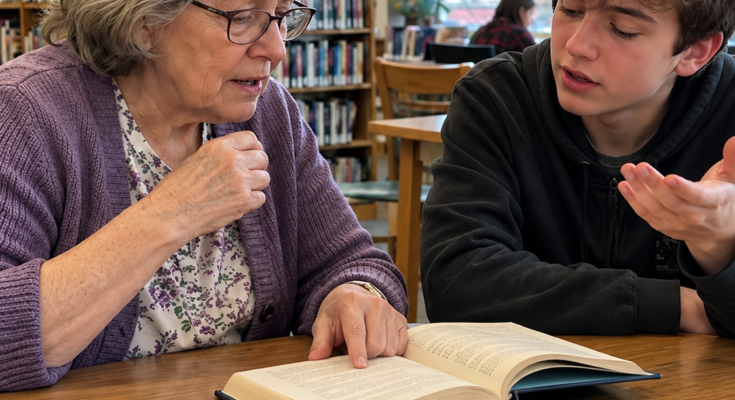
Lorraine Beck’s voice came out slowly, each word separated by a painful little pause.
Across the library table, fifteen-year-old Tyler immediately looked down.
“I’m sorry,” he said.
Lorraine swallowed, pointed at the mystery novel between them, and tried again.
“The… man… walked… through…”
“Door,” Tyler blurted.
Lorraine closed the book.
Tyler groaned and leaned back in his chair.
For thirty-two years, Lorraine had taught English in a small Michigan town where nearly everybody seemed to know somebody who had once sat in her classroom.
She had been the teacher who could read a story aloud and make thirty restless teenagers go quiet.
She remembered names.
Birthdays.
Which students needed encouragement and which ones needed somebody to tell them, firmly but kindly, that they were capable of more.
Then, at sixty-five, Lorraine had a stroke.
She survived.
But words—the very things she had spent her life teaching—no longer came easily.
She knew exactly what she wanted to say.
Getting those words from her mind to her mouth was another matter.
Sometimes a simple sentence took twenty seconds.
Sometimes the word disappeared completely.
Lorraine returned home after weeks of rehabilitation believing she would eventually return to her classroom.
She never did.
Her retirement came earlier than planned.
People called it “a new chapter.”
Lorraine hated that phrase.
It didn’t feel like a new chapter.
It felt like somebody had taken the book out of her hands halfway through the story.
Former coworkers invited her to lunch, but Lorraine often declined.
She couldn’t stand the sympathetic silence when she struggled to speak.
She especially hated when people guessed her words.
They meant well.
But every finished sentence reminded Lorraine of something she could no longer do quickly for herself.
So she began spending afternoons at the town library.
Nobody expected anything from her there.
She could sit by the window with tea, turn pages slowly, and disappear among the shelves.
Then Tyler arrived.
He was fifteen, permanently annoyed, and had been assigned tutoring after falling badly behind in reading.
He wanted nothing to do with books.
“They’re boring,” he told Lorraine the first afternoon.
Lorraine took several seconds to answer.
“Maybe… you’ve been… reading… boring books.”
Tyler almost smiled.
Almost.
The librarian asked Lorraine whether she might help him once or twice a week.
At first, Lorraine nearly said no.
How could a woman who sometimes struggled to say “paperback” teach a teenager to read?
But Tyler reminded her of hundreds of students she had known.
The slouch.
The crossed arms.
The expression that said, I don’t care when what it really meant was, I don’t want anyone to see me fail.
So Lorraine stayed.
Their first sessions were terrible.
Tyler rushed.
Lorraine couldn’t.
When she paused, he finished her sentences.
When he stumbled through a paragraph, Lorraine corrected him.
They irritated each other constantly.
One afternoon, Tyler finally slammed his book shut.
“Why do you care if I read this stuff anyway?”
Lorraine looked at him.
She could have given the answer she had given students for three decades.
Instead, she slowly said:
“Because… everyone… deserves… to find… one book… they can’t put down.”
Tyler stared at her.
Then Lorraine walked him to the mystery section and pulled out a worn novel about an ordinary kid who discovered something strange in an abandoned house.
“No school stuff?” Tyler asked.
Lorraine shook her head.
“No… essay.”
“Seriously?”
“No… vocabulary test.”
Tyler narrowed his eyes.
“What’s the catch?”
Lorraine smiled.
“You… have to… read.”
That time, Tyler laughed.
He took the book home.
Three days later, he returned demanding the sequel.
And that was when everything began to change.
━━━━━━━━━━━━━━━━━━━━
Part Two — The Boy Who Learned to Wait
Tyler started arriving early.
Lorraine began bringing mystery novels she thought he would like.
And without either of them deciding it officially, Tyler began helping Lorraine too.
When she struggled for a word, he stopped guessing it.
He waited.
Sometimes ten seconds.
Sometimes twenty.
At first, waiting seemed physically painful for a teenager accustomed to everything happening instantly.
But he learned.
Lorraine would pause.
Tyler would sit quietly.
And eventually, the word would come.
One afternoon, Lorraine became stuck halfway through a sentence.
Her face tightened with frustration.
Tyler leaned forward.
“You’ve got time, Mrs. Beck.”
Lorraine looked at him.
Nobody had said that to her before.
Doctors had encouraged her.
Friends had reassured her.
Family members told her she was improving.
But this impatient fifteen-year-old boy had somehow found the four words she needed most.
You’ve got time.
So Lorraine tried again.
And finished the sentence herself.
By winter, they had developed a routine.
Lorraine helped Tyler slow down enough to understand what he was reading.
Tyler helped Lorraine slow down enough to trust that people would wait for her.
His grades improved.
Her confidence did too.
Then the librarian announced a winter reading night.
Local residents would read favorite passages aloud to families and children.
She asked Lorraine to participate.
Lorraine immediately shook her head.
“No.”
The librarian didn’t push.
Tyler did.
“You made me read out loud.”
Lorraine frowned at him.
“That… was different.”
“How?”
Lorraine searched for the words.
Tyler waited.
Finally she said:
“I was… the teacher.”
Tyler shrugged.
“Maybe you still are.”
Lorraine went home thinking about that sentence.
For weeks, she practiced.
She chose a short passage from an old children’s book she had read to students years earlier.
At first, she couldn’t get through one paragraph without stopping.
So she practiced again.
And again.
Slowly.
On the evening of the event, Lorraine nearly turned around in the parking lot.
Through the library windows she could see dozens of people.
Former students.
Parents.
Old colleagues.
People who remembered the Lorraine Beck who could stand in front of a classroom and speak without thinking twice about it.
Her hands started shaking.
Then she walked inside.
When Lorraine’s name was called, she stepped toward the chair at the front of the room carrying the book with both hands.
She looked up.
And there was Tyler.
Front row.
He had arrived twenty minutes early to save the seat.
Lorraine opened the book.
Her first sentence was slow.
The second had a long pause.
Near the third paragraph, one word refused to come.
Lorraine stared at the page.
The room was silent.
The old fear returned.
Then she looked at Tyler.
He didn’t mouth the word.
He didn’t rescue her.
He simply nodded.
Lorraine could almost hear him.
You’ve got time.
She took a breath.
Waited.
And found the word.
Then the next one.
And the next.
When she finished the passage, the room remained silent for half a second.
Then everyone stood.
Lorraine began crying.
Not because the reading had been perfect.
It hadn’t.
Because for the first time since the stroke, nobody had applauded what she used to be.
They were applauding who she was now.
And Tyler was clapping harder than anyone.
━━━━━━━━━━━━━━━━━━━━
Part Three — The Teacher She Still Was
After the reading event, something shifted inside Lorraine.
She still struggled with words.
Some mornings were better than others.
Sometimes a sentence came easily.
Sometimes she lost a simple word and had to sit quietly until it returned.
But she stopped treating every pause as proof that something had been taken from her.
She started seeing the pauses differently.
As space.
Space to breathe.
Space to think.
Space for someone else to learn patience.
Tyler kept coming to the library.
By spring, he no longer needed mandatory tutoring.
His English grade had climbed from a D to a B.
The librarian told him he could stop the sessions.
Tyler shrugged.
“I know.”
Then he showed up the following Tuesday anyway.
Lorraine looked at him.
“You… don’t… have to… be here.”
“I know.”
“Then… why?”
Tyler dropped a book on the table.
“I finished this one.”
Lorraine smiled.
“And?”
“It was terrible.”
“You finished it.”
“That doesn’t mean I liked it.”
She laughed.
It still took Lorraine longer to laugh than it used to because sometimes laughter interrupted her breathing.
Tyler waited for that too.
A few weeks later, he brought her a school assignment.
A personal essay.
The title was:
THE PERSON WHO TAUGHT ME TO READ
Lorraine looked at him.
“You’re… writing… about me?”
Tyler immediately became defensive.
“Don’t make it weird.”
She began reading.
At first, it was funny.
He wrote about how annoying she was.
How she refused to let him skip paragraphs.
How she somehow found the only books in the library with enough murder and mystery to keep him interested.
Then the tone changed.
Tyler wrote:
Mrs. Beck had trouble talking, and I had trouble reading. At first, I thought hers was worse because everyone could hear it. Then I realized mine was easier to hide.
Lorraine stopped.
Tyler stared at the table.
“Keep going.”
She did.
She never made me feel stupid when I got something wrong. That made me realize I shouldn’t make her feel rushed when she couldn’t find a word.
Lorraine’s eyes filled.
The final paragraph said:
I used to think good teachers were people who knew all the answers. Mrs. Beck taught me that sometimes a good teacher is just someone willing to sit there long enough for you to find the answer yourself.
Lorraine closed the paper.
For several seconds, she couldn’t speak.
Tyler smiled nervously.
“It’s okay. You’ve got time.”
She laughed through tears.
Then she managed:
“A.”
Tyler grinned.
“You didn’t even check the grammar.”
“B-plus.”
“Okay, okay. A is fine.”
Years passed.
Tyler graduated high school.
Lorraine attended.
When his name was called, he looked into the crowd until he found her.
Then he pointed at her before walking across the stage.
Lorraine cried.
Of course she did.
A few months later, Tyler left for community college.
He studied education.
That surprised almost everyone except Lorraine.
At twenty-two, he came back to Cedar Falls Middle School as a reading specialist.
On his first day, he visited Lorraine.
She was seventy-two by then.
Her speech had improved, but it was still slower than before the stroke.
Tyler sat across from her at the same library table where they had once argued over mystery novels.
“I have a student,” he said.
Lorraine raised an eyebrow.
“Only… one?”
“You know what I mean.”
He laughed.
Then he told her about a twelve-year-old boy who refused to read aloud.
The boy joked constantly.
Got angry when corrected.
Pretended nothing mattered.
Lorraine smiled.
“Sounds… terrible.”
“Exactly.”
Tyler leaned forward.
“What do I do?”
Lorraine looked at him for a long time.
Then said:
“Wait.”
“That’s it?”
“Wait… long enough… to learn… what he’s afraid of.”
Tyler nodded slowly.
Then smiled.
“You’re still doing it.”
“Doing… what?”
“Teaching me.”
Lorraine looked toward the shelves.
For years after her stroke, she had believed her career ended the day she lost the ability to speak the way she once had.
She had measured teaching by classrooms.
Lecterns.
Lesson plans.
A voice strong enough to fill thirty desks.
But Tyler had taught her something she had somehow missed during thirty-two years in education.
A teacher’s greatest tool isn’t always her voice.
Sometimes it’s attention.
Patience.
The willingness to stay.
Lorraine never returned to a traditional classroom.
Instead, she volunteered at the library for almost another decade.
She helped reluctant readers.
Adults learning English.
Children with dyslexia.
Students who had spent years believing they weren’t smart because reading came slowly.
Whenever someone became embarrassed by a pause, Lorraine said the same thing.
Sometimes clearly.
Sometimes slowly.
But always with a smile.
“You’ve got time.”
Years later, after Lorraine died peacefully at eighty-one, the library held a memorial.
The room was full.
Former students came.
Teachers.
Parents.
People Lorraine had tutored after her stroke.
And Tyler.
By then, he was the head of literacy programs for the school district.
He stood at the front holding the first mystery novel Lorraine had ever given him.
The cover was worn.
The pages had yellowed.
He opened it.
Then he looked around the room.
“I used to think Mrs. Beck taught me how to read.”
He paused.
“She did.”
“But that’s not the most important thing she taught me.”
Tyler looked down at the book.
“She taught me what happens when you refuse to rush someone through the part of their life that’s difficult.”
His voice cracked.
Then he smiled.
“She taught me that sometimes the kindest thing you can give another person isn’t an answer.”
He paused again.
“It’s time.”
After the memorial, the library placed a small plaque beside Lorraine’s favorite table.
It doesn’t list awards.
It doesn’t mention how many years she taught.
It simply says:
LORRAINE BECK
TEACHER
“YOU’VE GOT TIME.”
And maybe that was the voice Lorraine had been searching for all along.
Not the one she lost after the stroke.
The one she discovered afterward.
Quieter.
Slower.
But powerful enough to keep speaking through every student who learned how to wait.