Part One — The Note Around Tammy’s Neck
On my last day carrying mail, the only goodbye I got was tied around the neck of an orange cat named Tammy.
I had walked Cedar Loop for eleven years. Same cracked sidewalks. Same leaning mailboxes. Same porch chairs nobody sat in anymore. Same little cameras blinking at me like they knew me better than the people inside did.
I wasn’t bitter about it. People were busy. They worked from home, ordered groceries to their doors, and spoke through tiny doorbell speakers instead of opening them. That was simply how life had changed. Still, after eleven years, I thought maybe one person would remember it was my last day.
Nobody did.
Not until I reached the final mailbox.
Tammy was waiting there, like always.
She was an old orange cat with a round belly, one cloudy eye, and a crooked walk that made her look like she had somewhere important to be but no reason to hurry. She had been meeting me at that mailbox since my first week on the route.
At first, I thought she wanted food. She didn’t. I thought she wanted attention. Not really.
Whenever I arrived, Tammy would stand, stretch, and fall into step beside me for the final twelve houses on Cedar Loop. When I reached the dead-end sign beneath the big maple tree, she would stop, turn around, and walk home.
I used to talk to her anyway.
“Well, Tammy, another day nobody bit us.”
She never answered.
But she stayed.
Some days, that was enough.
That Friday, my knees hurt worse than usual. Retirement was supposed to feel like a reward, but all I felt was grief. A man spends years becoming part of other people’s routines, then one afternoon he simply disappears from them.
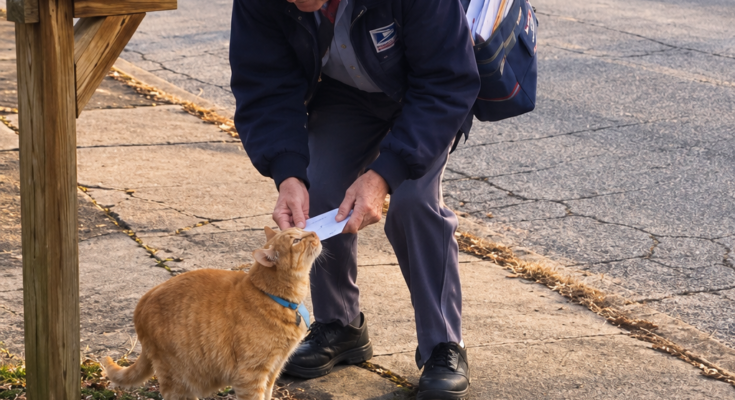
When I reached Tammy, something white was tied to her collar with blue yarn.
I bent down and read it.
Thank you for walking him home.
I read it three times.
“Walking who home?”
Tammy looked at me, then started down the sidewalk.
Instead of turning where she normally did, she passed the dead-end sign and headed toward a small white house whose curtains were almost always closed.
I followed.
Before I could knock, the door opened.
Mrs. Evelyn Brooks stood there.
“You found the note,” she said.
“I don’t understand.”
She looked down at Tammy.
“My husband had this mail route before you.”
I knew an older carrier had worked Cedar Loop before me, but I barely remembered his name.
“His name was Walter,” she said. “And Tammy used to walk him home too.”
My chest tightened.
She explained that Walter had found Tammy as a kitten behind the final mailbox and carried her home in his mailbag. After that, she began waiting for him every afternoon.
“Our son moved away. My health declined. Friends died. Walter started coming home quieter every year.”
Mrs. Brooks rubbed Tammy’s head.
“He used to tell me the last part of his route was the hardest because it meant another day was over.”
“And Tammy?”
“She walked with him.”
“Every day?”
“For years.”
I swallowed.
“What happened when Walter retired?”
Mrs. Brooks looked toward the street.
“He never got to.”
Then she told me Walter had died suddenly on the route.
At the very last mailbox.
Exactly where Tammy had been waiting for me for eleven years.
━━━━━━━━━━━━━━━━━━━━
Part Two — What Tammy Had Been Waiting For
I sat with Mrs. Brooks in her living room while Tammy curled beneath Walter’s old chair.
There was a photograph on the mantel of a smiling man in a postal uniform. He had one hand on his mailbag and the other resting on a much younger orange cat.
“That was Walter?”
She nodded.
I stared at the picture.
Something about him looked familiar.
Then I realized why.
I’d seen his name scratched into the old metal shelf at the sorting station.
W. BROOKS — ROUTE 17
Eleven years earlier, on my first morning assigned to Cedar Loop, my supervisor had pointed at that shelf and said, “Old carrier died. You’re taking his route.”
That had been the entire explanation.
Mrs. Brooks continued.
“Walter had a heart attack near the end of his shift. Someone found him beside the mailbox.”
I looked down at Tammy.
“And she was there?”
“When the ambulance came.”
Afterward, Tammy kept returning to the mailbox every afternoon at nearly the same time.
For months.
Then one day, I appeared.
New uniform.
Same bag.
Same route.
Mrs. Brooks smiled sadly.
“She started walking with you that week.”
I suddenly remembered my first days on Cedar Loop. I had been forty-nine, recently divorced, and sleeping in a small apartment with almost no furniture.
I hated that route at first.
Every house seemed to contain somebody else’s family.
Bicycles in driveways.
Dinner smells drifting through open windows.
Kids running toward fathers coming home from work.
I would finish my shift and return to a silent apartment.
Then Tammy started appearing.
I had never thought much about why.
Mrs. Brooks handed me another note.
“This was Walter’s.”
The paper was yellowed and folded several times.
Walter had written it years before his death.
Evelyn says I talk to the cat too much. Maybe I do. But there’s something comforting about knowing somebody will be waiting at the end of the route.
I laughed softly.
“That sounds familiar.”
Mrs. Brooks smiled.
“I thought it might.”
She explained that for years she had watched from behind her curtains as Tammy walked beside me.
Sometimes I talked to her.
Sometimes I limped.
Sometimes I stopped beneath the maple tree and scratched her ears before heading back toward my truck.
Mrs. Brooks had wanted to introduce herself many times.
But grief had made her world small.
“Then why today?”
“Because yesterday I saw the substitute carrier.”
My throat tightened.
“She told me you were retiring.”
Mrs. Brooks reached for my hand.
“And I realized Tammy was going to lose another mailman without understanding why.”
For some reason, that broke me.
Not the forgotten retirement.
Not the empty congratulations.
That.
I looked toward the old cat beneath Walter’s chair.
“What happens to her tomorrow?”
Mrs. Brooks’s eyes filled.
“I was hoping you might help me with that.”
━━━━━━━━━━━━━━━━━━━━
Part Three — Nobody Walks the Last Stretch Alone
The following Monday, I woke at 6:10 even though I had nowhere to be.
Eleven years of alarm clocks don’t disappear because somebody signs retirement papers.
I made coffee.
Stood in the kitchen.
Then sat down.
By eight o’clock, I hated retirement.
The silence was enormous.
At nine, my phone rang.
Mrs. Brooks.
“She’s at the mailbox.”
I didn’t need to ask who.
I drove to Cedar Loop.
Tammy was sitting in her usual patch of grass.
When she saw my car, she stood.
I got out.
“You’re supposed to understand retirement better than this.”
She blinked.
I started walking.
Tammy followed.
No mailbag this time.
No uniform.
Just an old man and an old cat walking past twelve familiar houses.
When we reached the dead-end sign, I expected her to stop.
She didn’t.
She continued toward Mrs. Brooks’s house.
So did I.
That became our routine.
Not every day.
At first, three mornings a week.
Then Mrs. Brooks started joining us.
She used a cane and moved slowly, which suited Tammy perfectly.
We walked one block.
Then two.
Eventually, we began stopping for coffee on Mrs. Brooks’s porch.
I learned about Walter.
He had served in the Navy.
Hated tomatoes.
Loved terrible western movies.
Remembered every dog’s name on his mail route but frequently forgot people’s names.
Mrs. Brooks learned about me too.
She learned my marriage had ended years earlier.
That my daughter lived in Oregon.
That I had spent most Christmases working overtime because going home to an empty apartment felt worse.
One afternoon she said:
“You and Walter would’ve liked each other.”
“I think we already shared a friend.”
Tammy opened one eye from beneath the porch chair.
Mrs. Brooks laughed.
A few months passed.
Then Tammy stopped meeting us at the mailbox.
I knew something was wrong immediately.
Mrs. Brooks called.
“She won’t eat.”
The veterinarian said Tammy was very old.
Older than either of us had realized.
Her kidneys were failing.
There wasn’t much to do except keep her comfortable.
For three days, I sat with Mrs. Brooks beside Tammy’s little bed near the window.
On the fourth morning, Tammy lifted her head when she heard my voice.
I put my hand beside her.
“Well, Tammy.”
Her cloudy eye looked toward me.
“Another day nobody bit us.”
Her paw rested against my fingers.
She died that afternoon.
Mrs. Brooks cried.
So did I.
We buried Tammy beneath the big maple tree near the dead-end sign.
Technically, I’m not sure we were allowed to.
At seventy, I decided I was willing to risk whatever punishment existed for illegally burying an orange cat who had completed more postal routes than most employees.
I made a small wooden marker.
It said:
TAMMY
SHE WALKED US HOME.
I thought that would be the end of the story.
It wasn’t.
The next week, someone left flowers beside the marker.
Then another person.
Then a card.
Apparently, people had noticed Tammy after all.
A woman from number six wrote that Tammy sat beside her son every afternoon after school when he was having a difficult year.
A man from number nine said Tammy used to sleep beneath his porch while he recovered from surgery.
A little girl drew a picture of an enormous orange cat carrying a mailbag.
Then something even stranger happened.
The neighborhood remembered me too.
One Saturday, I arrived at Mrs. Brooks’s house and found almost thirty people standing near the maple tree.
There was cake.
A folding table.
Balloons.
And a handmade sign:
HAPPY RETIREMENT, FRANK. SORRY WE’RE LATE.
I stopped walking.
My old supervisor was there.
So was the new carrier.
People whose mail I had delivered for eleven years came over one by one.
One woman thanked me for noticing when her mother’s mail began piling up and calling for a welfare check.
A father remembered how I always carried dog treats after his puppy started following the truck.
A teenager told me I had delivered every college acceptance letter she’d received.
“I didn’t do anything,” I kept saying.
“You delivered the mail.”
But that was the point.
Ordinary things become part of people’s lives when you do them long enough.
Mrs. Brooks eventually handed me a small wrapped package.
Inside was Walter’s old brass postal badge.
“I can’t take this.”
“You can.”
“It belonged to your husband.”
She smiled.
“And now it belongs to the man who finished his route.”
I couldn’t speak.
So she hugged me.
It has been three years since I retired.
Mrs. Brooks is eighty-six now.
I still visit her every Wednesday.
We walk when her knees allow it.
When they don’t, we sit on the porch and complain about things, which might be even better exercise.
The new mail carrier sometimes stops to talk.
His name is Miguel.
He’s young.
Always rushing.
A few months ago, I noticed a gray kitten sitting near the final mailbox.
Miguel looked down at it.
“Is that cat supposed to be here?”
I laughed.
“Careful.”
“Why?”
“That’s how they recruit you.”
He looked confused.
I didn’t explain.
Some things make more sense after you’ve walked the route awhile.
I spent eleven years thinking Tammy was simply a strange old cat who happened to follow me.
I was wrong.
Before me, she had walked Walter through the final stretch of his working life.
After Walter died, she kept returning to the place where she last saw him.
Then I arrived.
Maybe she thought I was replacing him.
Maybe she simply recognized the uniform.
Or maybe cats don’t think about these things the way we do at all.
It doesn’t matter.
Because somehow, without saying a word, Tammy gave two lonely men the same gift.
She made the end of the day feel less empty.
And on my last day carrying mail, when I thought eleven years had passed without anyone really noticing me, an old orange cat walked me to a door that had been closed almost as long as I’d been on the route.
Behind it was a widow who needed company.
A story I had never heard.
And proof that being remembered doesn’t always look the way we imagine.
Sometimes nobody throws you a retirement party.
Sometimes nobody buys a card.
Sometimes the only goodbye waiting for you is tied around an old cat’s neck with blue yarn.
And sometimes that’s enough to lead you exactly where you need to go.
Because the older I get, the more I believe Walter was right.
The last stretch is often the hardest.
That’s why none of us should have to walk it alone.