Part 1: The Decision
I dropped the front plow blade, engaged the wing plow, and threw the heavy truck into low gear. I turned off the main road and shoved thousands of pounds of packed snow off her private driveway. The engine roared, straining against the heavy drift, but I kept my foot steady on the gas. I plowed all the way up to her front porch, backed down, and made a second wide pass so a full-sized ambulance would have a clear, smooth lane all the way from the highway to her front door.
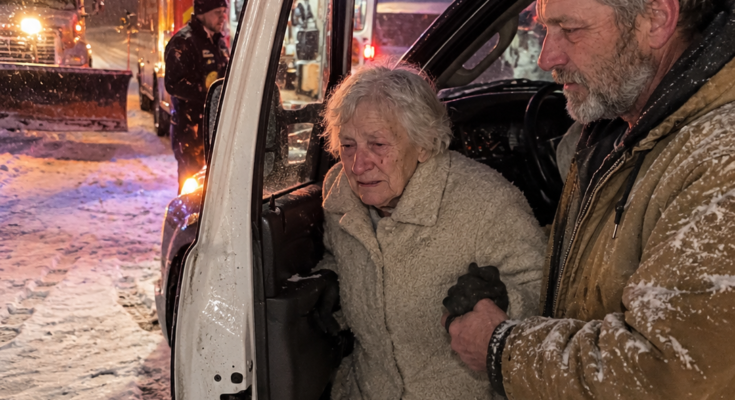
I helped her down from the cab and made sure she got safely inside her house before I backed out onto the main road and resumed my route.
By noon, the storm had finally passed, and I drove the rig back to the county garage to top off the tank and sign out. As soon as I stepped out of the cab, my supervisor was standing near the office door holding a clipboard and a printout of my GPS log.
“Russell,” he said, his voice flat. “Your unit sat idle on a private driveway for twenty minutes off County Road 12, then registered three passes back and forth. You know the rules. That’s private property, fuel expenditure, and lost time on the primary route. I have to write this up, and the director wants to see you in the morning.”
I stood there in my heavy winter coat, exhausted down to my bones, and didn’t offer a single word of defense. I just nodded.
Before he could hand me the disciplinary notice, the garage door swung open. A local paramedic crew walked in, holding thermoses of hot coffee. One of them looked around the bay and spotted my truck number.
“Which one of you cleared the long driveway at the Miller farm off Road 12?” the paramedic asked loudly.
My supervisor looked up from his clipboard. “Why?”
The paramedic took off his gloves and shook his head in disbelief. “Because we got a critical call out there at five this morning. Severe respiratory failure. The roads out that way were almost impassable, but when we turned down their lane, it was plowed wide open right to the porch. We got the oxygen to him with minutes to spare. The doctor at the ER said if we’d had to trek through three feet of snow on foot carrying those heavy tanks, the old man wouldn’t have made it through the morning.”
The room went completely quiet. The only sound was the drip of melting snow falling off the plows onto the concrete floor.
My supervisor looked down at the GPS paper in his hands. He slowly folded the paper in half, tore it straight down the middle, and tossed it into the trash can beside his desk. He looked up at me, his eyes softening, but he couldn’t quite find the words to speak.
I put my hands in my pockets, looked toward the garage window at the pale morning light, and spoke quietly.
What did Russell say? You won’t believe what happened next. Keep reading to find out. 👇
Part 2: The Truth
“I did what I had to do,” I said. “You can write me up. You can suspend me. You can fire me. But I would do it again.”
My supervisor, whose name was Dave, stared at me for a long moment. Then he did something I never expected. He pulled out his chair and sat down heavily. He rubbed his face with both hands. When he looked up, his eyes were wet.
“Russell,” he said. “I owe you an apology.”
“What?”
“I’ve been riding you for two years. Ever since Tyler died. I thought you were distracted. I thought you were a liability. I thought you were going to get someone hurt.” He paused. “I was wrong.”
I didn’t say anything. I just waited.
“That paramedic just told me something else,” Dave continued. “The old man you saved? His name is Harold Miller. He’s eighty-six years old. He’s a retired volunteer firefighter. He spent forty years running into burning buildings to save strangers. And last night, when his oxygen machine failed, his wife called 911. She was told the roads were impassable. She was told to wait. She was told there was nothing anyone could do.”
Dave’s voice cracked. “She was standing in that driveway, waving a flashlight, praying for a miracle. And you were the miracle.”
I felt my throat tighten. I thought about Tyler. I thought about the night he died. I thought about the ambulance that couldn’t get through. I thought about the ice and the cold and the helplessness.
“I couldn’t save my son,” I said quietly. “But I could save someone else’s husband. Someone else’s father. Someone else’s grandfather.”
Dave stood up. He walked over to me and put his hand on my shoulder. “You’re not getting written up,” he said. “You’re getting a commendation. And I’m going to recommend that the county change the policy. Emergency vehicles should be able to access private driveways during storms. It’s the right thing to do.”
What happened next would change everything. Keep reading to find out what happens next. 👇
Part 3: The Reckoning
The county did change the policy. Within a month, the board approved a new protocol that allowed snowplow drivers to clear private driveways during declared states of emergency if emergency vehicles needed access. They called it “Tyler’s Exception.” It was named after my son.
I was invited to the county board meeting where they announced the change. I stood in front of the board and told them about Tyler. I told them about the night he died. I told them about the ambulance that couldn’t get through. I told them about the guilt I had carried for two years, the feeling that I should have been able to save him, even though there was nothing I could have done.
Then I told them about Harold Miller. I told them about his wife standing in the driveway. I told them about the paramedics and the oxygen tanks and the minutes that mattered.
“If the policy had been different two years ago,” I said, “my son might still be alive. I can’t change the past. But I can help make sure no other family goes through what we went through.”
The board gave me a standing ovation. I didn’t feel like a hero. I felt like a father who had finally found a way to honor his son.
Harold Miller recovered. He came to the county garage a month later with his wife. He shook my hand and told me I had saved his life. He told me he had been a firefighter for forty years, and he had saved hundreds of lives, and he had never been on the receiving end before. He said it felt strange to be the one who was saved.
“You don’t owe me anything,” I said.
“I know,” he said. “But I want to give you something anyway.”
He handed me a small wooden box. Inside was a medal. A medal from his years of service. He told me he wanted me to have it. He told me it belonged to someone who understood what it meant to risk everything for a stranger.
I keep that medal on my dashboard, right next to Tyler’s photograph. Every time I climb into the cab, I look at both of them. I look at my son, who I couldn’t save. I look at Harold’s medal, which reminds me that sometimes, you can save someone else.
I still drive the plow. I still clear the roads. I still turn down Miller’s Ridge first. Not because the policy says so, but because it’s the right thing to do. Because somewhere out there, there might be another Mrs. Gable, standing in the snow, waving a flashlight, praying for a miracle.
And I will always be the miracle.
The End.