Part 1: The Forgotten Road
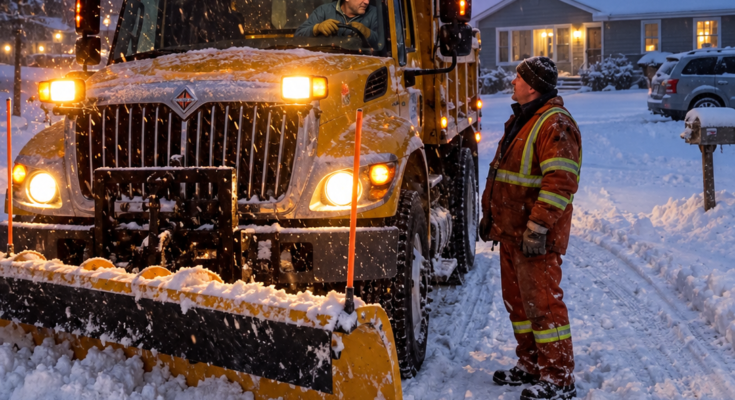
The cab of a county snowplow at 4:30 in the morning is the quietest place on earth. It’s just the hum of a diesel engine, the rumble of the blade scraping frozen asphalt, and the white glare of headlights bouncing off a blinding Minnesota blizzard.
My doctor told me six months ago to take early retirement. He said after a massive heart attack, a 62-year-old man shouldn’t be pulling twelve-hour shifts in sub-zero weather, wrestling a forty-thousand-pound truck through black ice. He didn’t understand. If I sat still in an empty house with just my thoughts, the silence would have finished what my heart started.
So every morning, I climbed up into that high vinyl seat, turned the heater on high, and took to the dark, frozen roads of our small county. My assigned route covered twelve miles of main county thoroughfares. But every single morning, before I touched the highway or the suburban avenues, I turned down Miller’s Ridge Road.
Miller’s Ridge was a dead-end gravel lane with only four houses on it. According to the county winter priority grid, it was classified as Level 4—the lowest possible priority. It was supposed to be plowed last, usually late in the afternoon after the main arterial roads were completely clear. Instead, I made it my very first stop at 4:45 AM.
For three weeks, nobody said anything. But then the storm of the decade hit. Seven inches of heavy, wet snow fell overnight, followed by a sudden deep freeze that turned the roads into sheets of glass. Main Street was backed up. Suburban commuters were slipping into ditches. And at 6:15 AM, my radio cracked open with the sharp, furious voice of my supervisor, Mark.
“Glen, where the hell are you?” Mark barked through the speaker. “I’m looking at the GPS tracking board. Why is your plow sitting at the very end of Miller’s Ridge? You haven’t even touched the route through the high school zone yet!”
“I’m finishing up here now, Mark,” I said softly into the mic. “I’ll be at the school zone in ten minutes.”
“Get your tail over there right now,” Mark snapped. “I’ve got three city council members calling my cell because their streets aren’t cleared. If you aren’t following the priority map, you and I are going to have a serious problem.”
Ten minutes later, as I was backing out of the cul-de-sac on Miller’s Ridge, I saw headlights coming down the narrow road. It was Mark’s white county pickup truck. He pulled directly across the lane, blocking my plow. He got out into the freezing wind, slamming his truck door so hard the glass rattled, and marched up to my cab.
I rolled down the window. The freezing air hit my face like a handful of needles. “What are you doing, Glen?” Mark demanded, his breath fogging heavily in the dark. “You’ve been a county driver for twenty years. You know the grid. You know Miller’s Ridge gets done last. Why are you wasting forty minutes of fuel and county time on four houses before the school buses even hit the main road?”
“Mark, just look at the gray house at the end of the lane,” I said quietly, pointing through the snowfall.
“I don’t care about the house, Glen! I care about the rules and the angry phone calls on my desk!”
“Look at the driveway, Mark,” I repeated, my voice steady, though my chest tightened.
Mark slammed his gloved hands against his coat, turned his head, and looked. The driveway of the gray house had been freshly cleared by my side blade. Sitting in the gravel near the front porch was a yellow, wheelchair-accessible school van. The driver was just pulling up, his hazard lights blinking in the dark.
Out on the small, lit porch stood an elderly woman wrapped in an oversized winter coat. Alongside her was a small boy wrapped in a heavy blue blanket, sitting in a motorized wheelchair. Because the lane was plowed clean, the van was able to back all the way up to the porch ramp. The driver stepped out, lowered the hydraulic lift, and safely wheeled the young boy inside without his tires sinking into six inches of frozen slush.
“Her name is Mrs. Gable,” I said quietly into the cold air between us. “She’s seventy-four. Her daughter passed away two years ago, and she’s raising those two boys all by herself on a tiny fixed income.”
Mark didn’t say anything. He just stared at the yellow van as the lift slowly raised the boy up into the warm vehicle.
“The little guy’s name is Toby,” I continued, my voice catching in my throat. “He has spinal muscular atrophy. The specialized van that picks him up for his physical therapy and special needs program only runs once a day, at 6:00 AM sharp. If this road isn’t cleared by 5:00 AM, that van can’t get down the ridge. And if that van misses him, he sits in that house all day, staring out the window, missing the only place where he gets to feel like a normal kid.”
Mark turned back to look up at me in the cab. His scowl was gone. “How did you even know that, Glen?” Mark asked softly. “It’s not on any county report.”
I looked down at the steering wheel, my hands trembling slightly inside my leather gloves. “Because twenty-two years ago, I had a boy named Matty,” I said, looking Mark in the eye. “He was in a chair, too. And twenty-two years ago, during a bad February storm, our driveway was plowed in by a drift four feet high. The school van couldn’t reach us. Matty sat by our front window in his coat and boots for three hours, holding his backpack, waiting for a truck that never came.”
I took a deep breath, feeling the cold air fill my lungs. “Matty passed away when he was twelve,” I whispered. “I couldn’t clear the road for my own son that morning, Mark. But as long as I am healthy enough to turn the key in this engine, no child on my route is ever going to sit by a window holding a backpack, feeling forgotten by the world.”
Mark stood frozen. The wind whipped around us. The snow continued to fall. But neither of us moved.
Then Mark did something I never expected. He reached up and gripped my shoulder through the open window. “I’m sorry, Glen,” he said. “I didn’t know.”
“No one does,” I said. “That’s why I do it.”
What happened next would change everything. Keep reading to find out what happens next. 👇
Part 2: The Change
Mark didn’t write me up. He didn’t report me to the county. He didn’t mention the missed priority grid or the angry council members. Instead, he climbed back into his truck and followed me to the high school zone. He watched as I cleared the main roads. He watched as I made my way through the suburban avenues. And at the end of my shift, he was waiting for me at the depot.
“Glen,” he said. “I want to make a change to the priority grid.”
“What kind of change?”
“I want to add Miller’s Ridge to Level 1. Top priority. Every storm. Every morning. Before anything else.”
I stared at him. “The county won’t approve that. It’s a dead-end road with four houses.”
“Then I’ll make them approve it,” Mark said. “I’ll tell them about Toby. I’ll tell them about Matty. I’ll tell them about every child on every forgotten road who deserves to be seen.”
What happened next would change everything. Keep reading to find out what happens next. 👇
Part 3: The Reckoning
Mark kept his word. He went to the county board. He told them about Toby. He told them about Matty. He told them about the forgotten roads and the forgotten children who lived on them. The board listened. They approved the change. Miller’s Ridge became Level 1. It was plowed first every storm.
But that wasn’t the end. Mark started a program. He called it “The Forgotten Roads Initiative.” He identified every dead-end lane, every rural route, every gravel road that had been classified as low priority. He found the people who lived there. The elderly. The disabled. The families who had been overlooked. And he changed their priority status too.
The county approved the funding. The drivers approved the new routes. And the people on those forgotten roads finally got the help they needed.
Toby is sixteen now. He graduated from high school last spring. He uses a power wheelchair and a communication device. He wants to be an advocate for people with disabilities. He wants to make sure no one is forgotten.
Mrs. Gable passed away two years ago. Toby lives with his aunt now. But he still remembers the snowplow driver who cleared his road every morning. He still remembers the man who made sure he never missed his van.
I’m sixty-eight now. I retired last year. My heart couldn’t take another winter. But I still volunteer at the county depot. I train new drivers. I tell them about the forgotten roads. I tell them about Toby. I tell them about Matty.
I tell them that every road matters. Every house matters. Every child matters.
I still visit Matty’s grave every year. I tell him about the program. I tell him about Toby. I tell him that his death wasn’t in vain. I tell him that because of him, no child on my route will ever be forgotten.
I miss him every day. I will always miss him. But I know he’s proud of me. I know he’s watching. I know he’s smiling.
The snowplow is still there. The roads are still there. The forgotten roads are no longer forgotten. And that is the greatest legacy I could ever leave.
The End.