Part 1: The Insult
The fluorescent lights in the hallway of our small Wisconsin hospital always had a low, steady hum at two in the morning. It was a sound I had listened to for twenty-eight years, ever since I packed two suitcases in Manila and moved to the Midwest with nothing but a nursing degree and a promise to my mother that I would work hard.
That night, my boots felt heavier than usual. Underneath my navy blue scrubs, my own body was fighting its own quiet battle. At fifty-five, my doctors had laid it out plainly for me: chronic kidney disease, stage three. My ankles were swollen, and a deep, aching fatigue settled into my bones around midnight every single shift.
My daughter had spent weeks begging me to cut back on my hours. In fact, I had a specialist appointment scheduled for eight o’clock that very morning—an appointment I had waited three months to get—to discuss starting dialyzing treatments.
“Just take it easy tonight, Ma,” my daughter had texted me before I clocked in. “Let someone else carry the heavy load for once.”
But in a small community hospital, night shifts don’t offer the luxury of taking it easy.
By midnight, Room 412 was in chaos. Mr. Miller, an eighty-two-year-old retired farmer with a weak heart, had taken a turn for the worse. His son, a tall, sharp-suited man named Greg who had driven in from the city, was frantic. Fear makes people loud, and Greg was very loud.
“Why hasn’t the doctor been in here yet?” Greg shouted, pacing the small room and waving his hands at the monitors. “My father’s face is pale! You people are just standing around!”
I stepped into the room, keeping my voice gentle, the way I always do. “Mr. Miller, I completely understand you are scared. I just checked your father’s vitals. His blood pressure is stable, and I’ve already paged the doctor on call to review his latest labs.”
Greg stopped and looked down at me. He looked at my worn sneakers, my quiet posture, and my tired eyes.
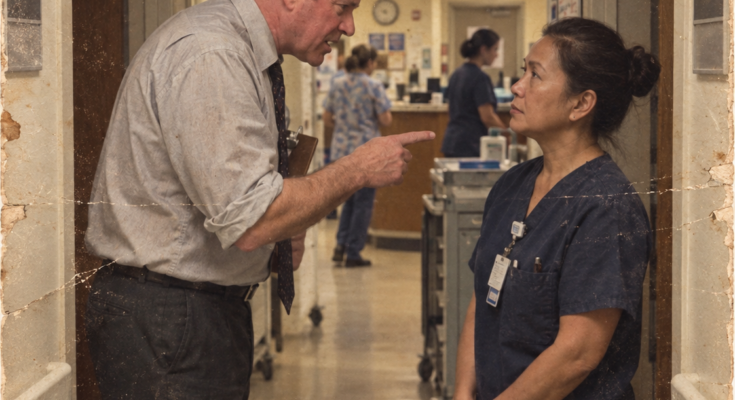
“You’ve paged him?” Greg scoffed, his voice carrying down the quiet hallway. “You’re just a night nurse. You don’t make decisions. You just stand here and follow whatever orders are written on the chart while my dad sits here suffering. Go get someone who actually knows what they’re doing!”
The words stung, like a cold draft slicing through the warm room. But when you’ve been a nurse for almost three decades, you learn that anger is usually just terror dressed up in a loud voice.
“I am watching him, sir,” I said softly, adjusting the blanket over his father’s shivering shoulders. “I will be right outside.”
By three in the morning, the hallway had fallen into that deep, heavy quiet that only night shifts know. Greg had collapsed into the vinyl armchair beside his father’s bed, exhausted from hours of pacing, and was fast asleep. The heart monitor beeped in a steady, reassuring rhythm.
To anyone looking at the screen, Mr. Miller was fine. The numbers were clear. The alarms were silent.
“Maria, go sit down,” the floor nurse whispered as she walked by. “You look exhausted. Your shift is almost over.”
I nodded, but my feet wouldn’t move away from Room 412. Something in the air felt wrong. It wasn’t something a machine could measure. It was the slight, barely visible tug in Mr. Miller’s chest every time he inhaled. It was the faint, dusky shadow beneath his fingernails.
What happened next would change everything. Keep reading to find out what happens next. 👇
I know you’re curious to see what happens next, so please be patient and continue reading in the comments below. Thank you for understanding the inconvenience. Please leave a “YES” below and give us a Like to get the full story. 👇to part 2.
—
Part 2: The Vigil
I stepped back into the dark room, silently moving to the side of the bed. I placed my warm hand lightly over Mr. Miller’s wrist, feeling his pulse. It was regular, but his skin was cool and clammy.
He was compensating. His body was quietly failing, hiding the fluid building up in his lungs before the monitors even knew it was happening.
I didn’t wait for an alarm. I ran out to the desk, picked up the phone, and speed-dialed the attending physician.
“Doctor, it’s Maria,” I said, my voice steady and urgent. “Room 412 is going into acute heart failure. We need a STAT chest X-ray and IV diuretics right now.”
“Maria, his last stats came back fine twenty minutes ago,” the doctor replied, his voice thick with sleep.
“I am standing next to him,” I said quietly. “His skin is cool. His breathing pattern has changed. Trust me. He doesn’t have much time.”
Within five minutes, the room erupted into controlled chaos. Doctors, respiratory therapists, and nurses flooded the doorway. The lights went up. Greg woke up with a start, shoved against the wall as the team went to work saving his father’s life.
For forty-five minutes, we worked side by side in the dim light. I pushed the medication, held Mr. Miller’s frail hand, and whispered prayers in Tagalog under my breath, asking God to give this old man a little more time.
By five-thirty in the morning, the fluid in Mr. Miller’s lungs began to clear. His color returned. His breathing slowed into a smooth, easy rhythm. He opened his eyes, looked at his son standing terrified in the corner, and squeezed my hand.
Greg stood frozen, his back pressed against the wall, watching the scene unfold. His face was pale. His hands were shaking. He looked at me—really looked at me—for the first time that night.
“You,” he said, his voice cracking. “You knew. You knew before the machines did.”
I nodded. “That’s what nurses do.”
He opened his mouth to say something else, but no words came out. He just stood there, staring at his father, tears streaming down his face.
What happened next would change everything. Keep reading to find out what happens next. 👇
I know you’re curious to see what happens next, so please be patient and continue reading in the comments below. Thank you for understanding the inconvenience. Please leave a “YES” below and give us a Like to get the full story. 👇to part 3.
—
Part 3: The Reckoning
By the time the sun rose over the Wisconsin fields, Mr. Miller was stable. The crisis had passed. Greg was sitting in the chair beside his father’s bed, holding his hand, speaking softly. He looked up when I walked in to check the monitors.
“Maria,” he said. “Can I talk to you for a minute?”
I nodded and stepped closer. He stood up, his tall frame towering over me, but there was no anger in his face now. Only shame.
“I owe you an apology,” he said. “I said terrible things to you. I treated you like you were nothing. And you saved my father’s life.”
I looked at him. “You were scared. Fear makes people say things they don’t mean.”
“That’s not an excuse,” he said. “You were the only one who noticed. You were the only one who stayed. You were the only one who fought for him when everyone else was asleep.”
He reached into his pocket and pulled out a business card. “I’m a lawyer,” he said. “If you ever need anything—legal help, advice, anything—you call me. It’s the least I can do.”
I took the card and smiled. “Thank you, Mr. Miller.”
“No,” he said. “Thank you.”
I finished my shift at seven that morning. I clocked out, walked to my car, and sat in the driver’s seat for a long moment. My body ached. My ankles were swollen. My head was pounding. But my heart was full.
I drove straight to my specialist appointment. The doctor reviewed my test results, adjusted my medication, and told me I wasn’t ready for dialysis yet. I had time. I could still work. I could still help people.
I cried when I heard that. Not because I was sad. Because I was grateful. Grateful for the time. Grateful for the work. Grateful for the patients who reminded me why I became a nurse.
I still work the night shift. I still wear the same worn sneakers. I still whisper prayers in Tagalog when I’m scared. And I still stay when everyone else goes home.
Because that’s what nurses do. We carry what others can’t. We see what machines can’t. We stay when everyone else leaves.
And sometimes, the people who insult us the most are the ones who need us the most.
Greg visited his father every day for the next three weeks. On the day Mr. Miller was discharged, Greg walked up to me in the hallway and handed me a small box. Inside was a necklace with a silver pendant shaped like a stethoscope.
“Thank you,” he said. “For everything.”
I wear it every shift. It reminds me that even when people don’t see me, I’m still making a difference.
The End. ❤️