Part 1: The Neighbor
My father stood on our porch in rural Colorado, wiping sawdust from his forehead with the back of a calloused hand. He stared across the gravel driveway at Mr. Henderson’s house.
For three years, Mr. Henderson was the kind of neighbor who only spoke when he had a complaint. He kept his blinds drawn tight and his interactions short. Once, when my aunts and uncles came over for a Sunday barbecue, Mr. Henderson walked to the property line, crossed his arms, and grumbled that there were “too many people and too much noise” coming from our yard. My father had only smiled, tipped his hat, and said, “Good afternoon, neighbor.”
My father, Miguel Santiago, was sixty years old and quietly carrying a broken heart. Just eighteen months earlier, the contracting business he spent thirty years building from the ground up went under. Bankruptcy took his office, his trucks, and his life savings. We had to sell our home in the city and move out to this quiet, windy plot of land outside town.
Dad didn’t complain. He took side jobs, repaired fences, and spent his evenings in our drafty garage, taking pride in the work of his hands even when the world felt like it had turned its back on him. He always told me, “A man’s worth isn’t measured by his bank account. It’s measured by how he treats the people standing right in front of him.”
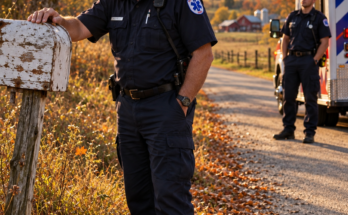
Then came the Tuesday afternoon when an ambulance pulled into Mr. Henderson’s driveway. We found out later through the local mail carrier that the old man had lost part of his left leg to complications from severe diabetes. He was eighty-two, living entirely alone, and had no family nearby to help him transition into a wheelchair.
Three weeks later, a medical transport van dropped Mr. Henderson off at his house. My father and I watched from our kitchen window as the old man struggled desperately to pull his wheelchair up three steep wooden porch steps. His arms trembled, his face turned red with exhaustion, and he nearly tipped backward onto the dirt before barely hauling himself through his front door.
My dad didn’t say a word. He just set his coffee cup down on the counter, walked out to the garage, and began sorting through his remaining pile of cedar lumber.
“What are you doing, Dad?” I asked, following him into the workshop.
“We have work to do this weekend,” he replied simply, pulling out his tape measure and circular saw.
What happened next would change everything. Keep reading to find out what happens next. 👇
I know you’re curious to see what happens next, so please be patient and continue reading in the comments below. Thank you for understanding the inconvenience. Please leave a “YES” below and give us a Like to get the full story. 👇to part 2.
—
Part 2: The Ramp
Early Saturday morning, while the ground was still cold and gray, Dad rolled a wheelbarrow full of tools across the driveway. He didn’t knock on Mr. Henderson’s door to ask for permission, and he certainly didn’t ask for money. He just got to work.
All day Saturday and through the afternoon on Sunday, the quiet valley echoed with the sound of my father’s saw, the rhythmic thud of his hammer, and the hum of his cordless drill. He measured every angle with meticulous care. He sanded down every edge until the wood was smooth to the touch, ensuring there would be no splinters for fragile hands. He built a beautiful, solid, gently sloping ramp that wrapped perfectly around Mr. Henderson’s front porch.
As Dad was sweeping the leftover sawdust off the smooth cedar planks late Sunday evening, the front door slowly creaked open.
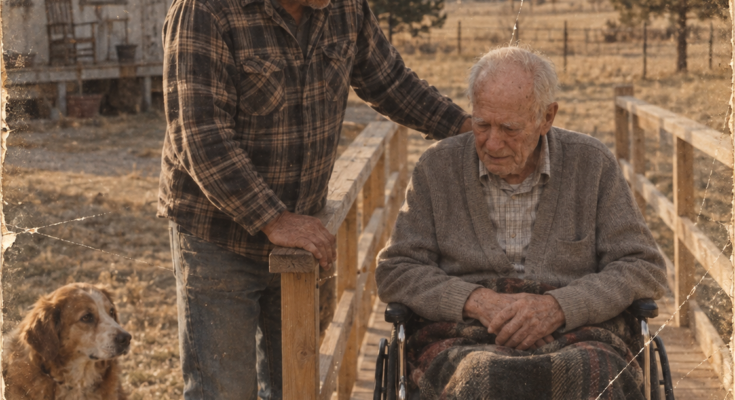
Mr. Henderson sat in his wheelchair at the doorway, staring down at the brand-new ramp. His eyes moved from the sturdy handrails to the heavy-duty concrete anchors, and finally to my father, who was standing at the bottom with a pencil tucked behind his ear.
For a long moment, neither man spoke. The wind rustled the high grass between their properties.
“Miguel…” Mr. Henderson’s voice cracked, sounding frail and smaller than I had ever heard it before. “I… I can’t pay you for this. You know I don’t have the money.”
My father smiled warmly, walking up the slope of the ramp. He wiped his hands on his jeans and reached out, gently placing Mr. Henderson’s trembling hand onto the top handrail he had spent all morning sanding.
“I didn’t build this for your money, Mr. Henderson,” Dad said softly. “I built it because winter is coming, and no man should be trapped inside his own home.”
The old man looked down at his lap. A single tear tracked through the deep lines of his weathered face. He swallowed hard, struggling to find the words he had held back for three long years.
“I was wrong about you,” Mr. Henderson whispered, his head bowed. “When you moved in… I saw your family, I heard the Spanish, I saw all the cars… and I made assumptions. I judged you before I ever knew your heart. I’m so sorry.”
My father didn’t scold him. He didn’t point out the hurt those past comments had caused. He just patted the old man’s shoulder with the steady, reassuring grip of a man who understood the heavy weight of human pride.
“Knowing your neighbor usually works better than fearing him,” Dad said gently. “Now, why don’t you try out this ramp? My wife made beef stew, and she’s bringing a bowl over for you in twenty minutes.”
What happened next would change everything. Keep reading to find out what happens next. 👇
I know you’re curious to see what happens next, so please be patient and continue reading in the comments below. Thank you for understanding the inconvenience. Please leave a “YES” below and give us a Like to get the full story. 👇to part 3.
—
Part 3: The Legacy
That afternoon changed everything. In the months that followed, until the day Mr. Henderson peacefully passed away two years later, there was no fence high enough to block the friendship between those two houses. Every holiday, Mr. Henderson sat at the head of our family table, laughing with the very aunts and uncles he once complained about.
My father lost his business, his savings, and his financial standing in the eyes of the world. But standing on that porch, watching two old men share a quiet moment of grace in the Colorado sunshine, I realized my father was the richest man I would ever know.
He taught me that character isn’t about what you have. It’s about what you give. It’s about showing up for people who don’t deserve it. It’s about building ramps for neighbors who once complained about your barbecue. It’s about choosing kindness when it would be easier to choose resentment.
My father passed away five years ago. At his funeral, Mr. Henderson’s daughter—a woman I had never met—stood up and told a story I had never heard. She said that when her father was dying, he told her about the ramp. He told her about the man who built it without being asked. He told her about the neighbor who showed him what grace looked like.
“He said it was the kindest thing anyone had ever done for him,” she said. “And he said he wished he had more time to be the kind of neighbor Miguel deserved.”
I cried when I heard that. Not because I was sad. Because I was proud. Proud of my father. Proud of the man he was. Proud of the legacy he left behind.
The ramp is still there. It’s weathered now, grayed by the Colorado sun. But it’s still solid. Still strong. Still standing. Just like the lesson my father taught me.
We don’t always get to choose our circumstances. But we always get to choose our character. And sometimes, the smallest act of kindness—a ramp, a bowl of stew, a simple hello—can change a life forever.
My father knew that. And now, so do I.
The End. ❤️