Part One: The Snowy Night
“Ma’am, just give me one second.”
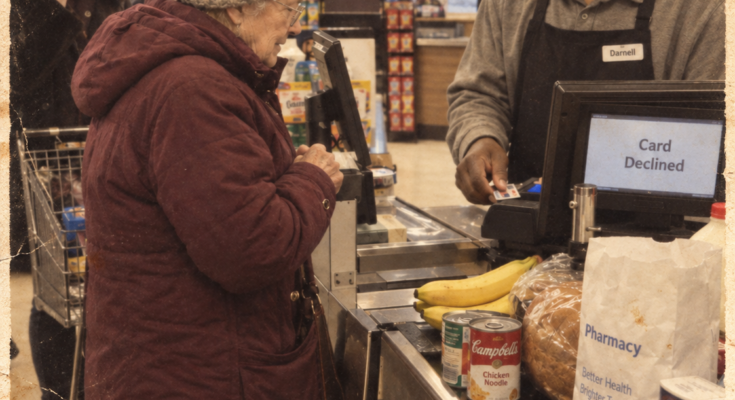
Darnell Brooks said it softly, before the elderly woman at register four could apologize again.
Her gloved hands were shaking as she stared at the little card reader.
DECLINED.
Behind her sat a few cans of soup, a loaf of bread, bananas, oatmeal, and a small paper pharmacy bag she had picked up from the counter inside the store.
Outside, snow was coming down hard enough to cover the parking lot lines.
Inside, the line behind her was getting longer.
“I’m sorry,” she whispered. “I thought my deposit had gone through.”
Darnell looked at the total.
$46.18.
Then he looked at the woman.
She had to be close to eighty.
Her gray hair was flattened under a knitted hat, and the sleeve of her old winter coat had been carefully stitched near the wrist.
Darnell knew that kind of stitching.
The kind people did when buying another coat wasn’t in the budget.
“Try taking off the bananas,” she said.
Darnell didn’t move.
“And the oatmeal. I’ve still got some crackers at home.”
A man farther back in line sighed loudly.
Darnell ignored him.
The woman reached toward the pharmacy bag.
“Maybe I can come back for this tomorrow.”
“No,” Darnell said.
Not harshly.
Just firmly.
“You’re taking that home.”
He reached into the back pocket of his faded work pants and pulled out a worn brown wallet.
Before the woman could understand what he was doing, Darnell slid his own debit card into the machine.
The register beeped.
APPROVED.
The woman stared at him.
“Oh, honey. No. You can’t do that.”
Darnell handed her the receipt.
“I already did.”
Her eyes filled.
“I can pay you back Friday.”
“You don’t owe me anything.”
She opened her mouth, but Darnell gently pushed the grocery bag toward her.
“Road’s getting bad. You get home safe.”
For several seconds, nobody in the line said anything.
And that included the woman standing three customers back in a wool coat that probably cost more than Darnell made in a week.
Her name was Marjorie Keene.
Darnell knew because she shopped there almost every evening.
Twenty minutes earlier, she had complained about him.
“Is there anyone else who can open a register?” she had asked another employee. “This gentleman is terribly slow.”
Darnell had heard her.
He always heard comments like that.
He just rarely answered them.
At fifty-nine, he had learned that not every judgment deserved a response.
People saw his worn shoes.
They saw the old sedan he drove.
They saw a quiet Black man working evening shifts at a grocery store when most people his age were talking about retirement plans.
Some assumed he had never done much with his life.
Some talked to him as though he were invisible.
Others talked louder, as if a grocery apron somehow meant he couldn’t understand them.
What they didn’t know was that Darnell had owned a small house three streets from the elementary school for almost twenty-seven years.
He had raised two daughters there.
He had built the backyard fence himself.
Every Christmas, he put white lights around the porch rail because his late wife loved the way they looked in the snow.
Then, the previous spring, an electrical fire started while he was working.
By the time the fire department finished, almost everything inside was gone.
Family photographs.
His wife’s old recipe cards.
The dining table where his daughters had done homework.
The recliner where he used to fall asleep watching Sunday football.
Insurance covered some things.
Not everything.
Darnell moved into a small rented apartment and picked up extra evening hours at the grocery store while trying to get his finances straight again.
He never told customers.
Why would he?
Everyone carries something.
Darnell figured his troubles weren’t a license to become unkind.
—
Part Two: The Apology
That snowy night, after the elderly woman left, he simply closed his wallet and kept scanning groceries.
Milk.
Bread.
Coffee.
Canned tomatoes.
When Marjorie reached the register, Darnell greeted her exactly as he always did.
“Evening, ma’am.”
She placed her groceries on the belt.
For the first time in months, she didn’t complain about how quickly he moved.
She kept looking down at his shoes.
Then at his hands.
Finally, she said, “That was a kind thing you did.”
Darnell shrugged.
“She needed her groceries.”
“You didn’t have to pay for them.”
“No.”
He put her eggs carefully into a separate bag.
“But I could.”
That sentence followed Marjorie all the way home.
*But I could.*
She thought about the way she had spoken to him earlier.
She thought about every assumption she had made.
A man working a grocery register at fifty-nine.
Worn shoes.
Old car.
Quiet voice.
In her mind, she had filled in the blanks without knowing a single fact.
The next morning, Darnell came in at nine because another clerk had called out.
The snow had stopped, but piles of it still lined the edges of the parking lot.
Around ten thirty, Marjorie walked through the automatic doors.
Darnell saw her approaching register four.
She wasn’t carrying groceries.
She was carrying a white envelope.
“Morning,” Darnell said.
“Good morning, Mr. Brooks.”
That got his attention.
Most customers didn’t know his last name.
Marjorie placed the envelope on the counter.
“This is for you.”
Darnell frowned.
“What is it?”
“Something I should have done a long time ago.”
—
Part Three: The Notes
He opened it.
Inside were several folded bills and a stack of small handwritten notes.
Darnell looked up.
“I can’t take this.”
“Yes, you can.”
“No, ma’am.”
Marjorie shook her head.
“It isn’t charity.”
Darnell paused.
She continued.
“I told my neighbors what happened last night. One of them knew about the fire. Then another neighbor did. Apparently half this town knew more about your situation than I did.”
Darnell looked back inside the envelope.
There was more money than he wanted to count.
But the notes were what stopped him.
One said:
*You helped my boy carry groceries to my car when I had my knee surgery. You probably forgot. I didn’t.*
Another:
*You found my mother’s purse in a cart and drove it to her house after your shift.*
Another:
*You always ask about my husband even though he’s been gone two years. Thank you for remembering his name.*
Darnell swallowed hard.
Then he found a note written in shaky blue ink.
*Dear Darnell, I got home safely. I ate soup last night and took what I needed from the pharmacy bag. You treated me like I wasn’t a burden. I will remember that longer than the groceries.*
Darnell stopped reading.
He took off his glasses.
For a moment, register four became very quiet.
Marjorie stood across from him.
“I owe you an apology,” she said.
Darnell shook his head.
“You don’t owe me anything.”
“Yes,” she said. “I do.”
She reached across the counter and touched his hand.
“I judged you. I complained about you. I treated you like you were invisible. And you never once deserved it.”
Darnell looked at the notes.
Then at Marjorie.
“I appreciate this,” he said. “But I don’t need people feeling sorry for me.”
Marjorie nodded.
“I know. That’s not what this is.”
She pointed at the notes.
“These are from people whose lives you touched. They wanted you to know. That’s all.”
Darnell was quiet for a long time.
Then he folded the notes carefully and put them back in the envelope.
“Thank you,” he said.
Marjorie smiled.
“You’re welcome, Mr. Brooks.”
She turned to leave.
Then she stopped.
“One more thing.”
“What’s that?”
“There’s a group of us who want to help. Not charity. Just neighbors helping a neighbor get back on his feet.”
Darnell looked at her.
“Why?”
Marjorie shrugged.
“Because you helped us first. We just didn’t know it.”
She walked out the automatic doors.
Darnell stood behind register four, holding the envelope.
Then he did something he hadn’t done in a long time.
He smiled.
—
That was six months ago.
The town raised enough money to help Darnell rebuild. Not the house—that was gone. But a new place. A small apartment with a porch. Room for his daughters to visit.
He still works at the grocery store.
He still wears the same worn shoes.
He still speaks quietly.
But now, when he walks through town, people nod.
They say his name.
They ask about his daughters.
And every Christmas, he puts white lights around his new porch rail.
Because his wife loved the way they looked in the snow.
Some people spend their whole lives waiting to be seen.
Darnell Brooks was seen all along.
He just didn’t know it.
—