Part One: The Floor
The first night I brought the dying cat home, she stopped one inch from my kitchen floor and screamed like it had hurt her before.
Her name was Dottie.
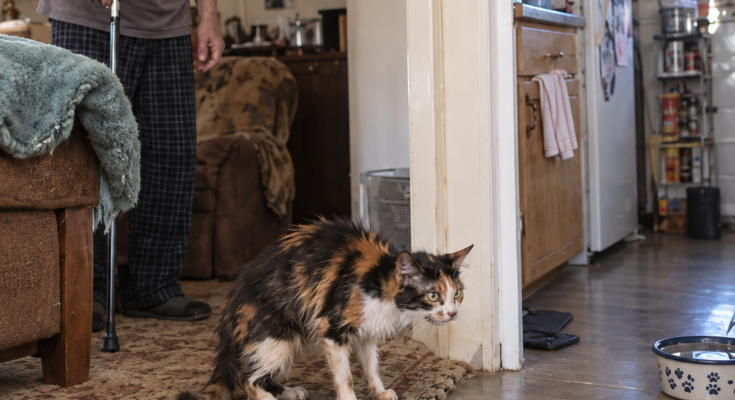
She was seventeen years old, mostly blind, thin as a folded towel, and small enough to fit beneath one arm. Her coat was a messy patchwork of black, orange, and white. One ear had a smooth half-moon missing from the edge. Her cloudy left eye stayed half closed, while the right one followed light without really seeing anything.
According to the papers that came with her, Dottie had been returned four times.
The words used to describe her were not kind.
*Difficult.*Copy to a new draft
*Unpredictable.*
*Does not use litter box consistently.*
*Bites when handled.*
*Poor adjustment to new environments.*
At the bottom of the page, someone had typed:
*Hospice placement recommended.*
That was why I had agreed to take her.
I wasn’t looking for a pet.
I was looking for a short assignment.
A few quiet weeks. Maybe a month.
Give an old cat a soft place to sleep, keep her fed, and make sure she didn’t spend her final days inside a metal cage.
Then it would be over.
That probably sounds cold. At the time, I thought it sounded practical.
My life had become very practical.
I was fifty-two years old and lived alone in a ground-floor apartment in Reno, Nevada. The building had once been a roadside motel. Somebody had covered the outside walkways, added kitchenettes, and turned the rooms into long-term rentals.
The place wasn’t fancy, but it had no stairs.
That mattered to me.
Three years earlier, I had injured my back and left leg while working in a warehouse. I could still walk, still drive, and still work from home. On a good day, most people would not have noticed anything wrong with me.
On a bad day, I needed a cane just to cross the room.
The pain did not always show on my face. That made people think it wasn’t there.
I had gotten tired of explaining.
So I stopped seeing most people.
I worked evenings, scheduling appliance repairs over the phone. I ate dinner at my desk. I watched old game shows with the sound low. I slept badly.
My apartment had one large area that served as the living room and kitchen, one bedroom, and one bathroom. Most of the floor was hard gray vinyl. The only carpet was an old rectangular rug beneath my chair.
I didn’t have pictures on the walls.
I didn’t have plants.
I didn’t own anything I couldn’t pack in an afternoon.
That evening, I placed Dottie’s carrier on the rug and opened the door.
She didn’t come out.
I sat in my chair and waited.
Two hours passed.
Then three.
I put food near the carrier. She didn’t touch it.
I placed water beside the food. Nothing.
Around midnight, I turned off the television and went to bed.
A little after two, I heard a soft scraping sound.
I came back into the living room and saw Dottie standing outside the carrier.
She was not graceful.
She moved low to the ground, placing each front paw carefully before bringing the rest of her body forward. Her whiskers brushed the rug. Her head turned toward every small sound.
She crossed the rug in a slow, crooked line.
The water bowl sat several feet away on the kitchen floor.
When she reached the edge of the rug, she stopped.
Her front paw lifted.
It hovered over the vinyl.
She touched the floor with the very tips of her toes and jerked back.
Then she screamed.
It was not a normal meow.
It was loud, rough, and full of panic.
I grabbed my cane and stood up too fast.
“What is it?”
Dottie crouched at the edge of the rug, trembling.
I checked the floor. Nothing sharp. No spilled cleaner. No heat. No loose pieces of vinyl.
I moved the water bowl closer.
She still wouldn’t step forward.
“Come on,” I said. “It’s just the floor.”
She screamed again.
I took an old bath towel from the bathroom and laid it across the vinyl, connecting the rug to the bowl.
Dottie reached out.
Her paw touched the towel.
She placed her weight on it.
Then she walked.
Slowly, carefully, she followed the towel to the water bowl.
Before drinking, she tapped the rim twice with one paw.
Tap.
Tap.
Then she lowered her head.
I stood there in the middle of the night, leaning on my cane, watching an old cat drink as if she had just crossed a broken bridge.
That was the first time I wondered whether Dottie was truly dying.
And whether the file had gotten her completely wrong.
—
Part Two: The File
The next morning, I called the shelter.
I asked about Dottie’s history. The woman on the phone sighed.
“Which one?”
“All of them.”
She pulled the records. Four returns in six years. Each adopter had similar complaints. She wouldn’t use the litter box. She hid. She bit. She screamed at night.
“One family said she attacked their toddler,” the woman said. “Unprovoked.”
“Was it unprovoked?”
Silence.
“I’m just asking.”
She read the notes. The toddler had cornered Dottie under a bed. The cat had swiped. The parents returned her the next day.
The second adopter had a dog. The third had moved. The fourth said she was “too much work.”
Nobody had kept her longer than eight months.
I looked at Dottie, curled on the towel I’d left on the floor. She was watching me with her good eye.
“Did anyone ever hurt her?” I asked.
The woman paused.
“There’s a note from the first owner. She was surrendered at age eleven. The owner said she ‘couldn’t handle the vet bills.’ But there was a remark from the intake officer.”
“What did it say?”
“She flinched when they raised their hands.”
I hung up.
I sat on the floor beside Dottie. She didn’t move away.
“I’m sorry,” I said.
She blinked slowly.
Then she tapped the floor twice with her paw.
Tap.
Tap.
I didn’t know what it meant.
But I was beginning to understand.
—
Part Three: The Bridge
Over the next few weeks, I learned Dottie’s language.
The tap meant she was about to move. She tapped before stepping onto anything new. She tapped before jumping onto the couch. She tapped before walking across the room.
If I tapped back, she came.
If I didn’t, she stayed where she was.
I started tapping the floor when I walked. She followed me everywhere, a slow, crooked shadow.
I bought more rugs. Cheap ones from the discount store. I laid them in paths across the vinyl, connecting every room. Dottie walked on them like they were islands.
The screaming stopped.
She started sleeping on my bed. Not beside me—at the foot, where she could watch the door. But she was there.
She started eating regularly. Her coat grew softer. Her ribs disappeared under a layer of fat.
The vet said she wasn’t dying.
“She’s just old,” he said. “And scared. But she’s got life left.”
I looked at Dottie in her carrier.
She tapped the side twice.
Tap.
Tap.
I tapped back.
She purred.
That was three years ago.
Dottie is twenty now. She’s slower than ever. Her eyes are cloudier. Her hearing is mostly gone. But she still taps. And I still tap back.
We have a language nobody else understands.
I don’t know how much time she has left. The vet says months, maybe a year.
But she’s not dying alone.
She’s not dying scared.
She’s dying in a house with rugs on every floor and a person who taps back.
Sometimes I think about the file. The words they used.
*Difficult. Unpredictable. Bites.*
They weren’t wrong. Dottie was difficult. She was unpredictable. She did bite.
But they never asked why.
They never asked what happened to her before she came to them.
They never tried to understand.
I did.
And because I did, she learned to trust.
And because she trusted, I learned to love.
That’s the thing about broken things.
They’re not broken.
They’re just waiting for someone to lay down a towel and show them the way.
—