Part One: The Surrender
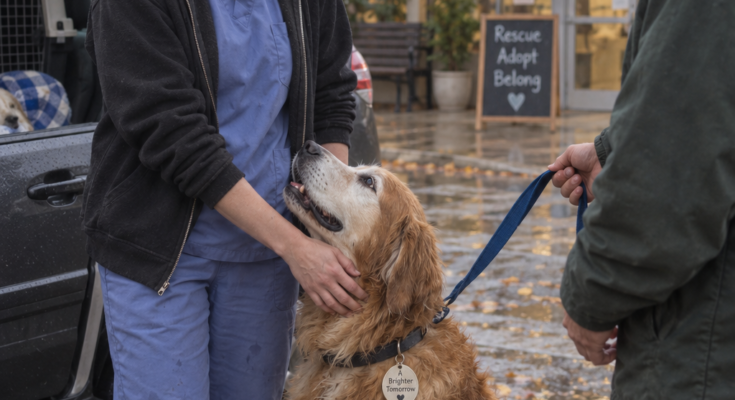
“Why are you surrendering a senior dog?” the worker asked, her eyes narrowing as she took the leash.
“I’m moving to an apartment that doesn’t allow large breeds,” I lied right to her face. I didn’t look down. I couldn’t look down at Barley, my beautiful Golden Retriever who had been by my side for over a decade.
He didn’t pull. He didn’t bark. He just gave me that dopey, trusting look, genuinely believing I was leaving him with a babysitter.
I walked out the glass doors without looking back. Waiting in my car was an eight-week-old, incredibly expensive designer puppy. I thought I was buying a fresh start.
As an emergency room nurse, I was completely burned out. Twelve-hour night shifts dealing with trauma left me with zero empathy when I got home. Barley’s severe hip dysplasia meant I was constantly cleaning up accidents and carrying a seventy-pound dog down the porch steps.
I just wanted something easy. I wanted a fun, energetic dog.
But the puppy was a nightmare. He chewed my nursing shoes, bit my ankles, and screamed in his crate every two hours.
Worse than the exhaustion was the crushing silence. When the puppy finally slept, I’d stare at the empty spot on the rug where Barley used to lay. There was no heavy head resting on my knee after a brutal shift. I had traded twelve years of soul-deep connection for a cute face.
Exactly ten days later, the reality of what I had done hit me like a freight train.
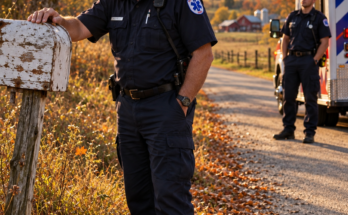
Paramedics wheeled a frail, confused elderly man into the ER. He had advanced Alzheimer’s. They found him sitting outside a shopping mall with a crumpled note pinned to his jacket: *”We are so sorry. We just can’t take care of him anymore. Please make sure he goes somewhere safe.”*
I stood frozen in the middle of the chaotic trauma bay. The old man sat on the stretcher, watching the doors, waiting with absolute trust for his family to return.
He was Barley.
I had taken a loyal soul that trusted me implicitly and threw him away because his failing body was inconvenient. I was a monster.
Right then, my phone buzzed with an automated voicemail from the local animal control center.
Barley’s stray hold had expired. Because of his age and medical issues, he was deemed unadoptable. He was scheduled for euthanasia the next morning.
They were going to kill him.
—
Part Two: The Return
I ripped off my stethoscope, threw it on the desk, and ran. I ignored my charge nurse shouting my name. I sprinted to my car and drove toward the shelter like a maniac through a blinding rainstorm.
I burst into the shelter lobby gasping for air, soaking wet in my scrubs. I shoved past the line of people at the front desk.
“Barley! The senior Golden in kennel 42! I need him back right now!” I screamed.
The worker remembered me. She didn’t hide her disgust. “He’s in the medical isolation block,” she said quietly. “You have to pay the reclaim fee.”
I threw my credit card at her and shoved my way through the restricted doors. I sprinted down the deafening cinderblock hallway, searching frantically for his white muzzle.
I found him at the very end of the row.
What I saw inside that cage made me wonder whether I had already come back too late.
—
Part Three: The Forgiveness
Barley was curled in the corner of the kennel, facing the wall.
He didn’t turn when I called his name. He didn’t lift his head. His food bowl was full. His water bowl was untouched. A thin blanket had been pushed into the farthest corner, as if he had tried to make himself as small as possible.
“Barley,” I whispered, dropping to my knees. “Baby, I’m here. I came back.”
Nothing.
I unlocked the kennel door and crawled inside. The concrete floor was cold. The smell of disinfectant burned my nose. I reached out and touched his back, and he flinched—actually flinched—as if he expected to be hurt.
That flinch broke something inside me that I didn’t know was still intact.
“Please,” I said. “Please look at me.”
Slowly, painfully, he turned his head.
His eyes met mine. And in them, I saw something worse than fear. I saw resignation. He had stopped waiting. He had stopped hoping. He had accepted that this was where he would die.
I gathered him in my arms and sobbed into his fur.
“I’m sorry. I’m so sorry. I’m sorry.”
He didn’t lick my face. He didn’t wag his tail. He just lay there, limp and quiet, as if he had forgotten how to be loved.
I carried him out of that shelter. He was lighter than I remembered—he had lost weight in ten days. The worker watched me leave without a word. I deserved her silence.
I put him in the passenger seat. He didn’t look out the window. He just closed his eyes and slept.
I drove home through the rain, one hand on the wheel, one hand resting on his back, making sure he was still breathing.
—
The first week was the hardest.
Barley wouldn’t eat unless I sat beside him. He wouldn’t go outside unless I carried him. He slept in the corner of my bedroom, as far from my bed as possible, as if he no longer believed he belonged near me.
The puppy didn’t understand. He bounded toward Barley with endless energy, wanting to play. Barley just turned away.
I called out of work for three days. I couldn’t leave him. I couldn’t risk him thinking I had abandoned him again.
I took him to the vet. She confirmed what I already knew—his hip dysplasia had worsened. He was in pain. But she also said something that gave me hope.
“Dogs forgive,” she said quietly. “It takes time. But they forgive.”
So I waited.
I hand-fed him chicken and rice. I carried him to his favorite spot in the backyard—the patch of sun near the fence where he had spent countless afternoons. I sat with him for hours, saying nothing, just being there.
On the fifth day, he licked my hand.
It was small. Barely a flicker. But it was something.
On the tenth day, he wagged his tail.
On the fourteenth day, he climbed onto the couch beside me and rested his head on my lap.
I cried so hard I couldn’t breathe.
The puppy eventually learned to respect Barley’s space. They became unlikely companions—the old dog teaching the young one how to sit quietly, how to wait, how to trust.
I rehomed the puppy six months later. Not because I didn’t love him, but because I finally understood something I should have known all along: love isn’t about what’s easy. It’s about what you commit to.
Barley lived two more years.
They weren’t perfect. His body kept failing. There were accidents and vet visits and sleepless nights. But I never once thought about giving up.
Because every morning, he looked at me like I was the best thing that had ever happened to him.
And every night, I fell asleep with his head on my chest, grateful for a forgiveness I didn’t deserve.
When he finally passed, it was peaceful. He was lying in his favorite spot in the backyard, the sun warming his fur. I held his paw and told him I loved him.
He wagged his tail one last time.
I buried him beneath the oak tree where we used to sit. I planted wildflowers there. They bloom every spring.
I still work in the ER. Some nights are brutal. Some patients I can’t save. But I go home to an empty house now, and I sit in the quiet, and I remember.
I remember a dog who loved me when I didn’t deserve it.
I remember a second chance I almost didn’t get.
And I remember the lesson I learned in kennel 42: loyalty is a gift. Abandonment leaves scars. But forgiveness—real forgiveness—is the most beautiful thing in the world.
Barley taught me that.
He taught me everything.
—