Part One: The Lie
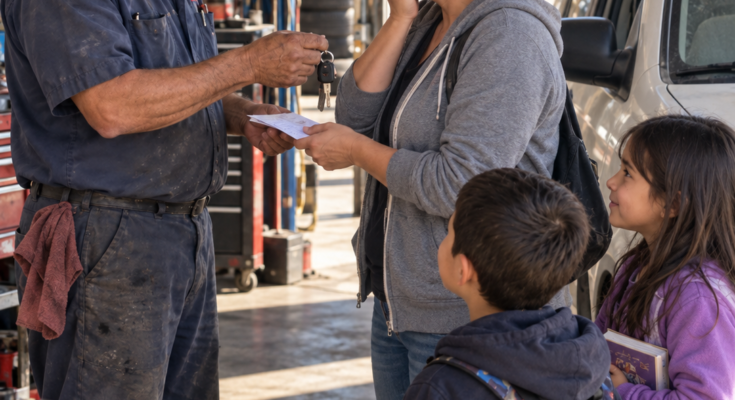
“I can pay for the brake pads,” the woman said quietly. “But if it needs anything else, I’ll have to come back next month.”
Ruben Castillo looked down at the estimate in his grease-stained hand.
It needed more than brake pads.
A lot more.
The old minivan had worn rotors, a leaking rear cylinder, and one tire so bald Ruben could nearly see the cords beneath the rubber.
Across the counter stood a woman named Melissa, maybe 38, holding a little boy’s backpack against her chest.
Her two children waited outside in plastic chairs under the faded awning of Ruben’s tiny repair shop in southern New Mexico.
Ruben glanced through the window.
The boy was swinging his legs.
His older sister was reading a library book.
“Is this your only vehicle?” Ruben asked.
Melissa nodded.
“My husband handled all this stuff.”
She stopped there.
Then she looked down.
“He died six months ago.”
Ruben didn’t ask how.
He had learned there are moments when questions are just another burden people have to carry.
Instead, he looked at the estimate again.
Six hundred and eighty-three dollars.
Melissa had $340.
“I need it for work,” she said. “And school. I can probably borrow my sister’s car a couple days, but…”
Her voice cracked.
“I just can’t do everything at once.”
Ruben understood that sentence better than she knew.
Four months earlier, he had been lying in a hospital bed staring at fluorescent ceiling tiles while a doctor explained that he’d had a heart attack.
Ruben had always been the man people called when things stopped working.
Cars.
Lawn mowers.
Old generators.
Once, somebody even brought him a broken restaurant mixer.
He had spent 37 years believing that as long as his hands worked, he could solve whatever came through the door.
Then his own heart failed him.
Suddenly, other people had to drive him places.
His apprentice, Cody, had to open the shop.
His sister brought groceries.
Bills arrived faster than customers.
Ruben hated every minute of needing help.
Not because the help wasn’t kind.
Because he finally understood how frightening it feels when your independence disappears overnight.
He looked back at Melissa.
“Good news,” Ruben said.
She raised her eyes.
“This van has a transferable safety warranty.”
Melissa blinked.
“A what?”
“Previous owner must’ve bought it. Covers safety-related repairs for a certain period.”
Ruben said it casually, like he’d explained it a hundred times.
Melissa stared at him.
“I didn’t see anything about that in the paperwork.”
“Most people don’t.”
From the garage, Cody looked up.
Ruben shot him a look.
Cody immediately turned back toward the van.
“So what does that mean?” Melissa asked.
“It means you pay what you brought.”
Ruben tapped the estimate.
“We handle the rest.”
Melissa covered her mouth.
“Seriously?”
“Seriously.”
She started crying.
Not loudly.
Just two exhausted tears sliding down the face of someone who had probably spent six months trying not to cry in front of her children.
Ruben pretended not to notice.
“Pick it up around five.”
Then he walked back into the garage before she could thank him too much.
Cody followed.
“There’s no warranty,” the 24-year-old whispered.
Ruben pulled on a glove.
“There is today.”
“Boss, you’re still paying hospital bills.”
“I know.”
“You’ve got that cardiology bill sitting under the register.”
“I know.”
“And rent’s due Friday.”
Ruben looked at him.
“Cody.”
The young man stopped.
Ruben pointed toward the minivan.
“Take the rear wheels off.”
That was the end of the discussion.
They replaced everything.
Ruben even found a decent used tire from a customer who had upgraded all four tires the week before.
At 5:15, Melissa returned.
Her children ran ahead of her.
Ruben handed her the keys and a receipt showing $340 paid.
At the bottom, he had written:
**SAFETY WARRANTY — BALANCE COVERED.**
Melissa read it twice.
Then she reached across the counter and hugged him.
Ruben froze.
He was better with engines than hugs.
Finally, he patted her shoulder.
“Just keep those kids buckled up.”
She nodded.
“I will.”
—
Part Two: The Truth
Three months later, Melissa came back for an oil change.
Ruben was at a doctor’s appointment, so Cody handled the paperwork.
Melissa noticed a fresh invoice on the desk.
An elderly man had needed a starter.
At the bottom Cody had written:
**RUBEN FUND — $120**
“What’s the Ruben Fund?” Melissa asked.
Cody looked up.
He hesitated.
Then he made the mistake young people sometimes make when they haven’t yet learned how carefully older men guard their kindness.
“It’s what we call the money Ruben uses when somebody can’t afford a repair.”
Melissa smiled.
“Oh. Like my safety warranty?”
Cody’s face changed.
That was enough.
“There wasn’t a warranty, was there?”
Cody sighed.
“Please don’t tell him I told you.”
Melissa stood silently for a moment.
Then she looked through the garage window at Ruben’s empty workbench.
His old coffee mug.
His reading glasses.
The small bottle of heart medication beside the cash register.
“How many people has he done that for?”
Cody shrugged.
“Depends what you mean.”
He pointed toward an old pickup outside.
“Mr. Jenkins paid forty dollars for a battery because his pension check was late.”
Then toward a sedan.
“Single dad paid for parts. Ruben ate the labor.”
Cody smiled.
“He makes up different names.”
“What names?”
“Senior safety discount. Community road program. Rural emergency coverage.”
Melissa laughed through tears.
“He lies a lot.”
“Only when he’s helping people.”
—
Part Three: The Fund
Melissa left without saying anything else.
Ruben never found out she knew.
Not then.
A week later, an envelope appeared under the shop door.
Inside was $50.
On the front, someone had written:
**WIDOW’S WARRANTY FUND**
Ruben frowned.
Cody said nothing.
Two days later, another envelope showed up.
Twenty dollars.
Then $100.
Then $35.
Soon people started coming in saying strange things.
“My neighbor Melissa said you have a safety warranty program.”
“My church friend said this shop helps people get back on the road.”
“My cousin said to bring this envelope.”
Ruben knew something was happening.
But nobody explained it.
By Christmas, a coffee can behind the counter held nearly $2,400.
Some people gave five dollars.
Some gave two hundred.
One retired teacher mailed a check with a note:
*”My husband kept our old Buick running for 31 years. He died last spring. Please use this for somebody who doesn’t have anyone to call anymore.”*
Ruben sat in his chair for a long time after reading that one.
Then he folded the note and kept it in his toolbox.
The next person helped by the fund was an 81-year-old widower whose truck needed a water pump.
After that came a young mother with a dead alternator.
Then a night-shift nursing aide whose tire blew two days before payday.
Nobody got a free ride.
That mattered to Ruben.
If they could pay something, they paid something.
Twenty dollars.
Fifty dollars.
Parts only.
Sometimes just a promise to help somebody else someday.
Years ago, Ruben believed dignity meant never needing anyone.
His heart attack had taught him something different.
Sometimes dignity is being helped without being made to feel small.
The little shop never became famous.
There was no newspaper story.
No television crew.
But the coffee can stayed full.
And Ruben kept working.
Kept lying about warranties.
Kept helping people get back on the road.
One afternoon, a young man came in with a worn-out truck and an empty wallet.
Ruben looked at the estimate.
Then he looked at the kid.
“Good news,” he said. “This truck has a transferable safety warranty.”
Cody, working under a hood nearby, smiled and shook his head.
He’d heard that lie a hundred times.
It never got old.
—