Part One: The Theft
“Put it back on the counter, son.”
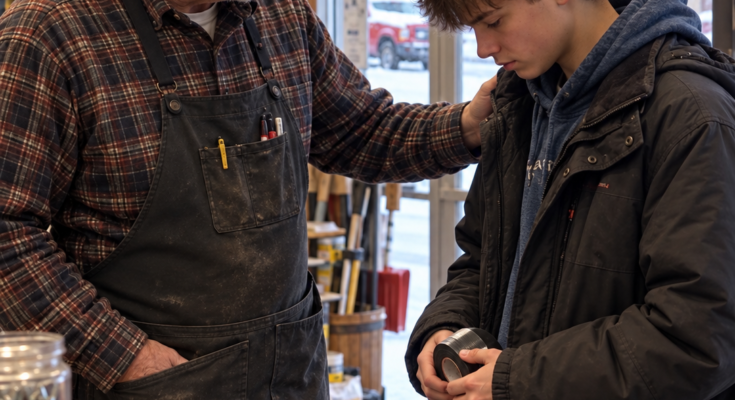
Fifteen-year-old Noah froze near the front door, one hand still buried inside his winter coat.
Russell Tate had worked behind the counter of that little northern Michigan hardware store for nearly twenty years. At sixty-four, he knew the sound of loose screws rolling across a floor, the smell of a burned-out motor, and the nervous look of someone hoping not to be noticed.
Noah slowly pulled out a roll of silver furnace tape.
His face went red.
“I’m sorry,” he whispered.
Russell looked toward the windows. Snow was falling hard outside, collecting against the curb in dirty white ridges.
“You got money for that?”
Noah shook his head.
“Then why were you taking it?”
For a few seconds, the boy said nothing.
Then his chin started trembling.
“Our furnace pipe came loose.”
Russell’s expression changed.
Noah stared at the floor.
“My mom tried to tape it with regular tape, but it melted. She said we have to wait until Friday to buy the right stuff.”
“Friday?”
“It’s Tuesday.”
Russell glanced again at the snow.
That week, nighttime temperatures had been dropping below freezing.
“Your dad around?”
Noah shook his head.
“Just my mom and my little sister.”
Russell had every right to call the police.
The store owner had made the policy clear. Theft was theft.
But Russell also remembered being fourteen and watching his own father stretch one paycheck across a family of six.
He remembered winters when they closed off half the house to save heating oil.
He remembered his mother warming socks on the oven door before sending the kids to school.
Some memories never really leave you.
They just wait for another cold day.
Russell picked up the furnace tape.
“How much is this?”
Noah looked confused.
“Eight dollars and forty-nine cents.”
Russell nodded toward the stockroom.
“You know how to use a broom?”
Noah blinked.
“Yes, sir.”
“Good. Then you’ve got money.”
Noah stared at him.
Russell pointed toward the back.
“You sweep the stockroom after school tomorrow. You can pay me with forty-five minutes of work.”
The boy looked like he wasn’t sure whether this was a trick.
“You’re not calling anybody?”
“Depends.”
“On what?”
“How well you sweep.”
For the first time, Noah smiled.
Russell handed him the furnace tape.
Then he grabbed another roll from the shelf.
“Take two.”
“I can’t pay for two.”
“You can stack the paint cans, too.”
—
Part Two: The Broom
The next afternoon, Noah showed up at 3:37 wearing the same thin coat.
Russell had expected him to disappear.
Instead, the boy stood by the register and asked, “Where’s the broom?”
He swept the stockroom.
Then he stacked the paint cans.
Then, without being asked, he broke down cardboard boxes and carried them to the recycling bin.
Russell looked at the clock.
“You’re twenty minutes over.”
Noah shrugged.
“My mom said if somebody gives you a chance, don’t make them regret it.”
Russell pretended to inspect a shelf so the kid wouldn’t see his smile.
“Your mother sounds smart.”
“She is.”
The next day, Noah came back.
He didn’t need anything.
He just asked whether Russell needed help.
Russell found him a box of loose washers that needed sorting.
The day after that, Noah returned again.
Soon, 3:30 became Russell’s favorite part of the day.
Before Noah, Russell’s afternoons had been quiet.
All three of his children had moved away years earlier—one to Arizona, one to North Carolina, one to Washington state.
They called.
They visited when they could.
But the house Russell returned to every evening was still empty.
Dinner was usually soup from a can, a sandwich over the sink, or whatever could be reheated without making too many dishes.
At work, he had customers.
At home, he had silence.
Then Noah started showing up.
Russell taught him how to replace a faucet washer.
How to find a stud in a wall.
How to shut off water before turning a small problem into a big one.
How to tell the difference between a stripped screw and the wrong screwdriver.
Noah absorbed everything.
“Why do you know all this stuff?” he asked once.
Russell laughed.
“Because I’ve spent sixty-four years breaking things.”
By spring, Noah wasn’t sweeping much anymore.
He was helping old customers carry salt bags to their cars.
He was cutting rope.
Sorting fasteners.
Learning which furnace filters fit which systems.
Russell started keeping an extra sandwich in the breakroom without saying who it was for.
Noah started pretending he didn’t know.
That was how they handled kindness.
Quietly.
One afternoon, Noah’s mother came into the store.
She looked exhausted, wearing work shoes and a name tag from a nursing home two towns over.
“You’re Mr. Tate?”
“Russell.”
She held out her hand.
“I’m Noah’s mom.”
Russell shook it.
She tried to speak, but her eyes filled.
“He told me what happened that first day.”
Russell glanced toward Noah, who was pretending to organize screws ten feet away.
“He paid for the tape.”
His mother wiped her cheek.
“That’s not what I mean.”
Russell knew.
She lowered her voice.
“He needed somebody.”
Russell looked at Noah.
Then he said something he hadn’t expected to say.
“So did I.”
—
Part Three: The Apprentice
Years passed.
Noah finished high school.
Russell attended the graduation and sat three rows behind Noah’s family.
When the boy crossed the stage, Russell clapped so loudly that Noah looked into the crowd and laughed.
Noah entered a heating and cooling apprenticeship.
He came by the store every few weeks, still wearing that same easy smile, still calling Russell “Mr. Tate” no matter how many times Russell told him not to.
“Mr. Tate, I need to know how to fix a boiler that keeps losing pressure.”
“Mr. Tate, what’s the best way to sweat a copper joint without burning the wall?”
“Mr. Tate, my boss says I’m the fastest learner he’s ever had. I told him I had a good teacher.”
Russell retired at sixty-eight.
The store owner threw him a small party. Cake, coffee, a card signed by regular customers.
Noah came.
He was twenty-two by then. Tall. Confident. Wearing a company jacket with his name embroidered on the chest.
He waited until the party thinned out.
Then he handed Russell a small box.
“What’s this?”
“Open it.”
Russell opened the box.
Inside was a broom.
A small, decorative broom with a brass handle and a ribbon tied around the bristles.
Russell laughed.
“Is this a joke?”
Noah shook his head.
“It’s a thank-you.”
“For what?”
“For not calling the police.”
Russell looked at the broom. Then at Noah.
“You paid for that tape a hundred times over.”
Noah shrugged.
“That’s not why I’m thanking you.”
Russell waited.
“I’m thanking you for giving me somewhere to go,” Noah said. “For teaching me things. For letting me sweep your floor when I didn’t have anywhere else to be.”
Russell’s eyes filled.
He didn’t trust himself to speak.
Noah hugged him.
“Thank you, Mr. Tate.”
Russell hugged him back.
“You’re welcome, son.”
That was six years ago.
Russell is seventy-four now. He lives in a small house near the lake. He fishes in the summer. He reads in the winter.
Noah is a licensed HVAC technician. He owns his own company. He has a wife and a baby girl.
He named her Ruth.
After Russell’s late wife.
Russell babysits every Thursday.
He teaches Ruth how to stack blocks. How to share. How to say please and thank you.
He doesn’t teach her how to sweep.
Not yet.
She’s only three.
But someday, when she’s older, he’ll tell her the story.
About a cold Tuesday in Michigan.
About a boy who needed tape for a furnace pipe.
About a broom.
About how a single act of kindness can change a life.
Because it can.
Russell knows.
He’s living proof.
—