Part One: The Notebook
“Put the eggs back.”
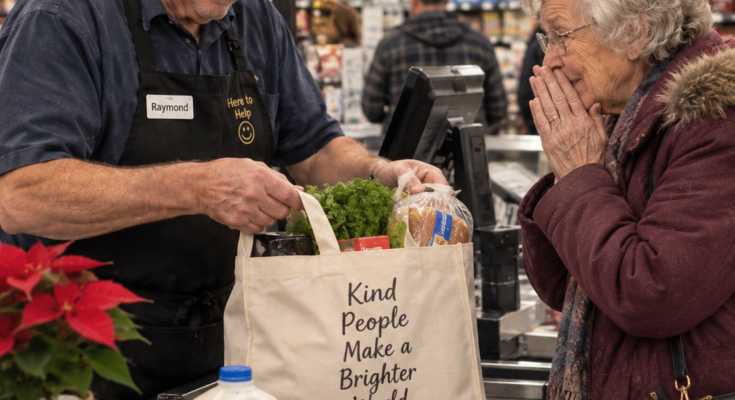
The elderly woman said it so softly that Raymond Bell almost pretended he hadn’t heard her.
She stood at his register with one hand wrapped around a worn coin purse and the other resting on the handle of her cart.
Bread.
A small carton of eggs.
Two cans of soup.
A bottle of over-the-counter pain reliever.
Nothing fancy.
Her total was $18.43.
She had $16.90.
Raymond looked at the eggs, then at the woman.
“Ma’am, you need those?”
She gave him the embarrassed little smile people use when they’re trying to make a hard thing look ordinary.
“I’ll get them next week.”
Raymond had seen that smile before.
He had worn it himself.
At 58, Raymond was working the evening register at a small grocery store in Nebraska because the factory where he had spent thirty-one years had closed the previous spring.
Thirty-one years.
Same steel-toed boots.
Same lunch pail.
Same parking space whenever he arrived early enough to get it.
Then one Friday, a supervisor gathered everyone near the loading dock and told them the plant was shutting down.
Raymond went home that afternoon carrying a cardboard box with a coffee mug, two family photographs, and a jacket he had forgotten in his locker.
His wife, Debbie, found him sitting at the kitchen table long after dark.
He had been the kind of man who always believed that if you showed up, worked hard, and didn’t complain, there would be a place for you.
Losing that job shook something in him.
For three months, he applied everywhere.
Finally, the grocery store hired him.
At first, Raymond hated the register.
He felt clumsy asking customers whether they wanted paper or plastic.
He hated wearing a name tag.
He hated running into former factory coworkers who would say, “Ray, didn’t expect to see you here.”
But bills didn’t care about pride.
So Raymond showed up.
And after a while, he began noticing things.
Especially after dark.
An older man would quietly remove a can of coffee.
A grandmother would tell him to take the hamburger off and keep the noodles.
A widower would stare at the total for a few seconds before saying, “Never mind the bananas.”
Usually they were short by less than five dollars.
Sometimes less than a dollar.
The first time Raymond reached into his own pocket, it was for 73 cents.
“Don’t worry about it,” he told a retired school custodian who was trying to count dimes.
The man shook his head.
“I’ll bring it tomorrow.”
“You probably won’t.”
The man’s face fell.
Raymond grinned.
“Because I’m not gonna let you.”
The old man laughed.
That laugh stayed with Raymond all evening.
A few nights later, a woman buying cat food, milk, and a loaf of bread came up $2.11 short.
Raymond covered it.
Then $4.60 for a man who put back his blood pressure monitor batteries.
Then $1.28 for a grandmother buying cereal for two grandchildren who were staying with her.
Raymond wasn’t wealthy.
Far from it.
Debbie kept a tight household budget, and Raymond knew exactly how much money sat in their checking account.
So he started keeping track.
He found a tiny spiral notebook and wrote on the first page:
**SHORT.**
Not names.
Never names.
Just amounts.
Tuesday — 73¢.
Wednesday — $2.11.
Friday — $4.60.
Sunday — $1.28.
Sometimes Raymond could spare it.
Sometimes he couldn’t.
On those nights, he found other ways.
A dented box marked down.
A store coupon the customer had missed.
A cheaper brand.
Once, when an elderly man started putting back the small birthday cake he had chosen for his wife, Raymond quietly handed him five dollars.
The man looked horrified.
“I can’t take that.”
Raymond shrugged.
“Then don’t.”
“What?”
“Take the cake instead.”
The man stood there blinking.
Then he whispered, “We’ve been married fifty-two years.”
Raymond smiled.
“Sounds like she earned cake.”
The man laughed, but his eyes filled with tears.
Raymond went on scanning groceries.
That was his rule.
No speeches.
No pity.
No making people feel like charity cases.
He understood that being broke was painful enough without being made to perform gratitude in front of strangers.
Months passed.
The little notebook filled.
Raymond started a second one.
—
Part Two: The Discovery
Then one evening, the assistant manager called him into the office.
Raymond knew immediately.
Someone had seen him.
The tiny notebook sat on the desk.
His stomach dropped.
The store owner, a woman named Linda Harper, was sitting beside the manager.
“Raymond,” she said, “what is this?”
Raymond stared at the notebook.
He thought about Debbie.
He thought about starting over again at 58.
He thought about walking into another place with a résumé that said thirty-one years at a factory that no longer existed.
Finally, he said, “If you’re going to fire me, just tell me.”
Linda frowned.
“Why would I fire you?”
Raymond pointed at the notebook.
“Because I’ve been covering people’s groceries.”
“With store money?”
“No, ma’am.”
“You’ve been taking cash?”
“No.”
“Then whose money?”
Raymond looked down.
“Mine.”
The room went silent.
Linda opened the notebook.
There were months of little numbers.
82¢.
$3.17.
$6.09.
$1.44.
$9.63.
Beside a few entries Raymond had written one-word reminders.
**Eggs.**
**Medicine.**
**Birthday.**
**Dog food.**
Linda turned another page.
“You did all this?”
Raymond shifted in his chair.
“I didn’t want people standing there deciding between supper and embarrassment.”
That sentence changed everything.
—
Part Three: The Jar
The next afternoon, Raymond arrived for his shift and saw a glass jar sitting beside his register.
There was a handwritten card attached to it.
**NEIGHBOR FUND**
That was all it said.
No company logo.
No long explanation.
No photograph of Raymond.
Just two words.
Raymond looked toward the office.
Linda was standing in the doorway.
“What’s this?”
She smiled.
“Your notebook got too heavy.”
By the end of Raymond’s shift, the jar held $63.
The next morning, an elderly man dropped in two dollars.
A mother added five.
A teenage boy put in the change from his purchase.
A farmer folded a twenty and pushed it through the opening without saying anything.
Within a week, there was a Neighbor Fund jar beside every register.
The rule was simple.
If someone came up short on basic groceries, the cashier could quietly use the fund.
No forms.
No public announcement.
No questions unless necessary.
No shame.
Raymond kept his notebook, but he didn’t need it as much anymore.
The jar filled faster than he could spend it.
Customers started donating without being asked. Some dropped in change. Some folded bills. One woman brought a check for two hundred dollars and asked Linda to keep her name off everything.
“It’s not about me,” she said. “It’s about the jar.”
Raymond understood.
The jar wasn’t charity.
It was a promise.
A promise that nobody in that store would have to choose between eating and dignity.
One evening, a young mother came through Raymond’s line. Her cart held formula, diapers, and a small bag of rice. Her total was $47.82. She had $43.
She started to put the formula back.
Raymond reached for the jar.
“Ma’am, don’t do that.”
She looked at him, confused.
“Put it back on the belt,” he said gently.
“I can’t pay for it.”
“You already did.”
She didn’t understand.
Raymond pointed at the jar.
“That’s the Neighbor Fund. Somebody in this town put money in there for exactly this.”
The woman stared at the jar.
Then she started crying.
“Who?”
Raymond shrugged.
“Doesn’t matter. What matters is you take your formula home.”
She wiped her eyes.
“Thank you.”
“Thank the jar.”
She did. She reached into her purse, pulled out a quarter, and dropped it in.
Then she pushed her cart out the door.
Raymond watched her go.
Then he looked at the jar.
It was almost full again.
That was the thing about kindness.
It multiplied.
The factory closed.
The job disappeared.
But Raymond found something better.
He found a way to take care of people.
And in doing so, he took care of himself.
The Neighbor Fund still exists.
It’s been running for seven years now.
Raymond retired last spring. He’s sixty-five. He and Debbie take walks by the lake. He fishes. He reads.
But every few weeks, he stops by the store.
Just to check on the jar.
Just to see if it needs anything.
It never does.
Because the town keeps it full.
Because the town remembers.
Because one man with a tiny notebook and a quiet heart taught them all something they should have known already.
That we take care of each other.
That we don’t let our neighbors go without.
That dignity is worth more than a dollar.
And that sometimes, the smallest acts of kindness echo the loudest.
Raymond Bell knew that.
He lived it.
He still does.
—