Part One: The Empty Envelope
I had six dollars tucked inside a graduation card when I decided to take them back out.
Three wrinkled bills. I smoothed each one against the kitchen table, feeling foolish for thinking they belonged in an envelope.
Then I felt worse for needing them.
At seventy-two, you’d think a person would be finished learning new kinds of embarrassment. But losing your husband teaches you things nobody mentions at the funeral.
How quiet a refrigerator sounds at night. How long a loaf of bread lasts. How hard it is to tell someone, “I’d love to come,” when you’re wondering whether your gas bill has cleared.
The invitation had been slipped under my screen door that afternoon.
*Graduation celebration. Saturday, four o’clock. Next door.*
My name was written across the envelope: *Mrs. Salgado.*
Underneath it, in smaller handwriting, someone had added two words.
*No gifts.*
I stared at them for a while.
Then I put the six dollars back in the little tin where I kept money for bread and milk.
The graduate’s name was Nolan. He was eighteen, tall and narrow, with hair that always looked as though he’d just taken off a baseball cap.
I knew him the way you know a neighbor’s child when your houses are close but your lives aren’t.
He brought my trash bin up when the wind knocked it over. I asked him to stop calling me “ma’am” because it made me look around for somebody older.
He kept doing it anyway.
Most of our conversations happened over the low fence between our yards, while I watered plants that had no business surviving an Arizona summer.
After my husband, Ernesto, died, I sometimes watered them twice.
It gave me a reason to stand outside.
One afternoon, Nolan came through his side gate carrying a grocery bag with a loaf of bread sticking out.
“Mrs. Salgado, can you make scrambled eggs without milk?”
“Of course you can.”
“My little brother says you can’t.”
“Your little brother owns a restaurant?”
That made him laugh.
I told him to use low heat and take the pan off before the eggs looked completely done. He listened with one hand on the gate.
A few days later, he asked how to make rice taste like something.
“Onion, if you have it. A little salt. Cook it in broth if there’s any around.”
“What if there isn’t?”
“Then water works. People have been eating supper without fancy ingredients for a long time.”
I’d spent thirty-one years cooking at a public elementary school. Feeding hungry children with what was available was about the only subject on which I considered myself an authority.
Once, he asked what I would do with potatoes, half a bag of frozen vegetables, and two eggs.
“First, I’d stop apologizing for them,” I said. “That sounds like supper.”
I explained how to dice the potatoes small so they cooked faster, then add the vegetables and scramble the eggs right into the pan.
Another evening, he wanted to know how you could tell if beans needed more salt.
“You taste them.”
“Just right out of the pot?”
“Well, use a spoon. We’re not wolves.”
Those were our conversations.
Nothing important, I thought.
On Saturday, I changed my blouse three times before settling on the blue one Ernesto used to like.
I signed the card, sealed the empty envelope, and almost stayed home anyway.
Then I heard laughter through the kitchen window.
I had spent eleven months listening to other people’s lives through that window. I decided I could walk next door for twenty minutes.
—
Part Two: The Party
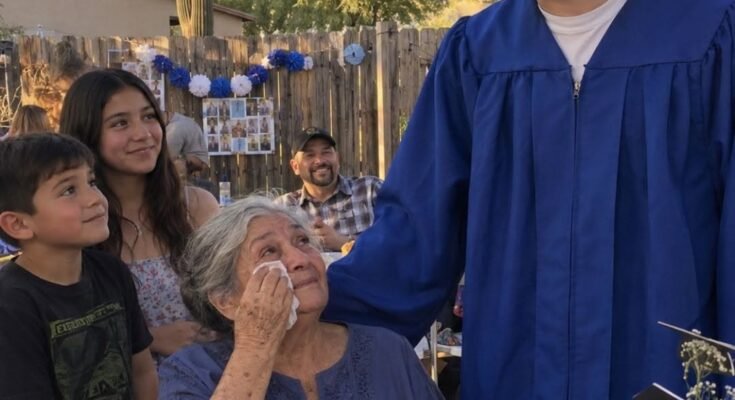
Their backyard had folding chairs, paper decorations, and a cooler sitting beneath a tree. Someone had taped Nolan’s school pictures along the fence.
There he was with missing front teeth. There he was in a shirt too big for him. There he was in his cap and gown, looking startled to have grown up.
His mother, Maribel, met me at the gate.
“I’m so glad you came.”
I handed her the card and immediately began explaining.
“It’s only a little note. I wasn’t sure what—”
She took both my hands.
“He wanted you here.”
Before I could answer, Nolan spotted me.
“Mrs. Salgado! Come here. I want you to meet somebody.”
He led me toward two younger children standing beside the food table. The girl was about eleven. The boy, maybe seven.
“This is her,” he told them.
The little boy looked up at me.
“The potato lady?”
Nolan shut his eyes.
“I told you not to call her that.”
“Well,” I said, “I’ve been called worse.”
The boy grinned, and Nolan pulled out a chair for me.
Then an older man near the grill asked how we knew each other.
Nolan rested a hand on the back of my chair.
“She’s the one who taught me to cook.”
I laughed because I thought he was being polite.
“Oh, honey. We’ve never even been in a kitchen together.”
“I know,” he said. “But you still taught me.”
His mother sat down beside me.
She explained that she’d been working evenings cleaning offices, leaving before dinner and getting home after the younger children were asleep. Nolan was the one at home with them.
He could make sandwiches. Heat soup. Follow the directions on a box.
But the little ones got tired of the same things, and groceries had to stretch until Friday.
“I didn’t want Mom getting messages at work asking what we were supposed to eat,” he said.
He took out his phone and opened a note.
At the top, he had typed:
*Mrs. S meals.*
Underneath were the things I’d told him at the fence.
Potatoes, vegetables, eggs.
Beans on toast.
Rice with onion.
Pasta with butter and peas.
Beside one entry, he’d written: *Save some cooking water before draining.*
Beside another: *Low heat. Don’t rush it.*
I reached for my glasses, although I could read it perfectly well.
I just needed a moment.
“You wrote all that down?”
“Afterward. In the house.”
His little sister leaned against his shoulder.
“He burned the potatoes the first time.”
“Thank you, Paige.”
“But he scraped the bottoms off,” she continued. “The rest were good.”
Maribel laughed, then pressed a napkin beneath her eyes.
“I kept coming home and finding a plate in the refrigerator,” she said. “He told me he was figuring it out.”
Nolan looked down at his shoes.
“She had enough to worry about.”
—
Part Three: The Plate
I knew that sentence. I had said it about Ernesto. Ernesto had said it about me.
All those years, each of us trying to make the other person’s load a little lighter without announcing we were carrying anything.
“I thought you were just being friendly to an old woman,” I told him.
“I was,” he said. “I also needed to know what to do with the potatoes.”
That was when I started crying.
Not gracefully, either.
Maribel put her arm around me. Paige brought me a napkin. The little boy—whose name was Mateo—stood in front of me and said, very seriously, “You can have my piece of cake. It’s chocolate.”
I laughed through the tears.
“I don’t need your cake, sweetheart.”
“You can have it anyway.”
Nolan knelt down beside my chair.
“Mrs. Salgado, I didn’t mean to make you cry.”
“You didn’t,” I said. “I’m just… I’m just glad I came.”
He reached into his pocket and pulled out a small, folded piece of paper.
“I wrote you something too,” he said. “But it’s not a card.”
I unfolded it.
It was a recipe.
*Mrs. Salgado’s Potatoes.*
*Dice them small. Cook them slow. Add whatever you have. Don’t apologize for it.*
*Serve with eggs if there are eggs.*
*Serves however many people show up.*
At the bottom, he had written:
*Thank you for teaching me that supper is more than food.*
I folded the paper carefully and put it in my purse.
Then I stayed for three hours.
I ate cake. I met Nolan’s aunts and uncles. I told Mateo that yes, I really did know how to make macaroni and cheese from scratch, and no, I would not teach him until he learned to stop calling me the potato lady.
He called me that anyway.
When I walked home that evening, the sun was setting behind the mountains. The air had cooled. My blue blouse still smelled like barbecue and someone’s perfume.
I sat down at my kitchen table and took out the recipe.
Then I took out the empty envelope I had brought to the party.
I hadn’t given it to Nolan. I had slipped it back into my purse before I left.
I opened it and looked at the card I had signed.
*Congratulations, Nolan. I’m proud of you. —Mrs. Salgado*
I put the card on the refrigerator, right next to the photo of Ernesto.
Then I made myself a plate of potatoes.
Diced small. Cooked slow. With whatever I had.
They were good.
—
That was two years ago.
Nolan is away at college now. He calls me sometimes, usually when he’s trying to figure out what to do with whatever’s in his refrigerator.
Last week, he asked about lentil soup.
I told him to use onion, carrot, and whatever spices he had. I told him not to apologize for the lentils.
He laughed.
“I remember,” he said.
I know he does.
That’s the thing about teaching someone.
You don’t always know you’re doing it.
You just stand at the fence and answer questions.
And sometimes, years later, you find out that those answers became dinners.
Became comfort.
Became something that held a family together.
I gave Nolan six dollars’ worth of nothing.
He gave me a recipe with my name on it.
And a reason to believe that even at seventy-two, I still had something worth giving.
—