Part One — The Lease I Had Never Signed
At the time, I was already twelve hours into a double shift in the cardiac unit.
My phone buzzed beneath a pile of patient charts.
The notification had nothing to do with a medical emergency.
But it was about to expose a family problem I had apparently been too exhausted to notice for years.
At 3:07 in the morning, my father tagged me in the main family group chat.
We’re using Arden’s lake house this weekend. Twenty guests. Friday through Tuesday. Everyone bring towels. Arden, get everything ready.
I stood behind the nurses’ station in Charlotte, North Carolina, with antiseptic clinging to my scrubs and stale coffee burning somewhere behind me.
A heart monitor flashed green through the glass wall of Room 12.
Farther down the hall, a ventilator released its steady mechanical sigh.
I read Dad’s message once.
Then twice.
Then a third time.
Exhaustion does strange things to your eyes.
After fourteen years as a registered nurse, I had learned never to trust the first version of anything at three in the morning.
But the message didn’t change.
My name is Arden Voss.
I was thirty-six.
Single.
Exhausted almost all the time.
And the sole owner of a small lake house on Lake Norman.
I had bought it after nine years of double shifts, packed lunches, discount scrubs, and driving the same dented silver Honda Civic my family loved to make jokes about.
That house belonged to me.
Not emotionally.
Not “eventually.”
Legally.
Financially.
Completely.
I bought it because I wanted one place in the world where nobody could walk through the door and tell me what I owed them.
Then Mom replied beneath Dad’s announcement.
Fill the refrigerator, sweetheart. And please don’t make this awkward.
Within minutes, reactions appeared.
Thumbs-up.
Hearts.
Laughing emojis.
Then my cousin Hollis asked:
Is the Wi-Fi password still the same?
That stopped me.
I had never given Hollis my Wi-Fi password.
I opened the security app.
Then the router history.
Then archived camera footage.
My hand slowly went still.
There was Dad unlocking my front door while I worked a Christmas weekend.
Mom carrying coolers onto my deck in March.
My aunt sunbathing beside the dock.
Cousins bringing people I had never met.
Cars parked across my grass.
Children running through rooms I had carefully furnished myself.
Then I found footage from a weekend when I had been at a nursing conference in Raleigh.
A couple I didn’t recognize arrived carrying suitcases.
Dad met them at the door.
He handed them keys.
The strangers stayed three nights.
I checked farther back.
More strangers.
More suitcases.
More cars.
I opened a browser and searched the address.
There it was.
My lake house.
Photographed beautifully.
Listed online as a “private family retreat.”
The host name wasn’t mine.
It belonged to a small property-management LLC I had never heard of.
The reviews went back almost eight months.
Great dock.
Wonderful family getaway.
Hosts were very responsive.
I had apparently been running a vacation rental without knowing it.
And judging by the calendar, somebody had been collecting thousands of dollars for the privilege.
I took screenshots.
Downloaded camera clips.
Saved the listing.
Then I replied to the family chat with one word.
No.
Mom answered almost immediately.
Three laughing emojis.
Then:
You really think you can stop us? We have a signed lease.
I stared at the screen.
A minute later she sent a photograph.
It was a document titled:
RESIDENTIAL LEASE AGREEMENT
My father was listed as tenant.
The fake management company was listed as landlord.
And at the bottom was something that made my stomach turn.
My name.
Or something trying very hard to look like my name.
Arden Voss.
I zoomed in.
I had never signed it.
I did not confront them.
I finished my shift.
At seven that morning, I clocked out, sat in my car, and made three calls.
The first was to an attorney who handled property disputes.
I sent him the deed, screenshots, listing, messages, and the supposed lease.
He was much less theatrical than I wanted him to be.
“Don’t change anything until we’ve reviewed whether anyone could plausibly claim lawful occupancy,” he said. “And preserve everything.”
That was why I hired him.
Not because he promised revenge.
Because he refused to improvise with my property.
The second call was to my insurance company.
The third was to a licensed locksmith and security company after my attorney confirmed the next steps.
Over the next two days, we learned the rest.
The supposed management company had been created by my father.
My parents had used a copy of my emergency key.
They had been advertising the house during weekends when they knew I was working.
The rent had been deposited into an account I did not control.
And months earlier, someone had apparently backed a vehicle into part of the crawl-space access.
The inspection I ordered afterward found moisture damage and a pest problem that needed legitimate professional treatment.
Not because I wanted a dramatic trap.
Because strangers had been staying in my house for months and nobody had told me what was happening to it.
My attorney sent written notice revoking any permission my parents believed they had to enter.
The rental listing was reported.
The locks and codes were changed.
The fake lease and rental income went to the proper people for review.
And the pest-treatment company scheduled work for Thursday.
I never mentioned any of this in the family chat.
Friday morning came.
At 10:15, my phone rang.
Dad.
I answered.
He didn’t say hello.
“WHAT DID YOU DO TO THE HOUSE?”
I held the phone slightly away from my ear.
Behind him, I could hear voices.
A lot of voices.
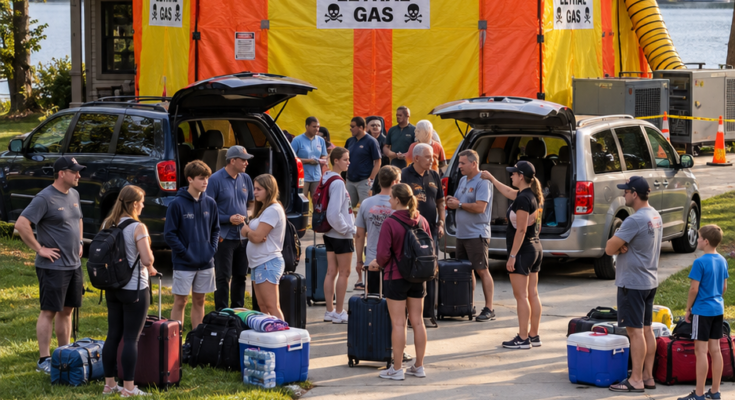
Apparently all twenty people had shown up anyway.
“What do you mean?”
“The whole place is covered for treatment! There are warning signs everywhere! Nobody will let us inside!”
I took a sip of coffee.
“Oh. That.”
“WE HAVE GROCERIES. WE RENTED TWO BOATS.”
“That sounds expensive.”
“Arden!”
I let him yell until he ran out of breath.
Then I said:
“The house is undergoing licensed pest treatment because the inspection found damage. The contractor controls access until it’s cleared.”
“What about our weekend?”
“There is no ‘our weekend.’ I told you no.”
“We have a lease!”
I was quiet for a second.
Then:
“Dad, the document Mom sent me is being reviewed by my attorney.”
Silence.
I continued.
“You don’t own my house. You weren’t authorized to rent it. And the signature at the bottom isn’t mine.”
For the first time since he called, nobody shouted.
Then I said the sentence that finally made him understand this was not another family argument he could bully me through.
“My lawyer also has the rental listings.”
The line went completely quiet.
━━━━━━━━━━━━━━━━━━━━
Part Two — The House Was Never the Worst Part
Mom called next.
Not apologizing.
Crying.
“You embarrassed us in front of everybody.”
I almost laughed.
“You arrived at a house after the owner told you not to come.”
“We’re your parents.”
“That isn’t a property right.”
“You always let us use it.”
Occasionally, I had.
That was how it started.
A weekend for Mom’s birthday.
One afternoon when Dad wanted to fish.
A family barbecue I attended.
Somewhere along the way, permission became assumption.
Then assumption became entitlement.
Then entitlement became income.
Mom lowered her voice.
“We thought you wouldn’t mind.”
“You forged my signature.”
“We didn’t forge anything.”
“Then who signed it?”
Silence.
Finally:
“Your father handled the paperwork.”
There it was.
The family language I knew so well.
Nobody did anything.
Things simply happened.
Dad “handled paperwork.”
Mom “helped organize.”
Cousins “thought it was fine.”
And somehow I was always the person expected to absorb the result.
The legal and financial mess took months to unwind.
I did not have anyone dragged away in handcuffs from the driveway.
I didn’t publicly post my family’s messages.
I didn’t call their employers.
I let my attorney, insurer, tax professional, and the rental platform handle what belonged in their lanes.
Records showed income had been collected from unauthorized rentals.
There was property damage.
There were questions about representations made to guests and about the signature used on the supposed lease.
My parents eventually repaid money connected to the unauthorized use and contributed toward documented damage as part of resolving the dispute.
But something bothered me more than the money.
I kept returning to Hollis’s message.
Is the Wi-Fi password still the same?
That one sentence told me how normal my absence had become.
My family had created an entire social life inside something I paid for.
They knew which cabinet held extra towels.
Which bedroom had the best mattress.
Where I kept the kayak paddles.
What temperature I preferred on the thermostat.
Strangers knew more about my vacation home than I knew about what happened there while I was working.
And I had been congratulating myself for becoming independent.
That realization hurt.
Not because independence had failed.
Because I had confused being useful with being loved for so long that I stopped noticing when people treated my boundaries as inconveniences.
━━━━━━━━━━━━━━━━━━━━
Part Three — The First Weekend I Actually Spent There
For almost six months after everything happened, I barely visited the lake house.
That surprised me.
I had fought so hard to protect it.
But when I walked through the door, I saw evidence.
A scratch on the dining table.
A stain near the guest-room carpet.
The replaced crawl-space panel.
Even after the pest treatment and repairs, the house felt crowded with people who weren’t there.
My therapist asked me one day:
“Why did you buy it?”
“To have somewhere peaceful.”
“Was it peaceful before you discovered the rentals?”
I thought about that.
The answer was embarrassing.
“I hardly went.”
“Why?”
“Work.”
Then, after a pause:
“Because every time I went, somebody needed something.”
An extra shift covered.
A family errand.
A bill researched.
A ride.
I had built myself a sanctuary and then spent years being too busy serving everyone else to use it.
So I changed something.
Not dramatically.
I reduced overtime.
Not enough to wreck my finances.
Enough to stop treating exhaustion like proof of character.
On my first free Friday in years, I drove to Lake Norman by myself.
No family.
No guests.
No group chat.
I stopped at a grocery store on the way.
Old habit made me reach for enough food to feed a crowd.
Then I laughed.
I bought one steak.
One baked potato.
A pint of ice cream.
And a bottle of sparkling water.
At the house, I opened every window.
I sat on the deck until sunset.
Nobody asked me for the Wi-Fi password.
Nobody demanded towels.
Nobody told me which groceries I’d forgotten.
For the first time since buying the place, I understood what ownership actually felt like.
Not control.
Rest.
My brother came to see me a few months later.
He had been strangely quiet during the entire dispute.
When I opened the door, he stood holding a small toolbox.
“What is that?”
He pointed toward the loose railing beside the steps.
“Dad told me it’s been bothering you.”
I crossed my arms.
“Did Dad send you?”
“No.”
“Do you expect a key?”
He smiled.
“No.”
I let him in.
While he repaired the railing, he admitted something.
“I stayed at the house twice without telling you.”
I looked at him.
“I know.”
His hands stopped.
“You do?”
“Cameras.”
“Right.”
He looked genuinely ashamed.
“I told myself Mom and Dad had permission.”
“You never checked.”
“No.”
“Why?”
He thought for a moment.
“Because checking might have made me responsible for the answer.”
That was one of the most honest things anybody in my family had said.
He apologized.
Not:
Sorry you got upset.
Not:
Sorry things got out of hand.
He said:
“I used something that belonged to you because it was easier to assume you’d say yes than risk hearing no.”
I accepted that apology.
He still didn’t get a key.
My parents took much longer.
Dad remained angry for months.
Mostly, I think, because he had spent his life believing providing for children while they were young created permanent authority over what they built later.
Mom tried guilt.
Then silence.
Then guilt again.
Eventually, almost a year after the Friday phone call, she asked if we could meet for lunch.
She brought an envelope.
Inside was a copy of the old fake lease.
Across the front, in red ink, she had written:
THIS WAS WRONG.
I looked at her.
“What is this?”
“A very late attempt at not making you explain it again.”
That got my attention.
She folded her hands.
“We got used to you saying yes.”
I said nothing.
“And when you started saying no, your father and I acted as if you’d changed.”
“I had.”
Mom nodded.
“Yes.”
Then she surprised me.
“You should have.”
She admitted she knew Dad had created paperwork to make their use of the house look legitimate.
She had not thought of it as stealing.
She had called it “protecting access.”
Now she understood what that phrase really meant.
“We were protecting access to something that wasn’t ours.”
That was the first apology I believed.
Dad took longer.
Two years later, he finally asked to visit the lake house.
He did not announce it.
He asked.
Would it be okay if your mother and I came Sunday afternoon? Just us. If not, that’s fine.
I stared at the message for almost a minute.
Then I wrote:
2:00 to 5:00. I’ll be there.
They arrived at 1:58.
Mom brought pie.
Dad stood outside the front door.
He did not reach for a key.
He didn’t have one anymore.
He knocked.
I opened the door.
For a second, neither of us spoke.
Then he held up a small cooler.
“I brought my own beer.”
I laughed despite myself.
“Progress.”
He smiled.
“I’m trying.”
That afternoon was almost painfully ordinary.
Dad fished.
Mom read on the deck.
I grilled chicken.
At five, Dad packed his things without being reminded.
Before leaving, he stood beside his truck and looked back at the house.
“You know,” he said, “I think I convinced myself family property meant property the family could use.”
“It wasn’t family property.”
“I know.”
He nodded toward the house.
“You built this.”
“Yes.”
Then he said something I had waited years to hear.
“And that doesn’t make you responsible for providing it to us.”
“No.”
He nodded.
No argument.
No defense.
Just acceptance.
After they left, I walked down to the dock.
The lake was completely still.
That family group chat still exists.
Nobody announces weekends at my house anymore.
If someone wants to visit, they ask.
Sometimes I say yes.
Sometimes I say no.
And the strangest thing happened once I stopped treating every no like an emergency.
The relationships that could survive boundaries became better.
The ones that depended on access became smaller.
That hurt at first.
Then it became useful information.
I used to think the most satisfying part of that whole story was Friday morning, imagining twenty people standing outside a house they had assumed they could take over.
It wasn’t.
The satisfying part came years later.
My father standing on my porch with his own cooler.
Waiting for me to answer the door.
Not because I had finally “won.”
Because he had finally understood.
A boundary is not revenge.
Ownership is not selfishness.
And generosity stops being generosity the moment someone else decides they are entitled to it.
I bought that lake house because I wanted one place where nobody could tell me what I owed them.
It took me years to realize the lock was never the important part.
The important part was learning I was allowed to say no—and discovering who still loved me after I did.