Part One: The Blizzard
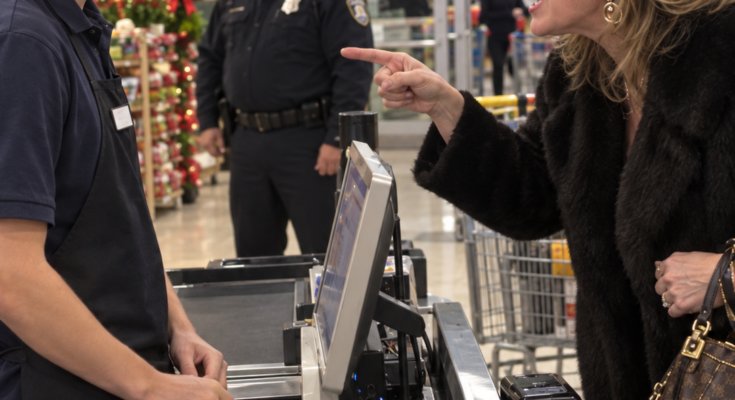
“You manipulated a sick old man!” the woman screamed, slamming her heavy leather purse against my checkout counter.
She was wearing enough gold jewelry to buy my family’s entire apartment building. Her face was flushed dark red with absolute fury. The supermarket security guard by the automatic doors was already reaching for his radio.
“Ma’am, I need you to step back,” I said, my hands shaking over the barcode scanner.
“My father was not in his right mind!” she shrieked, pointing a manicured finger directly at my face. “You are a thief. You stole my inheritance over a stupid, worthless mutt!”
I did not steal anything. I just did what I thought was right on the coldest night of the year.
It started four months ago during the worst blizzard our city had seen in a decade. I worked the closing shift at the neighborhood grocery store. Arthur was a regular customer. He was eighty-two years old, walked with a heavy wooden cane, and was notoriously the grumpiest man in the county.
He complained about the prices. He complained about the lighting. He never smiled.
But Arthur always brought his dog.
The dog was a scruffy, one-eared terrier mix named Buster. Arthur was not allowed to bring Buster inside the store, so he would tie him to the metal bench near the sliding glass doors for the exactly seven minutes it took to buy his daily bread and soup.
On the night of the blizzard, the temperature dropped to five degrees. I was pushing a line of metal carts toward the entrance when I heard a commotion inside.
Arthur had collapsed in aisle four.
It was a massive heart attack. The store manager called emergency services. The paramedics arrived in less than five minutes, loaded Arthur onto a stretcher, and rushed him to the local hospital. The entire store was in shock.
Ten minutes later, I walked outside to gather the last row of carts. The wind was howling. The snow was falling so fast I could barely see the streetlights.
That is when I heard the whimper.
Buster was still tied to the frozen metal bench. He was shivering so violently that his paws were lifting off the concrete. He was covered in a thick layer of ice and snow.
I rushed back inside and found my manager. I told him we had to call someone. My manager called Arthur’s daughter—the woman now screaming at my register. She was listed as his emergency contact.
I stood right next to the office phone when my manager explained the situation.
“My father is in surgery,” the daughter’s voice snapped over the speakerphone. “I do not care about that filthy animal. Call animal control. Let the city pound deal with it.”
She hung up.
My manager called the city shelter, but the roads were completely iced over. They said they could not dispatch a truck until the next morning.
“Leave him out there,” my manager sighed, rubbing his temples. “Or tie him up in the cart corral. We are closing the store.”
I looked through the glass at Buster trembling alone in the storm, and I knew that if I obeyed my manager, he might not survive the night.
So I made a decision behind everyone’s back—a decision that would eventually put two million dollars in my hands and turn Arthur’s daughter against me.
—
Part Two: The Storage Closet
I waited until my manager went to his office. Then I walked outside, untied Buster from the bench, and carried him inside.
He was so cold he didn’t even struggle. Just trembled against my chest.
I couldn’t take him home—my apartment didn’t allow pets. I couldn’t leave him in the break room—someone would find him. So I carried him to the storage closet near the back loading dock. It was small, dusty, and filled with old mop buckets and cardboard boxes. But it was warm.
I made him a bed from my jacket and an old towel I found on a shelf. I filled a plastic container with water from the bathroom sink. I found a can of soup in the break room and emptied it into a bowl.
Buster ate slowly. Then he looked up at me with those tired brown eyes and licked my hand.
I stayed with him for an hour. I missed my bus. I walked home in the blizzard. But I didn’t care.
The next morning, I came back early. Buster was still there. Still alive.
I kept him in that closet for three days.
I fed him scraps from the deli. I walked him behind the store before my shifts. I cleaned up after him. Nobody noticed.
On the fourth day, Arthur walked into the store.
He was pale. He was weak. He leaned on his cane like it was the only thing holding him up. But he was alive.
He shuffled to the customer service desk and asked if anyone had seen his dog.
I walked up to him.
“Mr. Arthur?”
He looked at me with tired eyes.
“I know where Buster is.”
—
Part Three: The Inheritance
Arthur cried when he saw Buster.
He sat on an overturned bucket in that dusty storage closet and held his dog against his chest. Buster licked his face. Arthur kept saying, “I’m sorry. I’m sorry.”
He told me his daughter had refused to pick up the dog. She’d told the hospital she was too busy. She hadn’t visited him once in the four days he was there.
“I have no one,” he said quietly. “Just Buster.”
I didn’t know what to say. So I just sat with him.
Arthur recovered slowly. He came to the store every day to see Buster. I’d let him in through the back entrance so he didn’t have to walk far. He’d sit in the storage closet and talk to his dog while I worked.
Three months later, Arthur passed away.
I found out at work. My manager pulled me aside and told me. I went into the storage closet and sat on the same bucket where Arthur used to sit. I cried for a man I barely knew.
A week later, a lawyer called me.
Arthur had changed his will. He left his entire estate to me. Two million dollars. His house. His savings. Everything.
His daughter was contesting it. She claimed I had manipulated him. She claimed he wasn’t in his right mind. She claimed I had stolen her inheritance.
But Arthur had left a letter with his lawyer. In it, he wrote:
*To the boy who saved my dog: You are the only person who showed me kindness when I had nothing left. My daughter has money. She doesn’t need mine. You have nothing. Take it. Build a life. And remember—kindness is never wasted.*
The judge upheld the will.
I didn’t keep all the money. I gave half to the local animal shelter. I used the rest to open a small dog rescue in Arthur’s name.
Buster lives with me now. He sleeps on my bed. He still has one ear and a scruffy coat and a face that only a father could love.
And every night, before I go to sleep, I think about that blizzard.
I think about the cold.
The whimpering.
The choice.
I was just a seventeen-year-old cart boy making minimum wage.
But I hid a freezing dog in a storage closet.
And it changed everything.
—