Part One: The Bow Tie
“Grandma, it ripped.”
Loretta Boone looked down at the tiny navy bow tie in her grandson’s hands.
One side had torn completely away from the elastic.
The school spring pageant was less than twelve hours away.
Her grandson Owen looked ready to cry.
His twin brother, Caleb, stood beside him in dinosaur pajamas, clutching his own bow tie like it might break just from being looked at.
Loretta smiled.
“Well,” she said, reaching for her sewing basket, “good thing your grandma grew up before people threw things away just because they broke.”
The boys laughed.
And just like that, the crisis was over.
At least for them.
Loretta was 68 years old and owned the only flower shop left on that side of their small North Carolina town.
“Owned” might have been a generous word.
Most months, the bank owned more of it than she did.
The cooler rattled.
The delivery van had a passenger door that only opened from the inside.
And the faded green awning outside had been patched twice with waterproof tape.
Still, Loretta opened the shop every morning at seven.
She trimmed roses.
Swept fallen leaves from the sidewalk.
Made funeral arrangements for families she had known for forty years.
Tied ribbons around prom corsages.
Delivered sunflowers to hospital rooms.
And somehow, between all that, she had become the person her son called whenever life got complicated.
“Mom, can you pick up the boys?”
“Mom, daycare is closed.”
“Mom, Caleb has a fever.”
“Mom, we’re running late.”
“Mom, could you keep them just until dinner?”
Dinner had sometimes turned into bedtime.
One night had sometimes turned into a weekend.
Loretta never complained.
Not even after her husband, Frank, died.
Especially not then.
After forty-three years of marriage, silence had become the hardest thing about going home.
Frank’s boots were still under the workbench in the garage.
His coffee mug still had a tiny chip near the handle.
And for months after the funeral, Loretta kept catching herself turning toward the back room of the flower shop to tell him something.
Then she would remember.
So when the twins came running through her shop after school, knocking tissue paper off the counter and asking for cookies, Loretta welcomed the noise.
She needed them more than anyone realized.
Maybe that was why she never kept score.
She didn’t count the school pickups.
The lunches packed.
The overnight stays.
The soccer practices.
The scraped knees.
The Saturday mornings when she opened the flower shop late because one of the boys had fallen asleep against her shoulder.
Loretta just showed up.
That was what she had always believed family did.
The boys had another grandmother too.
Denise.
Denise lived about forty minutes away and always arrived looking like she had stepped out of a catalog.
Pressed clothes.
Perfect hair.
Pearl earrings.
Beautiful handbags.
She loved the twins.
Loretta never doubted that.
But Denise’s visits usually happened around birthdays, holidays, school programs, or anything involving photographs.
She brought impressive presents.
She posted beautiful pictures.
She remembered matching wrapping paper.
Loretta remembered which twin hated mustard.
Nobody was a villain.
They were simply different kinds of grandmothers.
But difference can hurt when one kind photographs better than the other.
The night before the spring pageant, Loretta sat at her kitchen table beneath the yellow light Frank had installed twenty years earlier.
She found an old navy tie in his closet.
She ran her fingers over it for a long moment.
Frank had worn it to weddings.
Graduations.
Their son’s high school ceremony.
Even Loretta’s mother’s funeral.
“You won’t mind,” she whispered into the empty room.
Then she carefully cut the fabric.
By midnight, she had made one bow tie.
By one-thirty, she had finished the second.
She made them matching because twins notice things adults think they won’t.
When she finally went to bed, tiny pieces of navy fabric were scattered across the table.
Frank’s sewing scissors sat beside her cold coffee.
—
Part Two: The Hallway
The next afternoon, Loretta closed the flower shop thirty minutes early.
She didn’t have time to change.
Her jeans had a faint green stain near one knee from flower stems.
Her old cardigan smelled like roses, damp leaves, and the big refrigerator cooler at the shop.
There was probably pollen in her gray hair.
She drove straight to the elementary school.
The parking lot was packed.
Parents carried bouquets and balloons through the doors.
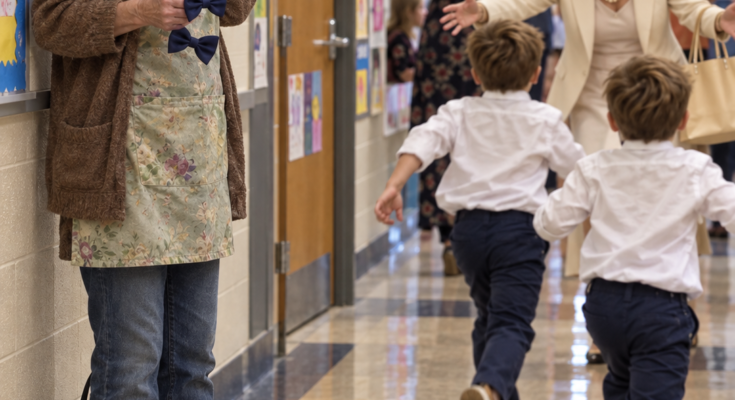
Inside, children dressed as trees, rabbits, clouds, and spring flowers hurried through the hallway.
Loretta found the twins near their classroom.
When Owen saw the bow ties, his whole face lit up.
“You fixed them!”
“Better than fixed,” Loretta said.
She knelt and fastened Frank’s old navy fabric beneath each boy’s collar.
Caleb touched his bow tie.
“Was this Grandpa’s?”
Loretta nodded.
Both boys went quiet for a second.
Then Caleb whispered, “So he gets to come too.”
Loretta had to look away.
That was when Denise arrived.
Pearls.
Cream-colored coat.
Perfect hair.
Two expensive gift bags hanging from one arm.
The twins spotted the bags.
“Grandma Denise!”
They ran toward her.
Loretta stayed kneeling for a moment, hands resting on her knees.
It shouldn’t have hurt.
They were children.
Children run toward shiny things.
She knew that.
Still, something inside her went very quiet.
Her daughter-in-law hurried over, already holding her phone.
“We’re taking family pictures before they go backstage,” she said.
Then she looked at Loretta.
Just for a second.
At the faded jeans.
The stained knee.
The cardigan.
The tired face of a woman who had slept four hours after turning her dead husband’s necktie into two bow ties.
Her daughter-in-law lowered her voice.
“Maybe stand back for this one. You don’t really look picture-ready.”
Loretta heard every word.
So did the hallway.
At least it felt that way.
For years, Loretta had been the woman who smoothed everything over.
She rearranged flowers when someone changed their mind.
Rearranged her schedule when her son needed help.
Rearranged holidays so nobody felt uncomfortable.
Rearranged her grief so other people didn’t have to see it.
She had spent most of her life arranging things so everyone else could stand where they wanted.
This time, she didn’t.
She simply smiled.
“All right, honey.”
No scene.
No angry words.
No tears in the hallway.
She kissed both boys on the head.
“Grandma loves you. Sing loud.”
Then she walked out.
—
Part Three: The Picture
For the first time in years, Loretta missed the family photograph.
She sat alone in her flower shop while the pageant happened.
The CLOSED sign hung on the door, but she didn’t turn off the lights.
She made herself tea.
She straightened a display of tulips that didn’t need straightening.
She thought about Frank.
She thought about the bow ties.
She thought about the look on her daughter-in-law’s face.
*Picture-ready.*
Loretta had spent her whole life being ready for things.
Ready to help.
Ready to show up.
Ready to put herself last.
She was tired of being ready.
She was just tired.
At 8:15, the bell above the shop door jingled.
She looked up.
Her son stood in the doorway.
He was still wearing his work clothes. His tie was loosened. His face was flushed.
“Mom.”
“Hi, honey.”
He walked toward her.
“I heard what Sarah said.”
Loretta looked down at her tea.
“She didn’t mean anything by it.”
“Yes, she did.” He pulled up a stool beside the counter. “And she’s wrong.”
“David—”
“No, Mom. Listen to me.”
He took her hand.
“I was in the audience. I watched the boys walk on stage. They were so proud of those bow ties. Owen told everyone in his class that his grandpa made them.”
Loretta’s eyes filled.
“He said that?”
“He doesn’t know the difference. He just knows they’re special because they came from you. Because they came from Dad.”
David squeezed her hand.
“After the show, the photographer took family pictures. Denise was in every one. Smiling. Perfect. And you know what I realized?”
Loretta shook her head.
“She’s not in a single memory I have of my childhood. Not one. Every birthday. Every graduation. Every hard day. You were there. Only you.”
He wiped his eyes.
“I told Sarah we’re not doing pictures like that anymore. If you’re not in them, they’re not family pictures.”
Loretta started crying.
David pulled her into a hug.
“I’m sorry, Mom. I should have said something sooner.”
She held onto him.
“I just wanted to be there,” she whispered.
“You were. You always were.”
The next morning, Loretta opened the flower shop at seven.
The sun was shining.
The tulips needed water.
And on the counter sat a framed photograph.
It was from the pageant. The twins, still in their costumes, standing on either side of Loretta. She was kneeling between them, her stained jeans hidden behind the boys. Her gray hair was messy. She was laughing.
Owen had his arm around her neck.
Caleb was holding her hand.
And pinned to both their collars were the bow ties made from Frank’s old necktie.
On the back of the frame, David had written:
*The only picture that matters.*
Loretta put it on the shelf behind the register.
Right next to the photo of Frank.
Then she got to work.
The flowers weren’t going to arrange themselves.
And Grandma was picture-ready.
She always had been.
—