Part One: The Rain
The rain was coming down in heavy sheets over Oak Street, blurring the headlights of afternoon traffic into long streaks of red and white.
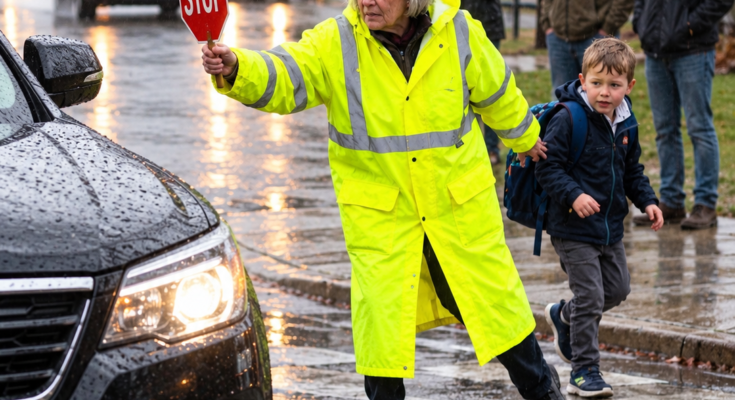
I was standing near the school gate, shivering in my hoodie, waiting for my younger brother to get dismissed. A few yards away, Evelyn Price was adjusting her oversized neon-yellow coat, her small frame practically swallowed by the thick reflective material.
At seventy-three years old, Evelyn wasn’t out on that corner every morning and afternoon because she wanted a hobby. Everyone in our neighborhood knew the truth. After her husband passed away and rent on her modest apartment jumped again, her small Social Security check just couldn’t stretch far enough to cover the basics. So, rain or shine, heatwave or freeze, she put on that heavy coat and held up her red stop sign.
A group of high school kids standing near the bus stop started chuckling.
“Look at her go,” one teenager laughed, mocking her slow, measured limp as she stepped up onto the curb. “She moves in slow motion. I think the sign weighs more than she does.”
Evelyn heard them. I saw the slight tilt of her shoulders, the quick moment where her head dipped toward her chest. But she didn’t say a word. She just straightened her back, adjusted her grip on the metal pole, and kept her eyes fixed on the children walking out of the elementary school doors.
She never complained about the cold, the teenagers, or the aching in her joints. She just smiled at every single child who crossed her street, calling them by name.
Then, in a fraction of a second, the entire afternoon shattered.
A small first-grader in a bright red backpack stepped off the curb, his eyes fixed on a toy in his hands. He took two steps into the crosswalk, completely unaware of the black SUV skidding down the slick asphalt toward him. The driver was looking down at a cell phone, completely missing the flashing yellow lights and the giant painted lines on the road.
The brakes screeched, but the heavy car was sliding fast on the wet pavement.
The teenagers stopped laughing. Everyone froze in pure terror.
Evelyn didn’t hesitate. She didn’t pause to judge the distance, and she certainly didn’t act like a woman with aching knees and a slow walk.
She lunged forward into the streaming rain with a burst of speed that seemed physically impossible for someone her age. She reached the boy a split second before the bumper did, grabbed the back of his heavy raincoat, and violently yanked him backward onto the sidewalk.
The force of her own pull threw Evelyn backward onto the hard concrete curb.
A loud, sickening crack echoed over the sound of the rain as her wrist hit the stone. The SUV finally skidded to a halt just inches from where the boy had been standing a moment before.
Silence fell over the street, broken only by the engine’s idling and the heavy downpour.
The driver scrambled out of the vehicle, white-faced and trembling. Parents rushed over, and the little boy began to cry, entirely unhurt but frightened by the commotion.
Evelyn was sitting in the puddle, clutching her arm to her chest. Her face was pale, and sweat was mixed with the rain pouring down her cheeks, but her eyes weren’t on her wrist.
“Is the boy okay?” she gasped, her voice shaking violently from shock and pain. “Please, someone check on the boy.”
“He’s safe, Miss Evelyn,” a parent shouted, kneeling beside her. “He’s completely fine because of you. But don’t move, your arm—”
“I don’t care about my arm,” she whispered, letting out a ragged breath as the tears finally came. “Just tell me he’s safe.”
The paramedics arrived a few minutes later. Even as they loaded her into the back of the ambulance with a fractured wrist and severe bruising, she reached out her uninjured hand to wave at the frightened kids gathered on the sidewalk, trying to force a reassuring smile through her pain.
I looked over at the bus stop. The teenagers who had been mocking her five minutes earlier were standing in dead silence. The boy who had joked about her slow walk was staring at the red paint on the street, his hands jammed deep into his pockets, his face flushed with pure shame.
Nobody said a word on the ride home.
—
Part Two: The Signs
The next morning, the sky was clear, but the morning air was bitter cold. A substitute guard was standing at the corner with a fresh stop sign.
As I walked up to the intersection, I saw a crowd gathered near the school entrance. Standing right at the edge of the curb were the same four teenagers from the day before.
They weren’t laughing. They weren’t holding phones.
They were holding two large pieces of poster board, carefully protected from the cold wind. Written across the front in big, dark marker were the words: **”Thank you, Miss Evelyn. We are sorry. You are our hero.”**
They stood there in silence for two hours, holding those signs high so every parent, teacher, and student passing by could read them.
Three days later, when Evelyn returned to the corner with a bright pink plaster cast on her left arm, the whole street erupted in applause. The teenagers were the first ones to walk up to her. The boy who had made the joke stepped forward, his head held low.
—
Part Three: The Corner
“I’m sorry,” the boy said. His voice cracked. “I didn’t mean what I said. I was just… I was just being stupid.”
Evelyn looked at him. Then she looked at the other teenagers standing behind him.
“You weren’t being stupid,” she said gently. “You were being thoughtless. There’s a difference.”
The boy nodded. He couldn’t look at her.
“I don’t walk slow because I want to,” Evelyn continued. “I walk slow because my knees hurt. I stand on this corner because I need the money. But I also stand here because I love these kids. Every single one of them. Including you.”
The boy finally looked up.
“Even after what I said?”
Evelyn smiled.
“Honey, I’ve been called worse by better. You’re just a kid. You made a mistake. The question is what you do next.”
The teenager wiped his eyes.
“I want to help,” he said. “Can I help?”
Evelyn pointed toward the crosswalk.
“You can start by holding this sign. My arm’s going to be out of commission for a while.”
The boy took the stop sign. He held it like it was made of gold.
That afternoon, the other teenagers joined him. They took turns helping Evelyn cross children. They walked slower. They paid attention. They stopped laughing.
By the end of the week, the whole town knew the story.
Someone started a fundraiser to help Evelyn with her rent. The local news came out to interview her. The school district gave her a raise. The mayor declared a day in her honor.
But Evelyn didn’t care about any of that.
What she cared about was the boy who had mocked her, now standing beside her every afternoon, holding the sign, learning what it meant to be responsible for someone else.
“What’s your name?” she asked him one day.
“Marcus.”
“Marcus,” she said, “you’re going to be alright.”
He smiled.
“So are you, Miss Evelyn.”
She laughed.
“I know, honey. I always was.”
The corner of Oak Street never changed. The rain still fell. The traffic still rushed. The children still crossed.
But something else changed.
The teenagers stopped mocking. The parents stopped ignoring. The town stopped looking past the woman in the oversized coat.
They saw her.
They saw a hero.
And Evelyn Price, seventy-three years old, with a pink cast on her arm and a smile on her face, kept doing what she had always done.
She showed up.
She kept them safe.
And she never stopped believing that people could change.
Because sometimes, all it takes is a rainy afternoon and a split-second decision to remind a whole town what really matters.
—