Part One
“Please don’t make me find room for one more thing.”
That was what my sister said when she saw the covered baking dish in my hands. Then she leaned against her kitchen counter and started crying so quietly I almost missed it.
Ramona was sixty. I had seen her cry at our mother’s funeral, at her daughter’s wedding, and once when a windstorm took down the cottonwood our father had planted.
I had never seen her cry over a chicken casserole.
“I can put it in the freezer,” I said.
She shook her head. “That’s full, too.”
From the living room, her husband called her name. Not loudly. Just enough to make her straighten up, wipe her cheeks with the heel of her hand, and leave me standing there.
“I’m coming, Dale.”
She said it with the same patience she’d used all her life. But before she reached the doorway, she stopped for a second and closed her eyes.
That was the first thing I should have noticed.
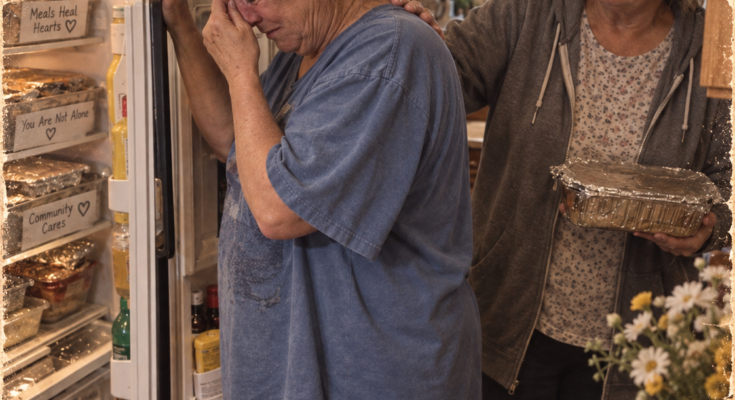
Instead, I noticed the refrigerator.
There were foil pans stacked on glass bowls, plastic containers wedged beside the milk, and a pie balanced on a carton of eggs. Every dish had a little note.
Heating directions. Ingredients. Names written on masking tape so the dishes could find their way home.
People in my sister’s little South Dakota town had been feeding her family ever since Dale’s illness stopped being something the doctors thought they could fix.
It was what we knew how to do.
Somebody got hurt, you browned hamburger. Somebody lost a parent, you baked bread. Somebody’s world fell apart, you found a pan you didn’t need back right away.
There was love in that refrigerator.
There was also enough food for twelve people, and only one woman trying to eat it.
Dale managed a few bites some days. Ramona ate standing at the counter, usually after whatever she’d warmed had gone cold.
Lately, she had stopped opening the door.
That was why I’d come over.
A neighbor had called me that morning, sounding hurt.
“I knocked twice. Her car was there. I could hear the television.”
I told her Ramona was probably helping Dale.
“I know,” she said. Then, after a pause, “I just hope we haven’t done something.”
Someone else wondered whether Ramona disliked the food. Another thought she wanted privacy.
Nobody was being cruel. They were reaching toward her and couldn’t understand why she seemed to be pulling away.
I had wondered, too.
Ramona returned carrying a glass with a bent straw. She rinsed it, filled it halfway, and stood watching the water run long after she’d moved the glass away.
“Are you mad at everybody?” I asked.
She turned off the faucet.
“What?”
“The meals. The knocking. People think maybe you want them to stop.”
She looked at the dish I’d brought. Then she opened the refrigerator all the way.
“I don’t know how to explain it without sounding awful.”
“Try me.”
She touched a piece of masking tape with somebody’s careful handwriting on it.
“Everybody says the same thing.”
“What thing?”
She swallowed.
“‘We won’t stay.'”
I waited.
“They hand me something and say, ‘We won’t stay. You’ve got enough on your plate.’ Or, ‘We won’t keep you.’ Sometimes they’re already halfway down the steps before I can think of what to say.”
Her face crumpled.
“And I want them to stay.”
I put my casserole on the counter.
Ramona had worked as a home health aide for twenty-three years. Even now, she took two short morning shifts each week while I sat with Dale.
She knew which of her clients liked their curtains open and who needed a few minutes of conversation before they were ready to get dressed. She remembered birthdays. She listened to the same stories without announcing she’d heard them before.
Then she came home.
There were towels to wash, calls to return, sheets to change, and a husband she loved who could no longer get comfortable in the chair he’d picked out himself.
“I talk to people all morning,” she said. “Then some evenings I realize I haven’t said anything here except asking him what he needs.”
She looked toward the living room.
“He’s still Dale. I love being with him. But I miss somebody asking me something I don’t have to figure out.”
I thought about my own visits.
I dropped things off. Picked things up. Asked what needed doing.
I called myself helpful, and I was.
But I couldn’t remember the last time I had taken off my coat.
“Why didn’t you tell me?” I asked.
She gave a small, embarrassed laugh.
“Because everybody’s being so nice.”
That answer hurt more than if she’d blamed me.
I took off my coat and hung it over a kitchen chair.
“Can I stay a while?”
She nodded, pressing her lips together.
We didn’t have a big conversation. I folded towels while she sat at the table. She told me the washing machine was making that noise again, and that Dale had dreamed about his old fishing boat.
Then she told me she was scared to go out to the mailbox some days because she didn’t want him calling for her and getting no answer.
I listened.
Before I left, I asked whether I could tell a few people what she’d told me.
“Don’t make me sound ungrateful,” she said.
“I won’t.”
—
Part Two
The next morning, I called four neighbors.
I didn’t explain everything. I just said Ramona loved the food but what she really needed was company. I told them to come in, sit down, and stay a while. I asked them to take their coats off before they knocked.
That afternoon, Helen from across the street showed up with a loaf of banana bread. When Ramona opened the door, Helen didn’t hand it over and hurry away. She stepped inside, set the bread on the counter, and asked if Ramona had time for a cup of coffee.
Ramona almost said no. I could see it in her face.
Then she looked at me. I nodded.
“Sure,” she said. “I’ve got time.”
They sat at the kitchen table for an hour. Helen talked about her grandson’s baseball game. Ramona talked about Dale’s fishing boat dream. Neither of them mentioned casseroles.
When Helen left, she hugged Ramona at the door. Not a quick, polite hug. A real one.
Ramona stood in the doorway for a long time after the car pulled away.
The next day, two more neighbors came. They didn’t bring food. They brought themselves. One of them asked Ramona about her garden. The other offered to sit with Dale for an afternoon so Ramona could take a walk.
By the end of the week, the refrigerator was still full. But Ramona had stopped avoiding the door.
—
Part Three
Dale passed away in the spring. It was peaceful. Ramona was holding his hand, and I was sitting in the chair beside her, and the room was quiet except for the sound of the birds outside the window.
At the funeral, the church was packed. Not just with family, but with neighbors. People who had brought casseroles and stayed to eat them. People who had learned to take off their coats.
After the service, Ramona stood in the fellowship hall, surrounded by friends. She wasn’t crying. She was listening.
“Tell me about the boat,” someone said.
And she did. She told the story about Dale’s old fishing boat, the one he’d dreamed about, the one he’d taken out on the lake every summer before he got sick. She told it slowly, and everyone listened.
Later, when the crowd thinned, she found me by the coffee table.
“Thank you,” she said.
“For what?”
“For telling me to take off my coat.”
I laughed. “I didn’t tell you that. You told me.”
She shook her head. “You showed me.”
We stood there for a moment, watching people gather their dishes and say their goodbyes.
“You know,” she said, “I still have too much food in my refrigerator.”
“You want me to help you clean it out?”
“No.” She smiled. “I want you to help me eat it. Come over Sunday. Bring whoever wants to come.”
I did.
The following Sunday, six of us sat around Ramona’s kitchen table. We ate chicken casserole and banana bread and a pie that someone had frozen three months earlier. We talked about Dale. We talked about the weather. We talked about nothing important at all.
Ramona laughed twice. Real laughs, the kind I hadn’t heard in years.
When I left that evening, she walked me to the door.
“Same time next week?” I asked.
She nodded. “Same time next week.”
I put on my coat and stepped outside. The air was cold, but the lights in Ramona’s kitchen were warm behind me.
I thought about all those casseroles. All that love, delivered and left at the door.
It wasn’t wasted. It was just waiting for someone to stay.
Sometimes the best thing you can give someone isn’t a meal.
It’s a chair at the table.
It’s a question that doesn’t need an answer.
It’s taking off your coat and saying, “I’m not going anywhere.”
—