Part One
“We’re done. He breaks everything. He’s your problem now.”
The woman slammed a crumpled piece of paper onto the triage desk, turned on her heel, and marched out the emergency room doors into the freezing night. She didn’t even look back at the nine-year-old boy shivering in the plastic waiting chair.
The paper was a medical release form. The boy, Leo, had just been abandoned by his fifth foster family.
The emergency room at 2 AM is a sensory nightmare. The harsh fluorescent lights buzzed loudly, sirens blared outside, and medical carts crashed against the walls. For anyone, it’s stressful. For a child with severe autism and sensory processing issues, it’s sheer torture.
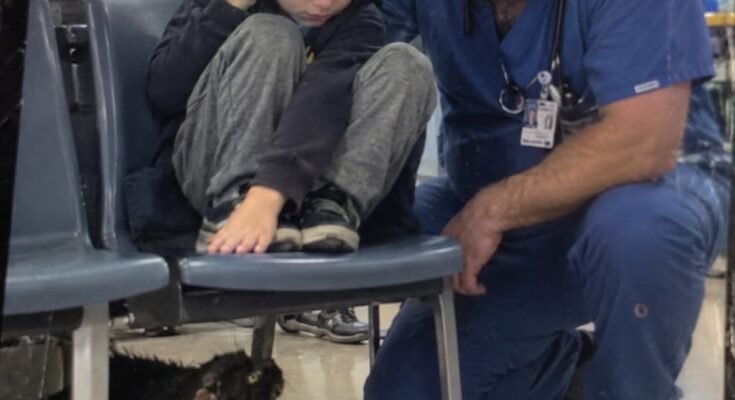
Leo pulled his knees tightly to his chest. He clamped his hands over his ears, rocking violently back and forth. Then, he started to scream—a raw, panicked sound of a terrified kid whose brain was completely overloaded.
I’m Arthur, the night-shift charge nurse. I’m a big guy with a thick beard and eyes that always look tired from seeing too much trauma. People think I’m intimidating. But looking at this little boy, my heart just shattered.
Security guards were already walking over, looking annoyed. They treated his panic attack like a disruption that needed to be silenced. I held my hands up, rushing over to stop them. But before I could reach him, the hospital doors burst open again.
Two animal control officers ran in, holding heavy-duty capture nets. Slipping wildly on the polished floor ahead of them was the hospital’s infamous “parking lot monster.”
He was a massive, feral black cat with a torn ear and patches of missing fur. He had survived behind the dumpsters for years, completely untouchable and fiercely aggressive. Tonight, he was cornered, terrified, and looking for a place to hide.
The massive cat darted under the row of plastic chairs, pressing his back against the wall. He ended up directly underneath the exact chair where Leo was sitting and screaming.
The entire waiting room froze. The guards backed away. We all thought the same terrifying thing: this frightened, cornered wild animal was going to lash out at the thrashing child. I braced myself to dive in and take the scratches.
But then, the impossible happened.
Leo stopped screaming. He slowly uncovered his ears and looked down into the shadows. The giant, scarred cat looked up, his ears pinned flat, teeth bared in a silent hiss.
Leo didn’t pull away. He simply reached his small, trembling hand down into the dark.
Someone in the waiting room gasped. An officer yelled at the boy to stop.
But Leo kept reaching—and what that feral cat did next made every person in the ER go completely silent.
—
Part Two
The cat didn’t bite.
He didn’t scratch.
He sniffed Leo’s fingers once, twice. Then, slowly, he pressed his scarred forehead into the boy’s palm.
Leo’s whole body relaxed. The rocking stopped. The screaming stopped. He slid off the chair onto the floor, sat cross-legged beside the dumpster cat, and began to stroke his torn ear with a gentleness that made my chest ache.
The cat closed his eyes. He started to purr—a deep, rumbling sound that seemed impossible from such a battered creature.
I knelt down a few feet away, not wanting to break the spell.
“Hey, buddy,” I said softly. “What’s your name?”
Leo didn’t answer. He just kept stroking the cat.
The animal control officers approached cautiously. “Sir, we need to take that animal. He’s dangerous.”
I looked at the cat. He was pressed against Leo’s side, his tail curled around the boy’s leg. Leo had stopped trembling for the first time since he’d been abandoned.
“Dangerous to who?” I asked.
The officer opened his mouth, then closed it.
I stood up and faced him. “That cat has been living behind our dumpsters for three years. He’s never let anyone near him. Tonight, a terrified little boy reached out, and that animal chose to trust him.” I crossed my arms. “You’re not taking him anywhere.”
—
Part Three
The hospital administrator was called. The social worker returned, furious and demanding Leo be placed in emergency foster care. But Leo wouldn’t move. He had wrapped himself around the cat, and the cat had wrapped himself around Leo.
I made a decision.
I took Leo home that night. Just temporarily, I told them. Just until we could find a proper placement.
I lived alone in a small apartment near the hospital. I had no kids, no pets, no experience with either. But I had a quiet living room and a spare bedroom and a deep, stubborn belief that this boy deserved better than what he had been given.
The cat came with us. I named him Biscuit, because he was the color of burnt toast and because Leo smiled when I said it.
The first week was hard. Leo had meltdowns. Biscuit hid under the couch. I burned dinner twice and questioned every choice I had ever made.
But slowly, things changed.
Biscuit started sleeping on Leo’s bed. Leo started eating at the table. I learned which sounds bothered him and which foods he would actually eat. I learned that when Leo couldn’t speak, Biscuit seemed to understand anyway.
I enrolled Leo in a school with a proper special education program. I fought with the state for custody. I hired a lawyer. I showed up to every meeting with a folder full of notes and a photo of Leo and Biscuit curled up together on my couch.
It took eleven months.
On the day the judge signed the adoption papers, Leo looked at me and said my name for the first time.
“Arthur,” he whispered.
I cried in the parking lot for twenty minutes.
Biscuit died two years later. He was old, and the streets had taken their toll. Leo sat with him at the end, stroking his torn ear, whispering something I couldn’t hear.
We buried him in the backyard beneath a small tree. Leo planted flowers around the grave.
“He was like me,” Leo said quietly. “Scared. Alone. But he found me.”
I put my arm around him.
“No,” I said. “You found each other.”
Leo is nineteen now. He works at an animal shelter. He’s adopted three cats, two dogs, and a rabbit. He still doesn’t talk much, but when he does, people listen.
And every night, before he goes to sleep, he looks at a photo on his nightstand.
It’s a picture of a nine-year-old boy sitting on a hospital floor, his hand resting on the head of a massive, scarred, purring cat.
Sometimes the most broken things are the ones that heal us.
Sometimes the monsters are just looking for someone to trust.
And sometimes, the best family is the one you find in the darkest moment.
—