Part One
“Put it back on the counter, son.”
Fifteen-year-old Noah froze near the front door, one hand still buried inside his winter coat.
Russell Tate had worked behind the counter of that little northern Michigan hardware store for nearly twenty years. At sixty-four, he knew the sound of loose screws rolling across a floor, the smell of a burned-out motor, and the nervous look of someone hoping not to be noticed.
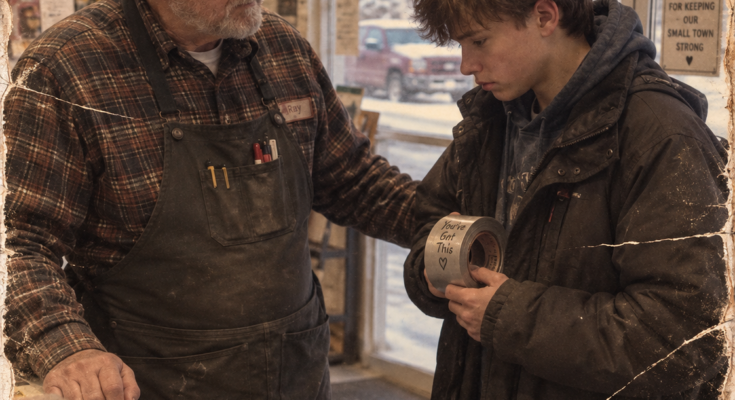
Noah slowly pulled out a roll of silver furnace tape.
His face went red.
“I’m sorry,” he whispered.
Russell looked toward the windows. Snow was falling hard outside, collecting against the curb in dirty white ridges.
“You got money for that?”
Noah shook his head.
“Then why were you taking it?”
For a few seconds, the boy said nothing.
Then his chin started trembling.
“Our furnace pipe came loose.”
Russell’s expression changed.
Noah stared at the floor.
“My mom tried to tape it with regular tape, but it melted. She said we have to wait until Friday to buy the right stuff.”
“Friday?”
“It’s Tuesday.”
Russell glanced again at the snow.
That week, nighttime temperatures had been dropping below freezing.
“Your dad around?”
Noah shook his head.
“Just my mom and my little sister.”
Russell had every right to call the police.
The store owner had made the policy clear. Theft was theft.
But Russell also remembered being fourteen and watching his own father stretch one paycheck across a family of six.
He remembered winters when they closed off half the house to save heating oil.
He remembered his mother warming socks on the oven door before sending the kids to school.
Some memories never really leave you.
They just wait for another cold day.
Russell picked up the furnace tape.
“How much is this?”
Noah looked confused.
“Eight dollars and forty-nine cents.”
Russell nodded toward the stockroom.
“You know how to use a broom?”
Noah blinked.
“Yes, sir.”
“Good. Then you’ve got money.”
Noah stared at him.
Russell pointed toward the back.
“You sweep the stockroom after school tomorrow. You can pay me with forty-five minutes of work.”
The boy looked like he wasn’t sure whether this was a trick.
“You’re not calling anybody?”
“Depends.”
“On what?”
“How well you sweep.”
For the first time, Noah smiled.
Russell handed him the furnace tape.
Then he grabbed another roll from the shelf.
“Take two.”
“I can’t pay for two.”
“You can stack the paint cans, too.”
—
Part Two
The next afternoon, Noah showed up at 3:37 wearing the same thin coat.
Russell had expected him to disappear.
Instead, the boy stood by the register and asked, “Where’s the broom?”
He swept the stockroom.
Then he stacked the paint cans.
Then, without being asked, he broke down cardboard boxes and carried them to the recycling bin.
Russell looked at the clock.
“You’re twenty minutes over.”
Noah shrugged.
“My mom said if somebody gives you a chance, don’t make them regret it.”
Russell pretended to inspect a shelf so the kid wouldn’t see his smile.
“Your mother sounds smart.”
“She is.”
The next day, Noah came back.
He didn’t need anything.
He just asked whether Russell needed help.
Russell found him a box of loose washers that needed sorting.
The day after that, Noah returned again.
Soon, 3:30 became Russell’s favorite part of the day.
Before Noah, Russell’s afternoons had been quiet.
All three of his children had moved away years earlier—one to Arizona, one to North Carolina, one to Washington state.
They called.
They visited when they could.
But the house Russell returned to every evening was still empty.
Dinner was usually soup from a can, a sandwich over the sink, or whatever could be reheated without making too many dishes.
At work, he had customers.
At home, he had silence.
Then Noah started showing up.
Russell taught him how to replace a faucet washer.
How to find a stud in a wall.
How to shut off water before turning a small problem into a flooded floor.
Noah listened carefully, asked good questions, and remembered what he was told.
By the end of the second week, Russell had started paying him.
Not much—minimum wage under the table, a few hours a week.
But Noah’s face when he received his first envelope was something Russell would remember for the rest of his life.
“Can I ask you something?” Noah said one afternoon.
“Shoot.”
“Why didn’t you call the police? That first day. When you caught me.”
Russell set down his coffee.
“Because I’ve been hungry before,” he said. “And I’ve been cold. And I know what it feels like when nobody gives you a chance.”
Noah nodded slowly.
“Thank you,” he said. “For the chance.”
Russell just nodded and went back to work.
But something in his chest had loosened.
Something that had been tight for a long time.
—
Part Three
Two months later, Russell pulled into his driveway after work and found Noah sitting on his front porch.
The boy was holding a covered dish.
“My mom made you dinner,” Noah said, standing up. “She wanted to say thank you.”
Russell looked at the dish.
“You told her?”
“I had to.” Noah shrugged. “She noticed the tape on the furnace. And the extra money I brought home. She said we don’t keep secrets from each other.”
Russell took the dish carefully.
“Your mom out in the car?”
Noah shook his head.
“She’s working. But she said to tell you that you saved us. Not just the furnace. Everything.”
Russell’s throat tightened.
He invited Noah inside. They ate the casserole together at Russell’s small kitchen table—the first real meal Russell had shared with anyone in months.
Noah talked about school. About his little sister, who was learning to read. About his mom, who had picked up a second job and was slowly climbing out of the hole they had fallen into.
Russell listened.
For the first time in years, his house didn’t feel empty.
Spring came. Noah kept working at the hardware store after school. Russell taught him how to fix a lawnmower, how to patch a hole in drywall, how to read a tape measure without squinting.
By summer, Noah could handle the register. By fall, he could answer most customer questions without asking for help.
The store owner noticed. He asked Russell where he had found the kid.
Russell just smiled.
“I didn’t find him,” he said. “He found me.”
Noah graduated high school three years later. He didn’t go to college right away—he couldn’t afford to—but he kept working. He saved. He helped his mom. He made sure his sister never had to wear a thin coat in winter.
And every holiday, he showed up at Russell’s door with a dish his mother had made.
Russell never had grandchildren.
But he had Noah.
And that was enough.
Years later, when Russell finally retired, Noah took over his job at the hardware store. He had learned everything Russell could teach him. He knew the inventory. He knew the customers. He knew which drawer held the furnace tape.
But more than that—he knew what it meant to give someone a chance.
On Russell’s last day, Noah walked him to the door.
“I don’t know how to thank you,” Noah said.
Russell shook his head.
“You already did. You showed up the next day. That’s all I ever needed.”
They shook hands. Noah didn’t let go right away.
“I’m going to do what you did,” he said. “If I ever catch a kid stealing something they need, I’m going to give them a broom.”
Russell laughed.
“Just make sure they take two rolls of tape.”
Noah grinned.
“I will.”
Russell walked out into the sunlight. He got in his truck and sat there for a long moment, watching the store.
Then he drove home.
The house was quiet when he arrived. It was still the same small house he had lived in for forty years. But it didn’t feel empty anymore.
Because someone was going to call him that evening.
Someone was going to ask how his day was.
Someone was going to say, “Thanks, Russell. For everything.”
And that, he realized, was all he had ever really needed.
A chance to be useful.
A chance to be remembered.
A chance to make sure that when a cold wind blew, somebody was warm.
—