Part One
“Excuse me, but you need to remove the animal. It’s upsetting the other guests.”
The manager wouldn’t even look me in the eye. He just pointed awkwardly at the large table next to ours.
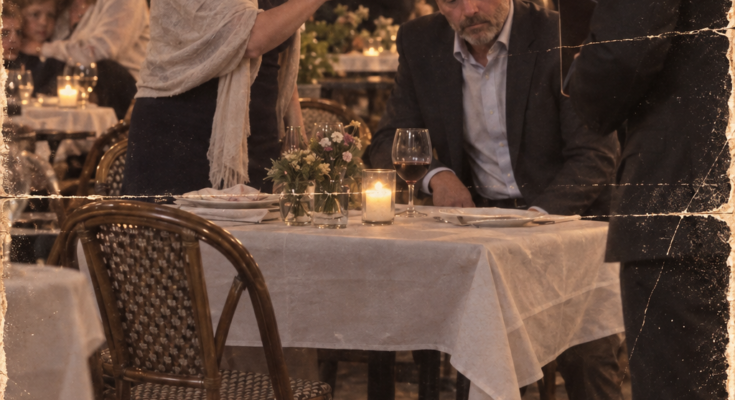
It was our fifteenth wedding anniversary. My husband Arthur and I were sitting on the beautiful outdoor patio of a fancy French bistro downtown. It was the first time in over a year we had saved enough money for a real night out.
Underneath our table was Barnaby. He’s a Golden Retriever, and he was wearing his bright red, official therapy dog vest.
But Barnaby doesn’t look like the pristine dogs you see in commercials. He is missing his left eye, has a jagged scar running down his snout, and walks with a heavy limp.
I looked over at the table the manager had pointed to. A woman in a silk blouse was practically shielding her kids’ eyes.
She made a theatrical face of pure disgust. She whispered furiously to her husband while pointing her manicured finger at my sweet, quiet dog.
Arthur didn’t argue. He never does. He just looked down, his shoulders slumping like he suddenly carried the weight of the entire world.
“I’m so sorry for the trouble,” my husband whispered. He reached under the table to clip the leash onto Barnaby’s collar.
Arthur looked at me with this defeated, tired smile. It’s the exact same smile he wears when he spends his entire weekend grading papers for students the system has given up on.
He started to push his chair back. He was actually going to take our long-awaited anniversary dinner in soggy takeout boxes just to appease a stranger.
That was the exact moment something inside me completely snapped.
“Sit down, Arthur,” I said. My voice wasn’t loud, but it was hard as stone.
Arthur froze halfway out of his chair. “Honey, it’s fine,” he murmured softly. “Let’s just go home.”
“No. Sit down.” I stood up. My heavy metal chair scraped loudly against the stone floor, echoing across the patio.
I turned completely away from my husband and faced the manager. Then, I locked eyes directly with the woman in the silk blouse.
The patio was packed with dozens of people enjoying expensive wine and steaks. I didn’t care who heard me.
“You’re asking us to leave,” I projected my voice clearly across the suddenly quiet tables, “because this family is uncomfortable looking at my husband’s dog.”
“His name is Barnaby,” I announced to the silent restaurant. “And let me tell you exactly who you are trying to kick out.”
I pointed straight at Arthur. “This man wakes up at five in the morning every single day. He drives forty-five minutes to a public school in the poorest district in the state.”
“He is a Special Education teacher. He works sixty hours a week and brings home a paycheck so small that we had to save for four months just to afford this one meal.”
The manager opened his mouth to interrupt. I cut him off instantly.
“I am not finished!” I stared directly at the complaining woman. Her fork was now frozen in mid-air.
I walked around our table and knelt down on the hard stone next to Barnaby. The golden retriever immediately leaned his scarred head against my knee.
“This dog that you think is too ugly to sit near? Let me tell you exactly how he got those scars.”
“Four years ago, Barnaby belonged to a man who kept him chained to a pole in a dirt yard. One day, an aggressive dog broke loose and went straight for a four-year-old boy.”
“Barnaby snapped his own collar in half. He threw his body right between the attacking dog and that screaming little boy.”
“He took the bites meant for a child. He lost his eye. He was nearly torn apart to save a life.”
The patio was dead silent. You could hear the distant traffic, but nothing else. Waiters stood frozen like statues.
After that, nobody wanted him. He was scheduled to be put down. But Arthur adopted him—and what happened next was the part no one on that patio was ready to hear.
—
Part Two
“Arthur brought Barnaby home the day before the shelter was going to euthanize him,” I said. “He didn’t care about the scars. He didn’t care about the limp. He saw a hero who deserved a second chance.”
I stood up and placed my hand on Arthur’s shoulder.
“But here’s what none of you know. Arthur doesn’t just teach special education. He teaches children who have been abandoned, abused, and forgotten. Kids the system has labeled as lost causes. Kids nobody else will fight for.”
“Three years ago, Arthur had a student named Marcus. Marcus hadn’t spoken a single word in two years. Not to his parents. Not to doctors. Not to anyone.”
“Arthur brought Barnaby to school every day. Barnaby would sit beside Marcus during lessons. During meltdowns. During the quiet moments when Marcus would hide under his desk and refuse to come out.”
“One afternoon, Marcus was having the worst day anyone had ever seen. He was screaming, throwing things, completely inconsolable. Arthur couldn’t reach him. Nobody could.”
“Barnaby walked over, laid down beside him, and put his scarred head in Marcus’s lap.”
“For the first time in two years, Marcus spoke. He looked at Barnaby and said four words.”
I paused. The entire patio was leaning forward.
“He said, ‘You’re ugly like me.'”
I let that hang in the air.
“Marcus saw himself in Barnaby. He saw someone who had been hurt, who had been discarded, who had been told he wasn’t good enough. And in that moment, he realized that if Barnaby could survive, maybe he could too.”
“That dog you want removed? He is the reason Marcus speaks now. He is the reason Marcus is in a mainstream classroom. He is the reason a little boy who had given up on the world decided to try again.”
I turned to face the woman in the silk blouse directly.
“So no. I will not remove my husband’s therapy dog. And if you have a problem with that, you can take it up with every child whose life this animal has saved.”
The woman’s face had gone pale. Her husband was staring at his plate. Their children were looking at Barnaby with wide, curious eyes.
The manager cleared his throat. “Ma’am, I—”
“Don’t,” I said. “Just don’t.”
I sat back down and picked up my menu. Arthur was staring at me like he’d never seen me before.
“What?” I asked.
He just shook his head slowly, a real smile spreading across his face for the first time all evening.
—
Part Three
For a long moment, nobody moved.
Then, something unexpected happened.
A man at a nearby table—mid-fifties, expensive suit, silver watch—stood up. He didn’t say anything. He simply walked over to our table, pulled out a chair, and sat down uninvited.
“I’m a pediatric surgeon,” he said quietly. “I’ve spent twenty years working with children who have been abused. Kids who have been told they’re worthless.” He looked down at Barnaby, who thumped his tail weakly against the stone floor.
“I’ve heard a lot of stories in my life,” the surgeon continued. “But that one matters.”
He signaled to the waiter. “Their dinner is on me. Whatever they want.”
Before I could respond, another person stood—a woman in her sixties with silver hair and kind eyes. She walked over and placed a gentle hand on my shoulder.
“My grandson is autistic,” she said. “His service dog changed everything for him.” She glared at the woman in the silk blouse. “Some people don’t understand what these animals do for us.”
One by one, other diners stood. A young couple across the patio. An elderly man near the railing. A group of college students in the corner.
The woman in the silk blouse grabbed her purse and stormed toward the exit. Her husband followed, his face red. Their children trailed behind, one of them glancing back at Barnaby with something like wonder.
The manager, visibly flustered, apologized repeatedly. He offered us free dessert. He offered to comp our entire meal. He asked if there was anything else he could do.
“Just do better,” Arthur said quietly. It was the first thing he had said since I stood up.
The manager nodded and disappeared inside.
We ate our dinner slowly. The surgeon stayed at our table for a while, telling us about his work. The silver-haired woman sent over a glass of wine. The college students asked if they could pet Barnaby. He thumped his tail and licked their hands.
That night, as we walked to our car, Arthur stopped and pulled me close.
“I don’t deserve you,” he said.
“You deserve everything,” I answered. “You and Barnaby both.”
He laughed—a real laugh, the kind I hadn’t heard in months.
Barnaby limped beside us, his red vest still on, his one good eye bright in the streetlights.
We never went back to that bistro. But the owner sent us a letter two weeks later. The manager had been replaced. The woman in the silk blouse had written a formal complaint and demanded the restaurant ban all dogs permanently. The owner refused.
Instead, he had a new sign installed on the patio door.
It read: *Therapy dogs welcome. Heroes always are.*
Sometimes the world tries to tell you that kindness is weakness. That scars are ugly. That the broken things should be hidden away.
But the truth is this: scars tell stories. The broken things are often the bravest. And sometimes, the best way to fight back is to stand up, speak loudly, and refuse to leave.
Barnaby never lost his limp. He never grew his eye back. But every day, he wore that red vest with pride.
And every day, he reminded us that love—real love—doesn’t care what you look like on the outside.
It only cares what you’re willing to do for someone else.
—