Part 1: The Sale
Caleb Rourke stood in the empty milking stall with one hand resting on a gate that no longer needed to be closed. For the first time in forty-three years, there wasn’t a single cow in his barn. He could still hear the livestock trailer rattling down the frozen road. And even though he was sixty-seven years old, Caleb lowered his head against the wooden post and cried.
The cow he’d just sold wasn’t worth much by dairy-farm standards. But Daisy had been the last animal his wife, Ellen, had raised herself. She’d bottle-fed Daisy as a calf in their Wisconsin kitchen after the little animal nearly froze during a February storm. For twelve years, Ellen joked that Daisy thought she was part dog.
“She’d come inside if you’d let her,” Ellen used to say. Caleb would pretend to complain. But every evening, he watched his wife scratch that cow between the ears like she was greeting an old friend.
Then Ellen got sick. At first, they thought it would be a few appointments and some treatment. Instead, their calendar slowly filled with hospital visits, long drives, prescriptions, and days when Caleb milked before sunrise, drove Ellen to treatment, then came home after dark and started chores all over again.
Ellen apologized constantly. That bothered Caleb more than anything. “You didn’t choose this,” he’d tell her. Still, she worried about the farm. She worried about the bills. Mostly, she worried about him.
One evening, sitting beneath an old quilt on the porch, Ellen looked toward the barn and said, “Promise me you won’t work yourself into the ground just because I’m gone.” Caleb frowned. “You’re not going anywhere.” She smiled the way people sometimes smile when they know something you aren’t ready to admit. “Promise me anyway.” He never answered.
Three months later, Caleb buried his wife of forty-one years. After the funeral, everyone told him to call if he needed anything. Neighbors brought casseroles. Friends stacked firewood. People from town sent cards. Then life moved forward, as life always does.
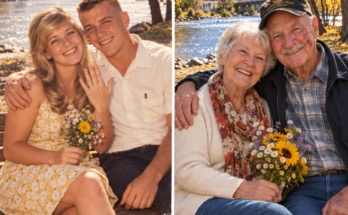
Caleb stayed on the farm. He told himself that keeping it alive meant keeping some part of Ellen alive too. Every morning at 4:45, he pulled on his old coat and walked through the dark toward the barn. Every evening, he ate alone at the kitchen table beneath the clock Ellen had bought at a yard sale thirty years earlier. He still kept her coffee mug beside his. He knew it didn’t make sense. He kept it there anyway.
Then came the winter that nearly finished him. The temperature stayed below zero for days. A water line froze. The tractor needed repairs. Feed prices climbed. Two cows got sick. Then an envelope arrived informing Caleb that he was months behind on his mortgage. There were medical bills too. Stacks of them. Some nights he sat at the table with a calculator, moving the same numbers around as if different arithmetic might create money that wasn’t there. It never did.
Part 2: The Morning After
Caleb sold equipment first. Then several cows. Then almost everything else of value. Finally, there was Daisy.
The livestock buyer looked at the old cow, then at Caleb. “You sure about this?” Caleb rubbed his jaw. “No.” The man waited. Caleb looked toward the farmhouse window. For half a second, he could almost see Ellen standing there in her blue sweater, holding a coffee cup. Then the image disappeared. “But take her.”
The buyer handed him the check. Caleb couldn’t look at it. He walked Daisy to the trailer himself. Before closing the gate, he rubbed the white patch on her forehead. “I’m sorry, girl.” Daisy nudged his coat pocket, searching for the treats Ellen used to carry. Caleb turned away.
That night, he didn’t eat dinner. He sat in Ellen’s chair until nearly midnight. At some point, he whispered into the empty kitchen, “I tried.”
The next morning, Caleb woke to engines. Lots of them. At first, he thought there’d been an accident. He pulled on his boots and stepped onto the porch. Then he stopped.
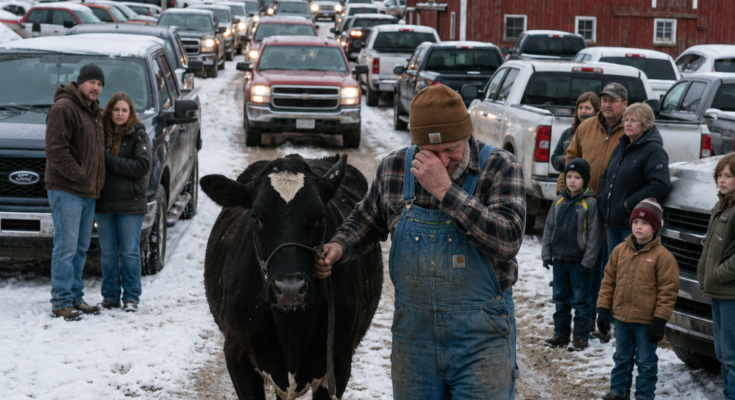
Pickup trucks filled his driveway. Red ones. White ones. Rusty ones. New ones. Some had farm plates. Some had children’s sports stickers on the windows. Some Caleb didn’t recognize at all. There had to be forty of them.
Men, women, teenagers, and children climbed out. His neighbor, Wade Mercer, walked toward the porch carrying a thermos. Behind him came a woman Caleb vaguely remembered from town. Then a man who had bought milk from the Rourkes twenty years ago. Then another family. And another.
Caleb stared. “What happened?” Wade took off his cap. “Nothing happened.” “Then why are you all here?” Wade looked back toward the road. Another truck was pulling in. “You sold Daisy yesterday.” Caleb’s face tightened. “That isn’t anybody’s business.” “Maybe not.” Wade handed him the thermos. “But Ellen made people her business for forty years.”
Caleb said nothing. Then someone shouted from the end of the driveway. A livestock trailer appeared. Caleb froze. The trailer backed slowly toward the barn. When the gate opened, Daisy stepped out.
For several seconds, Caleb didn’t move. The old cow looked around, then walked straight toward him. Someone laughed softly. A little boy clapped. Caleb covered his mouth. “What did you people do?”
A woman stepped forward. Her name was Teresa. As a girl, she’d visited the Rourke farm with her fourth-grade class. “I don’t know if you remember me,” she said. Caleb shook his head. “You let me bottle-feed a calf on a field trip thirty-two years ago.” Teresa smiled through tears. “I went home and told my dad I wanted to be a farmer.” People laughed. “I didn’t become one. But I’ve never forgotten this place.”
Part 3: The Reckoning
Then others began talking. One man said Ellen had brought groceries when his father lost his job. A retired teacher remembered Caleb repairing the school’s old utility trailer and refusing payment. A mother said Ellen had let her children visit the newborn calves during the hardest year of her divorce. A former farmhand said Caleb had once paid him for two weeks of work after an injury even though he’d only worked three days.
Caleb looked from face to face. He remembered pieces of those moments. Most of them had seemed small at the time. Things neighbors did. Things decent people did. Things that didn’t need keeping score.
Then Wade handed Caleb an envelope. Caleb opened it. Inside was a cashier’s check. He looked at the number. Then he looked again. His knees nearly gave out. It was enough to cover his overdue mortgage payments. And then some.
“No.” His voice cracked. “I can’t take this.” Wade shrugged. “Too late.” “You don’t understand.” “We understand perfectly.” Caleb shook his head. “I spent my whole life handling my own problems.” An elderly man near the barn called out, “So did the rest of us.” Then he smiled. “Didn’t stop you and Ellen from helping when we needed it.”
Caleb looked down at the check. His hands were shaking. For years, he’d believed strength meant carrying things without complaining. Bad harvests. Sickness. Debt. Grief. Loneliness. You woke up. You worked. You endured. That was how his father had lived. That was how farmers survived.
But standing there among forty pickup trucks, Caleb finally understood something Ellen had probably known all along. There is a difference between being strong and being alone.
Caleb sat down on the barn step. Daisy walked over and pushed her nose against his shoulder. That broke him. He cried openly. Nobody looked away. Wade sat beside him. A few others followed. Someone poured coffee. Children wandered toward the barn. And for the first time since Ellen’s funeral, the farm didn’t feel empty.
Later that afternoon, after most of the trucks had gone, Caleb found a folded note tucked inside the envelope. It had been written by one of the children who’d visited the farm years earlier. Caleb never learned which one. It said: “Mr. Rourke, you probably don’t remember all the people you helped. But they remember you.”
Caleb taped that note above his kitchen sink. Right beside a photograph of Ellen holding Daisy as a calf. The farm never became wealthy. Caleb never wanted it to. He kept enough cows to stay busy, rented part of his land to a younger farmer, and finally learned to ask for help when the tractor broke or winter became too much.
Every February, he invited local families to the barn for coffee, hot chocolate, and pancakes. He called it Ellen’s Day. When people asked why, Caleb would smile toward Daisy’s old stall. “My wife spent her life teaching me something I was too stubborn to learn.”
Then he’d say the lesson plainly. “We think the good we do disappears after the moment passes.” He would shake his head. “It doesn’t. Sometimes it waits quietly in other people’s hearts until the day we need it returned.”
Because a strong community isn’t made by people who never need help. It’s made by people who remember who helped them. And sometimes, when one person’s strength finally runs out, forty pickup trucks show up to carry the rest.
Caleb lived another fifteen years. Every morning, he walked to the barn and greeted Daisy, who had grown old and slow. Every evening, he sat at the kitchen table, looking at the note above the sink.
And he never forgot what forty trucks had taught him: that the love we give never truly leaves us. It stays. It waits. And when we need it most, it comes back to us—sometimes in the form of neighbors, friends, and strangers who remember our kindness.
The farm is still there. The cows are still there. And every spring, when the calves are born, Caleb’s grandchildren run to the barn to see them, just like their grandmother used to do. ❤️