
Part 1: The Cookie Ghost
“Are you the girl who brought Henry Porter cookies?”
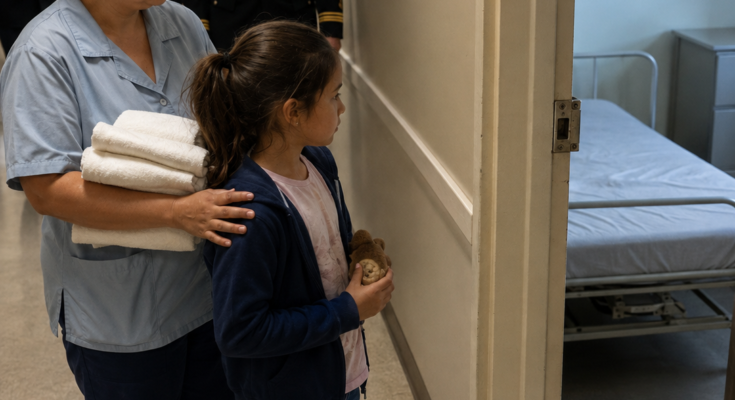
Emma Carter could not answer. She stood in the doorway of Room 214 with a wax paper bag squeezed in both hands. Inside was one oatmeal raisin cookie, a little bent at the edge from being carried in her backpack all day. But the man she had brought it for was gone. The bed was empty. Not just empty. Stripped. The thin white blanket was gone. The sheets were gone. The lumpy pillow Mr. Hank always complained about was gone. Only the pale plastic mattress remained, bare and cold under the hospital lights.
Emma’s sneakers squeaked as she stepped into the room. “Mr. Hank?” she whispered. No answer. No cough. No grumble. No rough voice saying, “You’re late, Cookie Ghost.” The room smelled like floor wax, lemon cleaner, and something too quiet.
“Emma Carter, what are you doing in there?” Emma jumped. Her mother stood in the doorway, holding a stack of clean sheets against her chest. Mary Carter wore the light blue housekeeping uniform from Riverside Veterans Medical Center. Her hair was pinned back so tight it made her face look sharper than it really was. She looked tired. She always looked tired now.
“I told you not to bother patients,” Mary said. Her voice was low, but Emma heard the fear under it. “I wasn’t bothering him,” Emma said. “I brought him his cookie.” Mary looked at the empty bed. Her face softened, then folded. “Oh, baby.” “Did he go home?” Mary did not answer right away. She set the sheets on the rolling cart in the hallway. Her red hands gripped the metal handle.
“Mr. Porter was very old,” she said carefully. “And very sick.” Emma stared at the mattress. “But he was here yesterday.” “I know.” “He traded me.” Mary frowned. “Traded you?” Emma opened her palm. A heavy coin rested there. It was not a quarter. It had an eagle on one side and a worn emblem on the other. “He said it was junk,” Emma said. “But he said I could have it for the cookies.”
Mary’s lips parted. Before she could speak, a new sound came from the end of the hallway. Hard. Sharp. Heavy. Not the squeak of nurses’ shoes. Not the soft shuffle of old men in slippers. Boots. Polished boots striking the tile in perfect rhythm. Mary pulled Emma close, one hand on her shoulder. The hallway seemed to stop breathing.
Part 2: The General
A nurse froze beside a medication cart. An orderly stopped with his mop halfway across the floor. Mr. Calder, the hospital administrator, appeared first. He was a small man who usually looked annoyed. Today he looked pale and scared, walking backward with his hands fluttering in front of him.
Behind him came six men in full dress uniform. The man in front was tall and broad, with silver hair cut close and a face that looked carved from stone. His dark uniform was pressed so sharply it seemed impossible that fabric could be so straight. Ribbons covered his chest. Silver stars rested on his shoulders. Five officers walked behind him, silent and formal.
They stopped in front of Room 214. The tall man looked at Mr. Calder. “You are the administrator?” “Yes, General Whitaker,” Mr. Calder stammered. “We are honored, sir. We were not expecting—” “I am not here for an honor.” The general’s voice filled the hall without being loud. He looked toward Mary. Then toward Emma. “I am here for Henry Porter.”
Mr. Calder swallowed. “Mr. Porter passed this morning, sir. Peacefully. We have already begun the necessary arrangements.” The general’s jaw tightened. Only for a second. Then he nodded once. “I see.” Emma felt Mary’s hand tighten on her shoulder.
“Then I am here to carry out his final instructions,” General Whitaker said. “I was his attorney. And his friend.” Mr. Calder blinked. “His attorney?” The general’s eyes returned to Emma. “I was told Mr. Porter had a visitor,” he said. “A young girl. One who brought him cookies.” Mary tried to move Emma behind her. “She’s just my daughter,” Mary said quickly. “She didn’t mean any harm. She waits here after school because I can’t afford—”
The general’s eyes settled on Emma. “Is this the girl Henry Porter had been waiting for?”
Emma nodded slowly, her heart pounding. The general knelt down, bringing himself to her eye level. “He talked about you,” he said quietly. “Every day. He told me about the little girl who brought him cookies and called him Mr. Hank. He said you never treated him like he was invisible.”
Emma’s eyes filled with tears. “He was nice to me,” she whispered. “He told me stories about flying.”
The general smiled. A real smile. “He flew a lot of planes, sweetheart. He was one of the best.” He reached into his pocket and pulled out a folded letter. “He asked me to give you this. And he asked me to tell you that you were the best part of his final days.”
Part 3: The Legacy
Emma took the letter with trembling hands. She opened it slowly, careful not to tear the paper. Inside was a handwritten note, the letters shaky but clear.
*”Dear Emma,*
*If you’re reading this, I’m gone. But I need you to know something. For the past two months, you have given me more joy than I had felt in years. I don’t have family. I don’t have visitors. I just have the walls of this room and the memories of a life I lived long ago.*
*Then you came. With your cookies. With your smile. With your questions about flying. You made me feel like I mattered again.*
*I was never able to have children. But if I had, I would have wanted a daughter like you. Brave. Kind. Full of light.*
*I asked General Whitaker to make sure you and your mother are taken care of. The house I own, the savings I have—it’s yours. All of it. Use it for school. Use it for a better life. Use it to remember that you made an old man very, very happy.*
*Thank you for being my Cookie Ghost.*
*Love,*
*Henry Porter”*
Emma read the letter twice. Then she looked up at the general. “He left me his house?” she whispered.
General Whitaker nodded. “He left you everything, Emma. He told me you were the only person who ever saw him. Not his rank. Not his medals. Him.”
Mary was crying now, tears streaming down her face. She hugged Emma so tightly the little girl could barely breathe. “I don’t know what to say,” Mary whispered. “I don’t know how to thank him.”
The general smiled. “He didn’t do it for thanks. He did it because Emma showed him what kindness looks like.” He stood up and looked at Mr. Calder. “I’ll need to speak with your legal department. We have paperwork to file.”
Mr. Calder nodded frantically. “Of course, General. Right away.”
The general turned back to Emma. “There’s one more thing. Henry asked me to make sure you know that the coin he gave you wasn’t junk. It’s a medallion he earned in the war. He wanted you to have it because he said you deserved something real.”
Emma looked at the coin in her hand. She had thought it was just a trinket. Now she knew it was a piece of history. A piece of Mr. Hank.
“Thank you,” she whispered. “Thank you for telling me.”
The general knelt down one last time. “Be kind, Emma. Be brave. And never stop bringing cookies to people who need them.”
He stood, saluted, and walked away with his officers. The hallway slowly returned to normal. Nurses resumed their rounds. The orderly began mopping again. But something had changed.
Emma and Mary went home that evening. They sat on their small couch in their small apartment, the letter and the coin on the table between them. Mary held Emma’s hand.
“Your father would be so proud of you,” she said.
Emma smiled. “I’m just glad Mr. Hank had someone who cared about him.”
“He had you,” Mary said. “And that was enough.”
Over the following months, Emma and Mary moved into Henry Porter’s house. It was small, but it was theirs. They fixed it up, painted the walls, and planted flowers in the yard. Emma kept the coin on her dresser, next to the framed photo of Mr. Hank she had found in his room.
She still brings cookies to the veterans’ hospital. Every week. She walks into the rooms, sits beside the beds, and listens. She tells them about Mr. Hank. She tells them they’re not invisible. She tells them they matter.
And every time she does, she feels him beside her.
Some people think kindness is small. They think it doesn’t matter. But Emma knows better. She knows that a cookie, a smile, and a little bit of time can change a life. It changed Mr. Hank’s. It changed hers.
And she will never forget the man who taught her that the people who seem the most forgotten are often the ones who need to be seen the most.
Sometimes, the greatest legacy we leave isn’t money or property. It’s the love we give. It’s the kindness we share. It’s the cookies we bring to people who are waiting for someone to notice them.
Emma Carter noticed Henry Porter. And he never forgot her. ❤️