Part 1: The Photographs
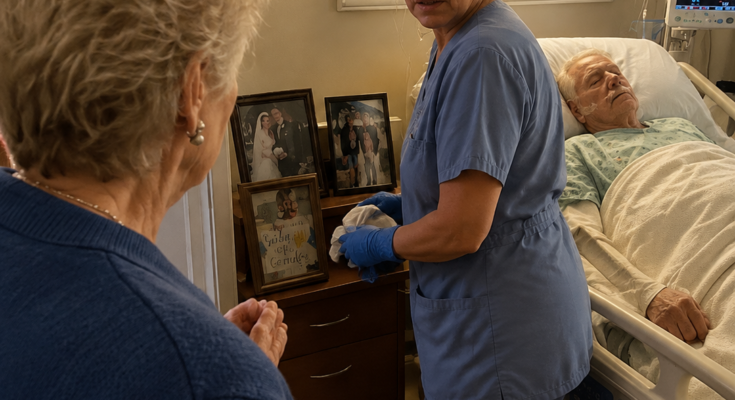
The first time Margaret found the photos standing straight again, she thought she was losing her mind. Her husband’s bedside table had become a tiny museum of the life he could not wake up to. Three framed photos. One of their wedding day, where Henry’s hair was still black and his grin looked almost too big for his face. One of their two sons standing barefoot in the backyard, holding up fish they had barely caught. And one of their granddaughter Lily, missing her front teeth, holding a crayon drawing that said, Wake up, Grandpa.
Every morning, Margaret placed them carefully beside Henry’s bed in Room 412. Every afternoon, one of them would be tilted. Sometimes the wedding photo leaned against the water pitcher. Sometimes Lily’s picture had slipped flat on its face. Sometimes the frame with their boys slid so close to the edge that Margaret’s stomach dropped when she walked in. And every evening, when she returned from the cafeteria with bad coffee and a dry sandwich she never finished, the photos were perfect again. Not just picked up. Perfect. Wedding photo in the middle. Boys on the left. Lily on the right. All three angled toward Henry’s face, like they were sitting with him.
“Must be one of the nurses,” Margaret whispered the first few times. The nurses were kind enough. Busy, but kind. They checked monitors, changed bags, adjusted pillows, softened their voices when they spoke to her. They said things like, “Stroke recovery can be unpredictable,” and “We look for small signs,” and “Talk to him. Hearing can be a comfort.”
So Margaret talked. At first, she talked all day. She told Henry the weather. She told him Lily had lost another tooth. She told him the neighbors had finally trimmed that terrible hedge he always complained about. She told him their youngest son, David, had flown in from Ohio and cried in the parking garage where nobody could see. She told him she was angry. Then sorry. Then scared. Then quiet.
By the second week, Margaret had started speaking less. There were only so many things a woman could say to a man who had not opened his eyes. Only so many ways to say, “I’m here.” Only so many mornings she could button the same blue cardigan, drive the same road, pass the same gift shop full of balloons that said Get Well Soon, and sit in the same vinyl chair while the man who used to whistle through his teeth lay still beneath a thin hospital blanket.
Henry had always been the loud one. He sang in grocery aisles. He talked to dogs through fences. He called strangers “friend” and meant it. Now the room hummed louder than he did.
On the fifteenth day, Margaret walked in and found Lily’s photo polished so clean she could see the window reflected in the glass. She stared at it. A small thing. A ridiculous thing, maybe. But her throat tightened. Because that morning, she had been too tired to clean anything. She had noticed the fingerprint on Lily’s frame and thought, I’ll wipe it later. Later had become the word she used for everything. Later I’ll eat. Later I’ll sleep. Later I’ll cry. Later I’ll imagine what happens if Henry never comes home.
A nurse came in to check Henry’s IV. Margaret stood quickly. “Excuse me,” she said. “Do you know who keeps fixing the photos?” The nurse glanced at the bedside table. “Fixing them?” “They fall sometimes. Or slip. But someone keeps arranging them.” The nurse smiled gently. “That’s sweet. Maybe Anna on day shift?” “Could you ask her?” “I can.”
But Anna only shook her head when Margaret asked. “No, honey,” she said, tucking the blanket under Henry’s shoulder. “I wish I could take credit.” Another nurse guessed it might be the volunteer who delivered newspapers. The volunteer said no. A young doctor said perhaps housekeeping moved them while cleaning. Margaret nodded, though the idea made her uneasy. Not because it was wrong for housekeeping to touch them. Because whoever it was had touched them with care. And somehow, not knowing who made the kindness feel heavier.
Part 2: The Tender
On day eighteen, Margaret arrived earlier than usual. The hallway outside Room 412 was pale with morning. A food cart rattled somewhere near the elevators. Someone laughed softly at the nurses’ station, then stopped when a call light chimed. Margaret paused outside Henry’s door. Inside, she heard a woman’s voice. Not a nurse’s voice. Not rushed. Not clinical. Low and soft, like someone speaking beside a sleeping child.
“You’ve got a beautiful family, Mr. Henry,” the woman said. “Your granddaughter drew you sunshine again. That’s good. A man needs sunshine.”
Margaret froze. Through the half-open door, she saw a cleaner standing beside Henry’s bed. The woman was small, maybe in her late fifties, with silver threaded through dark hair pulled into a bun. She wore gray housekeeping scrubs, yellow gloves, and soft black shoes that made almost no sound. A cleaning cart sat near the wall. The woman held Lily’s photo in one hand and a cloth in the other. She wiped the frame slowly. Not like she was doing a task. Like she was holding something fragile. Then she set it down at the perfect angle, facing Henry.
“You keep looking at them,” the cleaner whispered. “Even with your eyes closed. They’re still here.”
Margaret stepped into the room. “What are you doing?” The cleaner startled so hard the cloth dropped from her hand. Her face changed instantly. The softness disappeared. She lowered her eyes. “I’m sorry,” she said quickly. “I was only cleaning.” Margaret looked at Henry. Then at the photos. Then at the woman’s gloved hands. “You’ve been touching our pictures?” The cleaner swallowed. “Yes, ma’am. Just to dust them.” “You’ve been talking to my husband?” The woman’s eyes flickered toward Henry, then back to the floor. “I didn’t mean any disrespect.”
Margaret felt something hot rise in her chest. It wasn’t anger exactly. It was fear. It was exhaustion. It was the unbearable feeling of a stranger doing something intimate in the place where Margaret already felt helpless. “You don’t know him,” Margaret said. The cleaner nodded once, small and wounded. “No, ma’am.” “Then why would you talk to him like that?”
The room seemed to shrink around them. The monitor kept its quiet rhythm. The cleaner picked up the fallen cloth and folded it in her hand. For a moment, Margaret thought the woman would apologize again and leave. Instead, the cleaner looked at Henry’s still face with such tenderness that Margaret forgot to breathe. Then she said, barely above a whisper, “Because once, no one talked to my husband at all.”
Margaret stared at her. The cleaner reached slowly into the pocket of her gray scrub top. Her fingers trembled as she pulled out a small, worn photograph with bent corners.
Part 3: The Tender Heart
The cleaner held the photograph out, her hand shaking. Margaret took it gently. The image was faded, the corners soft from years of handling. It showed a man in his early forties, smiling, wearing a blue plaid shirt and holding a fishing rod. Behind him was a lake Margaret didn’t recognize. “My husband,” the cleaner said quietly. “His name was Harvey. He had a stroke too. Four years ago. He was in this very hospital, Room 412.”
Margaret’s breath caught. “This room?”
The cleaner nodded. “He was here for six weeks. I came every day. I sat in that same chair, talked to him, held his hand. But he never woke up. And after a while, I noticed something. When I wasn’t here, the nurses were so busy. They checked his vitals, changed his sheets, but they didn’t talk to him. They didn’t touch his photos. They didn’t tell him about the weather or the birds outside the window.”
She paused, her voice trembling. “I was alone with him in a room full of people. And I thought, if he can hear anything, he must be so lonely. So when I started working here, I made a promise to myself. Every patient who couldn’t speak, I would talk to them. I would touch their photos. I would make sure someone saw them as more than a diagnosis.”
Margaret looked down at Harvey’s photograph. Tears blurred her vision. “I didn’t know,” she whispered.
The cleaner smiled sadly. “I know. Nobody knows. I’m just the woman who mops the floors. But I see things. I see families who stop coming. I see patients who never get visitors. I see people who are still in there, waiting for someone to notice.” She looked at Henry. “Your husband, he’s still in there. I see him. I see the way his fingers twitch when you talk about your granddaughter. I see the tear that slips down his cheek when you leave. He knows you’re here. He’s fighting to come back to you.”
Margaret sank into the chair beside Henry’s bed, clutching Harvey’s photograph. “Thank you,” she said. “Thank you for seeing him.”
The cleaner—her name was Elena—sat down in the visitor’s chair across from Margaret. She told her story. Harvey had been a high school biology teacher. He loved fishing, cooking, and bad puns. He had been her best friend for thirty-seven years. When he died, she was shattered. She took the housekeeping job at the hospital because she couldn’t bear to be away from the place where he had spent his final weeks. And somewhere along the way, she started talking to the patients who couldn’t talk back.
“Some people think it’s foolish,” Elena said. “But I believe they can hear us. I believe our voices reach them, even if they can’t answer. And I believe your husband hears you, Margaret. He hears every word.”
Margaret reached across and took Elena’s hand. “You’re not foolish. You’re the kindest person I’ve ever met.”
Elena smiled. “I just do what I would have wanted someone to do for Harvey.”
From that day on, Margaret and Elena met every morning. They sat together in Room 412, talking to Henry, telling stories, laughing sometimes, crying sometimes. Elena brought fresh flowers from the hospital garden. Margaret brought photos of the grandchildren. They became friends, bound by a shared understanding of what it meant to love someone who couldn’t love you back.
One evening, a week later, Margaret was sitting alone with Henry when his fingers moved. Just a twitch, barely noticeable. But she saw it. She leaned forward. “Henry?” His eyelids fluttered. His hand moved again, reaching toward her. Margaret grabbed his hand and held it tightly. “I’m here. I’m right here.” Henry’s eyes opened slowly. They were glassy, unfocused. But he was looking at her. He was seeing her.
“Hey, old man,” she whispered. “Welcome back.”
Henry smiled weakly. “You… were talking… a lot,” he said, his voice barely a whisper. “Couldn’t… get any sleep.”
Margaret laughed so hard she cried. The next morning, she told Elena. Elena cried too. “He heard you,” she said. “I told you. He heard every word.”
Henry recovered slowly. He had a long road ahead, but he was back. And every day, Margaret told him about Elena—the cleaner who had talked to him when he was lost, the woman who had seen him when nobody else did.
When Henry was discharged, he insisted on meeting Elena. She came to his room, her eyes shining. “You look good, Mr. Henry,” she said.
Henry reached out and took her hand. “I hear you’ve been taking care of me,” he said. “Thank you.”
Elena shook her head. “I just kept you company.”
“No,” Henry said. “You kept me alive.”
Years passed. Margaret and Henry stayed in touch with Elena. They invited her to their granddaughter’s wedding. She sat in the front row. She cried with them. She was part of their family.
And every time Margaret placed photos by a bedside—visiting friends, visiting family, visiting Elena’s new apartment—she remembered the lesson she had learned. Sometimes, the most important people in a hospital aren’t the doctors or the nurses. Sometimes, they’re the ones who clean the floors and speak to the silent. The ones who see the person beneath the diagnosis. The ones who offer dignity when dignity feels lost.
Elena taught Margaret that. And Margaret never forgot.
In the end, it wasn’t the medicine that saved Henry. It was the tender.
It was the woman who touched the photos and talked to the man who couldn’t answer. It was the kindness that expected nothing in return.
That was the real miracle. ❤️