Part 1: The Reading Buddies
The teachers expected Malik Turner to make the little boy cry. That was the quiet truth nobody said out loud when Mrs. Ellis matched the reading buddies on a rainy Tuesday morning, with twenty-four first graders sitting cross-legged on the library rug and twenty-four fifth graders trying to look too old to care.
Malik stood in the back with his hood up. He was eleven, but he carried himself like someone twice that age and twice as tired. His knuckles were scabbed. His shoes were untied. His backpack hung open because the zipper had broken sometime before Christmas and nobody had replaced it. Every teacher knew his name. Not in the good way.
Malik had flipped a desk in October. He had gotten into two hallway fights before Thanksgiving. He had once told the music teacher, “I don’t sing,” with such coldness that half the class stopped singing too. By January, the front office had a folder with his name on it, thick with behavior reports and parent contact logs that led mostly nowhere.
So when Mrs. Ellis, the reading specialist, looked at her clipboard and said, “Malik, you’ll be with Noah,” the whole library seemed to pause. Noah Reed looked up from the rug. He was the smallest child in first grade, a pale little boy with glasses that slid down his nose and sleeves pulled over his hands. He did not speak much. When he did, his voice came out like he was asking permission to exist.
“Noah,” Mrs. Ellis said gently, “this is your reading buddy.”
Malik looked at him. Noah looked at the floor. Across the room, Mrs. Patterson, Noah’s teacher, pressed her lips together. She had already asked Mrs. Ellis that morning if maybe Noah could be paired with someone “a little softer.” Mrs. Ellis had only said, “Let’s see.”
But everyone was seeing the same thing. A shy first grader who cried when someone bumped his chair. An angry fifth grader who had been suspended for shoving a boy into the lockers. A reading program meant to build confidence. A disaster waiting in the picture book aisle.
Malik dropped into the tiny chair beside Noah, knees almost touching the underside of the small round table. The chair squeaked under him. Noah flinched. Malik noticed. His face did not change.
Mrs. Ellis placed a thin book between them. It had a smiling dog on the cover and big friendly letters. “Take turns,” she said. “Older buddies help, not rush.”
Malik stared at the book like it had offended him. Noah’s fingers curled into his sleeves. For a moment, nobody moved.
Then Malik pulled the book closer. The librarian pretended to organize bookmarks behind the counter. Mrs. Patterson pretended to check attendance. Two fifth-grade boys whispered near the nonfiction shelf, waiting for Malik to say something mean.
Malik opened the book. Noah swallowed. The rain tapped the windows. And then Malik read the first line. Not loud. Not annoyed. Softly. So softly, at first, Mrs. Patterson thought she had imagined it.
“The dog… sat… by the red ball.” He slid one finger under each word, slow and careful. Noah stared at him. Malik looked at the page, not at the room. “Your turn,” he said. Noah shook his head. “It’s just words,” Malik said.
Noah’s eyes filled immediately. Mrs. Patterson took one step forward. But Malik did not snap. He did not roll his eyes. He did not laugh. He leaned closer, lowering his voice until only Noah could hear. “I ain’t gonna let nobody hear you mess up.”
Noah blinked. Malik tapped the first word. “The.” Noah whispered, “The.” “Dog.” “Dog.” “Sat.” Noah hesitated. Malik waited. Not the impatient kind of waiting adults sometimes did, with a smile that still pushed. Real waiting. Quiet waiting. Like he had all day. “Sat,” Noah finally said. Malik nodded once. “See? You got it.”
Part 2: The Cafeteria
Mrs. Patterson stopped moving. The two boys by the shelf stopped whispering. Noah read the next three words with Malik’s finger under them. His voice shook, but it came out. When he finished the page, Malik turned it carefully, like the paper mattered.
For twenty minutes, that was all they did. No big moment. No speech. No miracle. Just an older boy in a gray hoodie, bent over a picture book, reading beside a child who seemed to shrink less with every page.
When the bell rang, chairs scraped. Fifth graders stood too fast, relieved to return to their regular world of multiplication quizzes and pretending not to care about anything. Noah stayed seated. He touched the corner of the book. “Do you come back tomorrow?” he asked. It was the most words Mrs. Patterson had heard from him all week.
Malik shrugged, but something moved across his face. “Yeah,” he said. “If they don’t kick me out first.” Noah looked confused. Malik pushed the chair in and walked away before anyone could praise him.
That should have been the end of it. A surprising good day. A note in Mrs. Ellis’s clipboard. A small reason to hope. But by Thursday afternoon, the whole school had heard what happened in the cafeteria.
It started with chocolate milk. Noah was carrying his tray with both hands, the way first graders do when the milk carton feels as heavy as a brick. A third grader named Ryan bumped him near the condiment station. The milk spilled across Noah’s tray, soaking his napkin, his chicken nuggets, and the little paper book he had brought from the library to practice. Ryan laughed. “Baby Noah’s gonna cry.”
Noah froze. The cafeteria got loud in that dangerous way children recognize before adults do. Malik, sitting at the fifth-grade table across the room, stood up. The lunch monitor called his name. “Malik, sit down.” He did not. Ryan said something else. Nobody heard exactly what it was, but Noah’s face changed. His chin tucked. His hands disappeared into his sleeves.
Malik crossed the cafeteria in six long steps. “Say it again,” he said. Ryan backed up. The monitor moved faster now. “Malik.” Ryan lifted both hands. “I was just playing.” “No, you weren’t.”
Malik did not hit him. He did not shove him. He did something worse, at least in the eyes of everyone who had already decided what kind of boy he was. He picked up Ryan’s full lunch tray and slammed it down so hard on the table that applesauce jumped from its cup and splattered across the floor.
The cafeteria went silent. Noah started crying then. Not because of Ryan. Because everybody was staring. Malik’s jaw tightened. Two adults reached him at the same time. “Office,” the lunch monitor said. Malik did not argue. He only turned to Noah and said, “Don’t let them throw your book away.” Then he walked out with applesauce on his sleeve and every old label following him down the hall.
Part 3: The Truth
By the end of the day, Mrs. Patterson heard three versions of it. Malik threatened a child. Malik lost control again. Malik ruined lunch. The principal, Mr. Alvarez, called his grandmother. No answer. He called the backup number. Disconnected. He put Malik in the conference room with a behavior reflection sheet and a dull pencil.
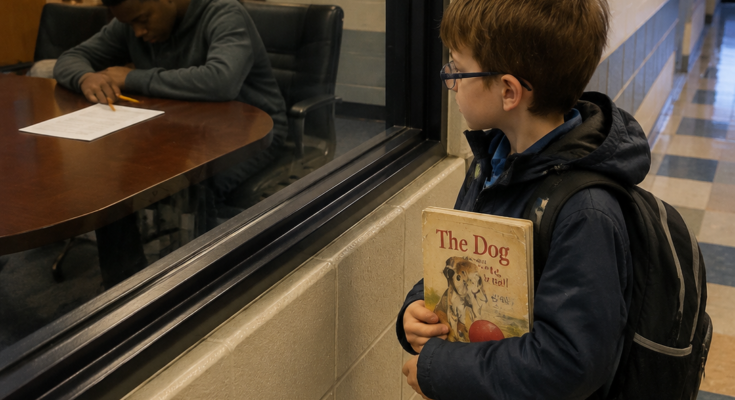
At 3:40, after the buses had pulled away and the hallway smelled like wet coats and floor cleaner, Mrs. Patterson found Noah standing outside the office. His backpack looked too big on him. In his hands was the library book. The pages were warped from milk. “Noah?” she asked. “Sweetheart, pickup is outside.” He did not move.
Through the office window, Malik sat alone at the conference table, hood down now, face turned toward the wall. Noah held the book tighter. “I have to give him this,” he whispered.
Mrs. Patterson crouched beside him. “Why?”
Noah looked at Malik through the glass. Then he said something that made every adult in the office go still. “Because he told me he knows what it feels like when nobody comes.”
Mrs. Patterson felt her throat tighten. She looked at Malik—the boy who had been labeled angry, violent, hopeless. And she suddenly understood.
Mrs. Ellis opened the conference room door. “Malik?” He didn’t turn. She stepped inside and sat down across from him. “Noah brought you something.” Malik’s eyes moved toward her, cautious and guarded. “He said you told him you know what it feels like when nobody comes.” Malik’s jaw tightened. He said nothing.
“I know about your grandmother,” Mrs. Ellis said gently. “I know she’s been working double shifts. I know you’re alone a lot.” Malik’s face twisted. “So what?” he said, his voice breaking for the first time. “You gonna write another report about me?”
“No,” Mrs. Ellis said. “I’m going to ask you something different. What do you need?”
Malik stared at her. The question seemed to hit him like a physical blow. He had been asked what he was doing wrong. What he had to be sorry for. How he would fix himself. He had never been asked what he needed.
“I need my mom to come back,” he said finally, his voice cracking. “But she ain’t coming.”
The room was silent. Then Mrs. Ellis reached across the table. “She might not be coming,” she said. “But you’re not alone. I’m sorry we made you think you were.”
Noah appeared in the doorway. He walked slowly to the table and placed the milk-stained book in front of Malik. “Here,” he said. “I saved it for you.” Malik looked at the book. The pages were wrinkled and stained, but it was still there. Noah had carried it to the office in his small hands because Malik had told him to.
“You saved it,” Malik said.
Noah nodded. “You said not to let them throw it away.”
Malik’s face crumpled. He turned away, wiping his eyes with his sleeve. Noah didn’t move. He just stood there, waiting.
Mrs. Patterson stayed after school that day. She made a phone call to Malik’s grandmother. She told her what had happened. She heard the exhaustion in the woman’s voice, the worry, the helplessness. “I don’t know what to do with him,” his grandmother said. “He’s a good boy. He’s just been through so much.”
“We’ll help,” Mrs. Patterson said.
The next week, Malik and Noah met in the library every afternoon. Teachers stopped calling them reading buddies. They called them friends. Malik still had his moments. He still got angry. He still got in trouble sometimes. But he had something different now. Something soft. Noah.
The reading program ended at the end of the year. But the bond between Malik and Noah didn’t. Malik would stop by Noah’s classroom just to say hi. He would help him carry his lunch tray. He would show up, again and again, as if proving that when someone needed him, he could be there.
Malik graduated from elementary school with a new reputation. Teachers stopped seeing the anger first. They started seeing the boy who carried a milk-stained library book in his backpack and the first grader who followed him around like he was the safest thing in the world.
Mrs. Patterson kept a photo on her desk. It was Malik and Noah, reading together in the library, the smiling dog book open between them. It reminded her of a lesson she would never forget: the kids who push people away the hardest are often the ones who need to be pulled in the most.
Malik is in high school now. He still visits the elementary school sometimes. He talks to the younger kids about how it’s okay to be angry, how it’s okay to be scared, how it’s okay to need help. He tells them he knows what it feels like when nobody comes. And he tells them he also knows what it feels like when someone does.
Noah is in middle school. He’s no longer the smallest kid in his class. He’s a leader, a reader, a boy who didn’t let a spill define him. He carries the lessons Malik taught him: that kindness isn’t weakness, that being brave means asking for help, that sometimes the most unlikely people can change your life.
Malik and Noah don’t see each other much anymore. But they both have the same memory. A rainy Tuesday. A picture book. A boy in a gray hoodie who read a line slowly, carefully, like he was unwrapping something fragile.
Sometimes, the people who seem the hardest are the ones who need the most love. And sometimes, all it takes is one person to believe in them for everything to change.
Malik believed in Noah. And Noah believed in Malik.
That was enough. ❤️