
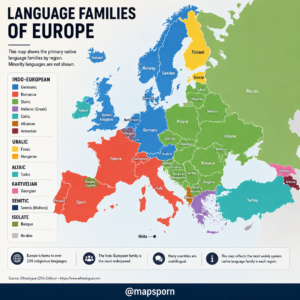
Europe may look like a continent divided into countries, but underneath its political borders lies another map entirely:
a map of language families.
English spoken in London is related to German in Berlin and Swedish in Stockholm.
Spanish spoken in Madrid belongs to the same family branch as French, Italian, Portuguese and Romanian.
Polish, Russian, Ukrainian, Czech and Bulgarian share another branch.
Finnish and Estonian belong to a completely different family from most European languages.
Hungarian is related—very distantly—to Finnish and Estonian despite being surrounded by Indo-European languages.
Maltese is Semitic.
Georgian belongs to the Kartvelian family.
Basque stands almost completely alone.
And Greek, Albanian and Armenian each form their own distinct branches of the enormous Indo-European family.
The result is one of the world’s most fascinating linguistic landscapes.
This map simplifies many multilingual regions, but it provides an excellent starting point for understanding why Europe’s languages sound the way they do—and how thousands of years of migration, empire and cultural contact created the linguistic borders we see today.
What Is a Language Family?
A language family is a group of languages descended from a common ancestral language.
Think of it like a family tree.
English and German are not simply similar because Britain and Germany are geographically close.
They descended from an earlier common Germanic language.
Spanish and Italian developed separately but both ultimately descend from Latin.
Russian and Polish developed from earlier Slavic speech.
Over centuries, communities separated.
Pronunciation changed.
Grammar changed.
Vocabulary changed.
Eventually dialects became distinct languages.
So modern languages that may initially seem very different can still share a deep common ancestor.
The Biggest Family by Far: Indo-European
Most of Europe’s major languages belong to the enormous Indo-European language family.
The family extends far beyond Europe.
It also includes languages such as:
- Persian
- Hindi
- Bengali
- Punjabi
- Kurdish
- Pashto
The existence of these relationships is one of the great discoveries of historical linguistics.
English, Greek, Russian and Hindi may sound completely different today, but linguistic evidence shows that their distant ancestors ultimately developed from a common prehistoric language conventionally called Proto-Indo-European.
Within Europe, Indo-European divides into several major branches.
They include:
- Germanic
- Romance
- Slavic
- Baltic
- Celtic
- Hellenic
- Albanian
- Armenian
These branches explain most of the large color zones visible on a corrected version of the map.
Germanic Languages: From Iceland to Austria
The blue zone across northern and central Europe represents the Germanic languages.
Major Germanic languages include:
- English
- German
- Dutch
- Swedish
- Danish
- Norwegian
- Icelandic
They all descend from a common Proto-Germanic ancestor.
Their relationships become surprisingly obvious when basic vocabulary is compared.
For example:
English: house
German: Haus
Dutch: huis
Or:
English: water
German: Wasser
Dutch: water
The words have changed over centuries but still reveal their common origin.
United Kingdom — English
English is a West Germanic language.
That sometimes surprises people because modern English contains enormous amounts of vocabulary derived from French and Latin.
The reason lies in history.
Early English developed from Germanic languages brought to Britain by Anglo-Saxon settlers.
Then came Viking settlement, bringing Old Norse influence.
After the Norman conquest of England in 1066, French became extremely influential.
Latin contributed another enormous vocabulary through religion, education and scholarship.
As a result, modern English has a Germanic grammatical and historical foundation combined with a huge Romance vocabulary.
That unusual mixture helped create the English we know today.
Germany, Austria and German-Speaking Switzerland
German forms the major language across Germany and Austria and much of Switzerland.
But even “German” contains enormous internal diversity.
Regional dialects can differ significantly.
Swiss German speech, for instance, can sound strikingly different from standard German used in formal writing and broadcasting.
Germany itself contains Low German, Central German and Upper German dialect traditions.
So coloring three countries simply “Germanic” hides considerable internal complexity.
Netherlands and Flanders
Dutch is another West Germanic language.
It is the primary language of the Netherlands and of Flanders, the northern part of Belgium.
That makes Belgium one of the clearest examples of why country borders and language-family borders are not the same thing.
Northern Belgium is predominantly Dutch-speaking and therefore Germanic.
Southern Belgium is predominantly French-speaking and therefore Romance.
A small area in the east is German-speaking.
Belgium therefore cannot accurately be represented by one single language-family color.
Scandinavia
Danish, Norwegian and Swedish belong to the North Germanic branch.
Their historical relationship is close enough that speakers can often understand neighboring Scandinavian languages to varying degrees.
Icelandic also belongs to North Germanic.
But because Iceland remained relatively isolated, Icelandic preserved many features closer to Old Norse.
Modern Icelanders can therefore access medieval Norse literary traditions much more directly than speakers of English can understand Old English.
Romance Languages: The Living Descendants of Latin
The red region of southern and western Europe represents the Romance languages.
They include:
- Portuguese
- Spanish
- Catalan
- French
- Italian
- Romanian
All descended primarily from varieties of spoken Latin used throughout the Roman Empire.
The name “Romance” does not originally refer to romantic love.
It refers to Rome.
After Roman political authority fragmented in Western Europe, Latin did not suddenly disappear.
People continued speaking it.
But different regional varieties evolved separately.
Over centuries they became distinct languages.
Italy — Italian
Italian developed from Latin varieties spoken on the Italian Peninsula.
Modern standard Italian is particularly associated historically with Tuscan and the language of writers such as Dante.
But Italy remains linguistically diverse.
Sicilian, Venetian, Neapolitan and numerous other traditional varieties have deep histories of their own.
Some linguists classify many of these as separate Romance languages rather than merely “dialects.”
So even the apparent heartland of Italian contains much more complexity than one color suggests.
Spain — Much More Than Spanish
Spain illustrates Europe’s multilingual reality beautifully.
Castilian Spanish is the country’s most widely spoken language.
But significant regional languages include:
- Catalan
- Galician
- Basque
Catalan and Galician are Romance languages.
Basque is not.
That means several fundamentally different linguistic histories exist inside the same modern state.
Galician is particularly close historically to Portuguese.
Catalan developed within the broader Romance world but has its own long literary tradition.
And Basque represents something completely different, as we will see later.
Portugal — Portuguese
Portuguese is another Romance language descended from Latin.
Its closest major linguistic neighbor is Galician, reflecting the shared medieval linguistic history of northwestern Iberia.
Portugal later spread Portuguese far beyond Europe through maritime expansion.
Today Portuguese is spoken across several continents, including Brazil, Angola and Mozambique.
A European language-family map therefore shows only a small part of the language’s modern global geography.
France — French
French is another Romance language, although its pronunciation has changed dramatically from Latin.
Germanic influence from the Franks also contributed to its development.
France historically contained numerous regional languages and varieties, including:
- Occitan
- Breton
- Corsican
- Alsatian
- Basque
- Catalan varieties
So France’s linguistic history is considerably more diverse than simply “French = Romance.”
Romania and Moldova — Romance, Not Slavic
This is one of the most important corrections to the original map.
Romanian is a Romance language.
It developed from varieties of Latin spoken in southeastern Europe and is the principal language of both Romania and Moldova.
Romanian may look unusual because it is surrounded largely by Slavic-speaking countries and has absorbed significant Slavic vocabulary and Balkan linguistic influences.
But its Latin ancestry is unmistakable.
Compare:
Romanian: mamă
Italian: mamma
Romanian: trei
Italian: tre
Romanian: apă
Latin: aqua
Romanian: bun
Latin: bonus
Romanian is therefore one of Europe’s most interesting linguistic survivors—a Romance language separated geographically from the great Romance bloc of Italy, France, Spain and Portugal.
Slavic Languages: From Poland to Russia and the Balkans
The huge green region across central, eastern and southeastern Europe represents the Slavic languages.
Slavic languages are generally divided into three large branches.
West Slavic
These include:
- Polish
- Czech
- Slovak
Polish is the largest of the three.
Czech and Slovak are particularly closely related, and mutual understanding between their speakers is often relatively high.
East Slavic
These include:
- Russian
- Ukrainian
- Belarusian
They descend from earlier East Slavic linguistic traditions associated historically with the medieval eastern European world.
Despite their relationship, Russian, Ukrainian and Belarusian are distinct languages with their own literary standards, vocabulary and phonological development.
South Slavic
These include:
- Slovenian
- Croatian
- Bosnian
- Serbian
- Montenegrin
- Macedonian
- Bulgarian
Many neighboring South Slavic varieties are closely related.
Bosnian, Croatian, Montenegrin and Serbian are especially close linguistically, although they have separate standardized forms tied to different national and cultural traditions.
Bulgarian and Macedonian share several grammatical features that distinguish them from many other Slavic languages.
Similar Words Reveal the Common Origin
Consider the word for “water”:
Polish: woda
Russian: вода — voda
Croatian: voda
Bulgarian: вода — voda
Slovenian: voda
Or “night”:
Polish: noc
Czech: noc
Russian: ночь — noch
Croatian: noć
These similarities are not coincidence.
They are inherited from common Slavic ancestors.
Latvia and Lithuania: Baltic, Not Slavic
The map needs another important correction here.
Latvian and Lithuanian are Baltic languages—not Slavic languages.
The Baltic languages form their own branch of Indo-European.
The two surviving major Baltic languages are:
- Lithuanian
- Latvian
An important extinct member was:
- Old Prussian
Baltic and Slavic languages are closely related enough that linguists commonly place them together in a broader Balto-Slavic grouping.
But Baltic and Slavic remain distinct branches.
That means Lithuania should not simply be colored the same way as Poland.
Nor should Latvia be grouped directly with Russian.
Lithuanian Is Famous Among Linguists
Lithuanian is particularly interesting because it preserves several archaic grammatical and phonological characteristics.
Historical linguists have long valued Lithuanian when reconstructing aspects of earlier Indo-European languages.
That does not mean Lithuanian is literally unchanged Proto-Indo-European.
Languages never remain frozen for thousands of years.
But it preserves certain old characteristics that disappeared elsewhere.
Celtic Languages: Survivors of a Once Much Larger World
The Celtic languages once covered enormous areas of Europe.
Today their surviving strongholds are concentrated along Europe’s Atlantic edge.
Modern Celtic languages include:
- Irish
- Scottish Gaelic
- Welsh
- Breton
- Manx
- Cornish
They are Indo-European languages, but their modern territory is only a small fraction of their historical distribution.
Ireland: The Map Needs a Qualification
Ireland is colored Celtic because Irish belongs to the Celtic family and is the indigenous national language.
However, English is the majority everyday language of modern Ireland.
So if the map is intended to show the most widely spoken native language today, Ireland should largely appear Germanic.
If it instead highlights the country’s historic indigenous language tradition, Celtic makes sense.
That distinction should be clearly stated.
Wales
Welsh remains one of Europe’s strongest Celtic languages.
It belongs to the Brittonic branch of Celtic and is related historically to:
- Breton
- Cornish
Welsh has official recognition in Wales and continues to be used in education, government, media and everyday community life.
Scotland
Scottish Gaelic belongs to the Goidelic branch alongside Irish and Manx.
But English and Scots—both Germanic—are used by much larger shares of Scotland’s modern population.
Again, the distinction between indigenous heritage language and majority spoken language matters.
Brittany
Breton is especially fascinating because it is spoken in northwestern France.
It is Celtic rather than Romance.
Breton developed from Celtic speech brought across the English Channel from Britain during the early medieval period.
So inside overwhelmingly Romance-speaking France survives a Celtic linguistic island.
Greek: An Entire Indo-European Branch of Its Own
Greek is shown separately for good reason.
Greek belongs to the Hellenic branch of Indo-European.
Modern Greek is the descendant of an extraordinarily long documented linguistic tradition extending back thousands of years.
Ancient Greek gave the world an enormous vocabulary in:
- Philosophy
- Mathematics
- Medicine
- Science
- Politics
- Theology
English alone contains thousands of Greek-derived words.
Consider:
democracy
biology
geography
philosophy
theater
history
Greek today is obviously not identical to Classical Greek.
But the historical continuity of Greek is exceptional.
Albanian: Another Branch All by Itself
Albanian occupies a tiny territory compared with the vast Germanic, Romance and Slavic zones.
Yet linguistically it is extremely important.
Albanian forms an independent branch of Indo-European.
It is not a Slavic language.
It is not Greek.
It is not Romance.
Its deeper ancestry lies somewhere among the poorly documented ancient languages of the Balkans, although scholars continue debating the precise historical pathway.
Centuries of contact have contributed vocabulary from:
- Latin
- Greek
- Slavic languages
- Turkish
- Italian
But its fundamental linguistic identity remains distinct.
Armenian: Indo-European, but Its Own Branch
Armenian provides another surprising case.
Because Armenia lies in the Caucasus, people sometimes assume Armenian belongs to a Caucasian language family.
It does not.
Armenian is Indo-European.
Like Greek and Albanian, it forms its own major branch.
Its vocabulary contains historical influences from Persian and neighboring languages, but comparative linguistics established Armenian as a distinct Indo-European branch.
This demonstrates perfectly why geography and language families do not always match.
Georgia and Armenia are neighbors.
Georgian and Armenian are not close linguistic relatives.
Finland, Estonia and Hungary: The Uralic World
Three major European national languages lie outside Indo-European while belonging to another major family:
Uralic.
The largest Uralic languages in Europe are:
- Hungarian
- Finnish
- Estonian
Other Uralic languages are spoken particularly across northern and eastern Europe and Russia, including Sámi, Mari, Udmurt and Komi.
Finnish and Estonian
Finnish and Estonian belong to the Finnic branch and are noticeably related.
Compare:
Finnish: kolme — three
Estonian: kolm
Finnish: kala — fish
Estonian: kala
Their grammar also shares many structural features.
Hungarian
Hungarian is also Uralic but much more distantly related.
Its ancestors moved into the Carpathian Basin more than a thousand years ago.
Today Hungary is surrounded mostly by Indo-European languages:
- German
- Slovak
- Ukrainian
- Romanian
- Serbian
- Croatian
- Slovenian
Yet Hungarian remains Uralic.
This makes Hungary one of Europe’s most striking linguistic islands.
Related Does Not Mean Mutually Understandable
Calling Finnish and Hungarian related sometimes gives people the wrong idea.
A Finn cannot simply understand Hungarian.
Their common ancestor existed so far back in time that the languages evolved enormously in different directions.
Their relationship is more like very distant branches of a large family tree than close siblings.
Turkish: Turkic, Not Simply “Altaic”
Turkey is another non-Indo-European area on the map.
Turkish belongs to the Turkic language family.
Other Turkic languages include:
- Azerbaijani
- Turkmen
- Kazakh
- Kyrgyz
- Uzbek
- Uyghur
- Tatar
Turkic languages stretch across an enormous zone from southeastern Europe through Central Asia and into Siberia and western China.
Why “Altaic” Should Be Removed From the Legend
Older maps frequently place Turkic inside an Altaic language family together with Mongolic and Tungusic languages.
That classification remains controversial.
The dominant view among many historical linguists shifted toward explaining the similarities between those families through long-term contact and convergence rather than a proven shared Proto-Altaic ancestor. Oxford’s overview describes the debate and notes that the contact-based interpretation became dominant from the mid-20th century onward.
For a modern educational infographic, the safest label is simply:
Turkic
rather than:
Altaic → Turkic.
Georgian: The Kartvelian Family
Cross from Turkey into Georgia and the linguistic family changes again.
Georgian belongs to the Kartvelian language family, also called South Caucasian.
The family includes:
- Georgian
- Mingrelian
- Laz
- Svan
Kartvelian is considered an independent language family with no demonstrated genetic relationship to Indo-European, Turkic or Uralic.
Georgian is by far its most widely spoken member and has its own distinctive writing system.
That makes the Caucasus one of the most linguistically diverse regions anywhere near Europe.
Within a relatively small area you encounter:
- Indo-European Armenian
- Kartvelian Georgian
- Turkic Azerbaijani
- numerous Northeast and Northwest Caucasian languages
Political geography barely hints at that diversity.
Malta: Europe’s Semitic Exception
Tiny Malta creates one of the most surprising spots on the entire map.
Maltese is a Semitic language.
It developed historically from a form of Arabic associated with medieval Sicily and Malta.
Its closest deep linguistic relatives therefore lie within the Arabic/Semitic world rather than among nearby Italian or French varieties.
Yet centuries of contact with Sicily, Italy and later Britain transformed Maltese enormously.
Modern Maltese contains substantial vocabulary derived from:
- Sicilian
- Italian
- English
It is also written using the Latin alphabet.
So Maltese sounds simultaneously familiar and unfamiliar to visitors from surrounding Mediterranean countries.
It represents one of Europe’s clearest examples of linguistic layering.
Basque: Europe’s Great Language Isolate
Then there is Basque.
Basque is perhaps the most famous linguistic exception in western Europe.
It is considered a language isolate.
That means no surviving language has been conclusively demonstrated to belong to the same language family.
Basque is spoken in areas spanning northern Spain and southwestern France.
It is surrounded completely by Indo-European Romance languages.
Yet Basque itself is not Indo-European.
Most scholars consider it the surviving descendant of linguistic traditions that existed in western Europe before Indo-European languages became dominant.
Basque Is Older Than Spain or France
This does not mean every modern Basque word is thousands of years old.
Languages constantly evolve.
But the ancestral linguistic lineage represented by Basque was present long before the modern states of Spain and France existed.
That makes Basque one of Europe’s most extraordinary cultural survivals.
Political Borders and Language Borders Rarely Match Perfectly
Perhaps the greatest weakness of any map like this is the temptation to color one country with one language.
Europe does not actually work that way.
Belgium
Contains major:
Germanic Dutch-speaking regions
and
Romance French-speaking regions
plus a smaller German-speaking community.
Switzerland
Has four national languages:
- German — Germanic
- French — Romance
- Italian — Romance
- Romansh — Romance
Spain
Contains:
- Spanish — Romance
- Catalan — Romance
- Galician — Romance
- Basque — isolate
United Kingdom
Contains:
- English — Germanic
- Welsh — Celtic
- Scottish Gaelic — Celtic
- Scots — Germanic
- Cornish — Celtic revival
Finland
Finnish is Uralic, but Swedish is also an official national language and has historic native-speaking communities.
Russia
Russian is Slavic, but the Russian Federation contains dozens of other indigenous languages belonging to families including:
- Uralic
- Turkic
- Northeast Caucasian
- Northwest Caucasian
- Mongolic
- Tungusic
- others
So the enormous green Russian area on a simplified map hides extraordinary linguistic diversity.
Europe Has Far More Than the Languages Shown Here
Europe is home to hundreds of indigenous and long-established languages and language varieties, depending on where scholars draw the boundary between “language” and “dialect.”
Many do not correspond to countries.
Examples include:
- Basque
- Welsh
- Breton
- Frisian
- Sorbian
- Sámi languages
- Romansh
- Sardinian
- Corsican
- Kashubian
- Rusyn
- Romani
- Gagauz
Some have millions of speakers.
Others have only thousands.
Some receive strong official protection.
Others are endangered.
This is why maps based solely on national languages can hide much of Europe’s real linguistic diversity.
Why Indo-European Became So Dominant
One of the biggest questions raised by the map is:
Why are Indo-European languages everywhere?
The exact prehistoric expansion remains an enormous field of archaeological, genetic and linguistic research.
But Indo-European languages spread over thousands of years through migrations, population expansion, cultural change and later empire-building.
Eventually Indo-European branches came to dominate most of Europe.
Germanic languages expanded across the north and west.
Slavic languages spread through much of eastern and southeastern Europe.
Latin produced the Romance world.
Greek survived in the southeastern Mediterranean.
Yet several older or separate linguistic traditions persisted.
Basque survived in the western Pyrenees.
Uralic languages remained strong in Finland, Estonia and Hungary.
Kartvelian languages survived in the Caucasus.
Turkic expansion eventually brought Turkish into Anatolia.
Semitic Maltese survived in the central Mediterranean.
The map therefore represents both linguistic expansion and linguistic survival.
Language Does Not Equal Ethnicity or Genetics
This is another important point.
Speaking a Germanic language does not make someone ethnically “Germanic.”
Speaking a Slavic language does not define someone’s genetic ancestry.
Language can spread without complete population replacement.
People adopt new languages because of:
- Political power
- Migration
- Trade
- Education
- Religion
- Social prestige
- Intermarriage
- Empire
Modern French people speak a Romance language descended from Latin, even though ancient France was inhabited heavily by Celtic-speaking Gauls before Roman rule.
English became dominant in Britain despite layers of Celtic, Roman, Anglo-Saxon, Viking and Norman history.
Turkish became dominant across Anatolia despite the region’s earlier Greek, Armenian and other linguistic histories.
Languages can move through populations far more quickly than genes or identities.
So a language-family map is not an ethnic map.
The Borders Tell Thousands of Years of History
Look again at the boundaries between the colors.
Every transition tells a story.
French → German reflects the long cultural frontier between Romance and Germanic Europe.
Finnish → Swedish marks a boundary between Uralic and Germanic speech.
Romanian → Bulgarian puts Latin-descended Romance beside Slavic.
Hungarian → Slovak/Romanian/Croatian reveals a Uralic linguistic island surrounded by Indo-European neighbors.
Greek → Turkish marks the meeting of Indo-European Hellenic and Turkic languages.
Georgian → Armenian places Kartvelian beside Indo-European.
And inside Spain, Basque preserves a language family completely separate from all surrounding Romance languages.
These borders are more than linguistic curiosities.
They reveal migrations, conquests, trade routes and political changes extending thousands of years into the past.
The Corrected Simplified Family Tree of Europe
A clearer version of the map would classify the major languages roughly like this:
Indo-European
Germanic
- English
- German
- Dutch
- Swedish
- Norwegian
- Danish
- Icelandic
Romance
- French
- Italian
- Spanish
- Portuguese
- Catalan
- Romanian
Slavic
- Russian
- Ukrainian
- Belarusian
- Polish
- Czech
- Slovak
- Slovenian
- Croatian
- Bosnian
- Serbian
- Montenegrin
- Macedonian
- Bulgarian
Baltic
- Latvian
- Lithuanian
Celtic
- Irish
- Scottish Gaelic
- Welsh
- Breton
- Manx
- Cornish
Hellenic
- Greek
Albanian
- Albanian
Armenian
- Armenian
Uralic
Finnic
- Finnish
- Estonian
Hungarian
- Hungarian
plus Sámi and numerous indigenous languages of northern and eastern Europe.
Turkic
- Turkish and several other languages in southeastern Europe and European Russia
Kartvelian
- Georgian and its related languages
Semitic
- Maltese
Language isolate
- Basque
That classification captures Europe’s major linguistic families far more accurately.
One Continent, Many Ancient Family Trees
Political Europe has around four dozen countries.
Linguistic Europe is much harder to count.
Its languages belong to families whose roots extend back thousands of years—long before today’s national borders existed.
English and Swedish turn out to be cousins.
Spanish and Romanian share Roman ancestry despite being separated by half a continent.
Russian and Croatian belong to the same Slavic family even though they developed in different regions.
Finnish and Hungarian are distant relatives surrounded largely by Indo-European languages.
Maltese connects Europe linguistically with the Semitic world.
Georgian represents an independent Caucasian tradition.
And Basque remains the extraordinary survivor with no confirmed living relative at all.
That is what makes Europe’s language map so fascinating.
Countries show us where political borders are today.
Languages show us where people have been moving, mixing and communicating for thousands of years.
Accuracy and Source Note
This map is best understood as a simplified introduction rather than a complete linguistic atlas. Many European states are multilingual, minority languages are omitted, and the choice between “majority language” and “indigenous national language” can change how areas such as Ireland should be colored. A corrected version should classify Latvian and Lithuanian as Baltic, Romanian in both Romania and Moldova as Romance, and Turkish simply within the Turkic family rather than treating “Altaic” as an established parent family. Baltic languages form a distinct Indo-European branch closely related to Slavic, while Romanian is Eastern Romance. The genetic unity traditionally proposed under “Altaic” remains disputed in modern historical linguistics.