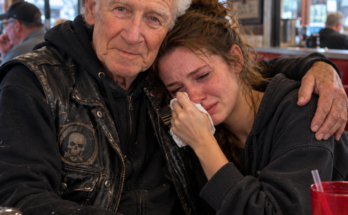
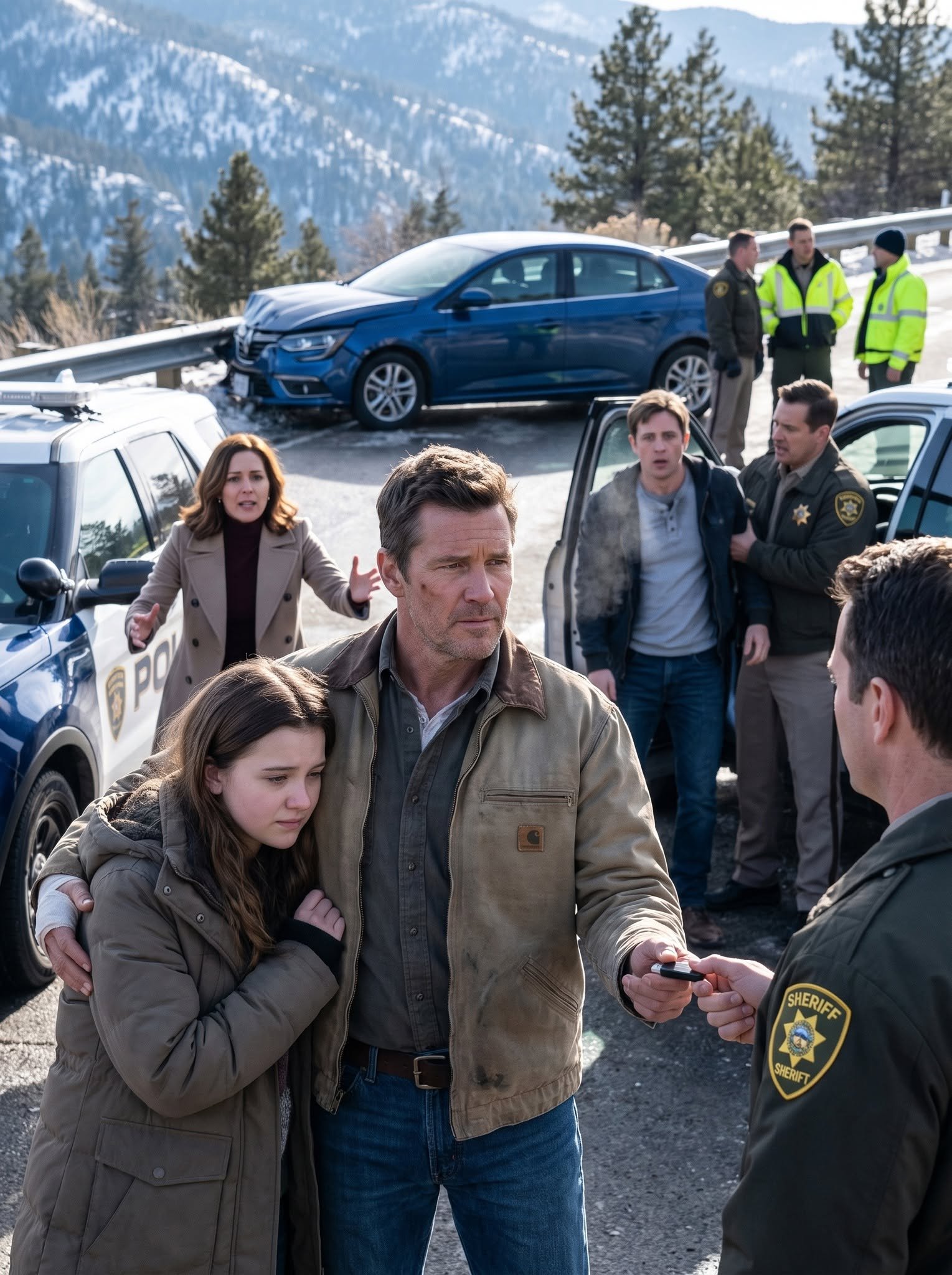
PART 1 — The Road She Chose for Me
For fifteen years, I built Knox Customs from an almost empty garage into one of Pinewood, Montana’s most trusted auto-body shops.
I understood damaged machines.
Metal bent for a reason.
Engines failed for a reason.
If you stayed patient, inspected every connection and ignored the noise around you, the hidden problem eventually revealed itself.
I should have examined my marriage the same way.
My wife, Nancy, had become distant over several months.
She claimed she spent three evenings each week working with a charity committee.
She stopped asking about my day.
She began returning home after midnight.
Our fifteen-year-old daughter, Lena, noticed before I admitted anything was wrong.
One afternoon, she came to the garage after school.
“Mom’s car wasn’t at the community center yesterday,” she said.
“Maybe she rode with someone.”
“She was dressed for dinner. When she came home, she showered immediately.”
I continued working on a damaged truck panel because I did not want my daughter to see my hands tighten.
“Let me handle it.”
“I’m not a child anymore.”
“No,” I said. “But I’m still your father.”
Later that afternoon, the mother of Lena’s best friend called the shop.
She had seen Nancy entering the Red Creek Motel with a man.
I thanked her, finished the day’s work and went home as though nothing had happened.
Nancy had prepared roast chicken.
It was the meal she cooked whenever she wanted something.
During dinner, she announced that her charity committee was organizing a three-day marriage retreat at a mountain resort.
“I already registered us,” she said.
Lena looked up sharply.
Nancy explained that our daughter could stay with her best friend.
That was when I understood the retreat was not an attempt to save our marriage.
It was part of something already planned.
That night, after Nancy went upstairs, Lena found me on the porch.
“She’s lying about the retreat,” she said. “I heard her talking about getting away.”
I placed a hand on her shoulder.
“Whatever happens, you are not responsible for fixing this.”
But Lena had already started trying.
While Nancy slept, I searched the kitchen and found a second phone hidden beneath warranties and takeout menus.
Three days later, I placed it on the counter when Nancy entered.
Fear crossed her face for half a second.
Then she smiled.
“That belongs to the committee.”
I opened the messages.
The newest one came from someone saved only as D.
Miss you already. Three weeks is too long.
“Charity work?” I asked.
Nancy began crying.
She accused me of spying.
She claimed D was a woman going through a divorce.
I apologized.
Relief flooded her face.
Then I agreed to attend the retreat.
That evening, I parked across from the Red Creek Motel.
At 8:42, Tanner Hullbrook arrived in a black towing truck.
He was a former convict who operated a business everyone in town suspected was connected to insurance fraud.
Twenty minutes later, Nancy entered his room.
I waited three hours.
When she emerged, Tanner followed her outside and kissed her beneath the motel sign.
I drove to my shop instead of confronting either of them.
Machines were easier than betrayal.
An engine did not tell you it loved you while quietly preparing to replace you.
The morning of the retreat, Nancy insisted we take her car.
She handed me the keys and asked me to drive.
Our route climbed through narrow mountain roads rarely used except by locals.
An hour into the trip, Nancy reclined her seat and closed her eyes.
When I pressed the brake approaching a curve, the pedal felt soft.
I pressed again.
It sank almost to the floor.
I downshifted, trying to slow the car through the transmission.
“Nancy. Wake up.”
Her eyes opened immediately.
Too immediately.
“The brakes are failing.”
For one instant, her face did not show fear.
It showed recognition.
The road descended toward a sharp curve with a steep drop beyond the guardrail.
I pumped the pedal.
Nothing.
I pulled the emergency brake gradually.
The rear tires began sliding.
Nancy screamed and grabbed the dashboard.
The car struck the barrier, spun across the road and crashed down the embankment.
Metal folded around us.
Glass exploded.
Then everything went dark.
I woke in a hospital with broken ribs, a concussion and stitches across my forehead.
A nurse told me Nancy was in surgery.
She had suffered a fractured arm and internal injuries, but doctors expected her to survive.
I asked for Lena.
“She’s downstairs with a family friend.”
“Bring her to me.”
Lena arrived with her best friend’s mother.
She waited until the nurse left.
Then she locked the hospital-room door.
“Dad, we have to leave before Mom wakes up.”
“What are you talking about?”
“She wanted you dead.”
Lena pulled out her phone.
“I found her secret messages weeks ago.”
“Why didn’t you tell me?”
“I tried. You told me to let you handle it.”
The words cut deeper than my broken ribs.
She opened an audio file.
“I hid my phone in the garage when Mom met Tanner there.”
Nancy’s voice came through the speaker.
The insurance pays double for an accidental death.
Tanner answered.
The line will leak slowly. He won’t notice until he reaches the descent.
Nancy asked what would happen if I survived.
Tanner laughed.
Then we say he damaged it himself. He owns a repair shop. Everyone will believe he knew how.
Lena’s hand began shaking.
“I have more.”
The next recording described the exact road.
The curve.
The guardrail.
The time we were supposed to leave.
Nancy reminded Tanner that there were few security cameras outside town.
Then she asked about the money.
Five hundred thousand should be enough to start over.
Tanner corrected her.
More than that if the business transfers to you.
My daughter stopped the recording.
“I found a notebook too.”
“Where?”
“In Mom’s closet. She moved it before the trip, but I took pictures.”
Lena opened a photograph.
The page contained dates, account numbers and a handwritten calculation beside my name.
$500,000.
Below it was another figure.
Knox Customs: estimated value $780,000.
I stopped trying to understand how the woman I had loved for fifteen years could calculate the value of my death.
I focused on the only thing that still mattered.
Keeping Lena alive.
“Did your mother know you recorded them?”
“I don’t think so.”
“Did Tanner ever see you?”
Lena hesitated.
“Once.”
“When?”
“Last week. He was leaving the garage when I came home.”
“What did he say?”
“He asked whether I liked living in Pinewood.”
My body went cold.
“What did you tell him?”
“That I did.”
Lena looked toward the hospital door.
“Then he said people sometimes have to leave places they love.”
The door handle moved.
Lena quickly locked her phone.
Nancy’s sister entered carrying flowers.
She smiled too widely when she saw us.
“Nancy is awake,” she said. “She has been asking for you.”
I looked at Lena.
Her mother had survived.
That meant the first plan had failed.
And Tanner already knew my daughter had seen him.
PART 2 — The Recordings My Daughter Saved
A trusted friend named Marcus drove Lena and me out of the hospital through a service entrance.
He had served with the sheriff’s department before opening a hunting-supply store outside town.
We went to a cabin he owned near Flathead National Forest.
No one followed us.
At least, no one we saw.
I called my shop manager, Eli, and asked him to retrieve the wrecked car before the insurance company moved it.
“Do not touch anything until you photograph it,” I told him.
“What am I looking for?”
“The brake line.”
He stopped speaking.
Then he said, “I’ll call you back.”
Two hours later, photographs arrived.
The brake line had been cut near the rear assembly.
Not completely.
Just enough to allow fluid to leak gradually.
The cut was clean.
Deliberate.
A utility knife had been found beneath the driver’s seat.
The handle carried traces of black shop grease.
The same type Tanner used at his towing yard.
Eli sent one final message.
This was not an accident.
By then, Nancy had already spoken to police.
She claimed I had become suspicious and controlling.
She said the crash happened after I accused her of cheating.
She told officers I had threatened to destroy the car if she tried to leave me.
According to her statement, I had been behaving strangely for weeks.
She said I understood brake systems better than anyone in town.
The implication was clear.
If investigators found evidence of sabotage, they were supposed to believe I had created it.
I copied Lena’s recordings three times.
One copy went to a state-police investigator Marcus trusted outside our county.
One went into a bank deposit box.
The third went to Sheriff Daniel Reese.
Daniel had known me for fifteen years.
He had brought damaged patrol cars to my shop.
He had eaten at my house.
He had watched Lena grow up.
He listened to the recordings alone.
When he returned, his face had changed.
“I believe you,” he said.
“Does anyone else?”
“They will when we verify the files.”
He looked toward Lena.
“Did your mother ever ask for your phone?”
“Yesterday morning. Before they left.”
“What did you tell her?”
“That I lost it.”
Daniel nodded.
“That may be the reason you are still safe.”
Investigators examined the metadata.
The recordings had not been edited.
One had been created in my garage nineteen days before the crash.
Another came from Nancy’s car.
Lena had left her phone recording inside the seat pocket while her mother met Tanner in a parking lot.
On that file, Tanner described the brake plan in detail.
Nancy sounded nervous.
What if he checks the car before we leave?
He won’t. You make him believe the trip is your idea. Keep him distracted.
And Lena?
Send her to the friend’s house.
She watches everything.
There was a pause.
Then Tanner said:
If she becomes a problem, I’ll solve that too.
Lena sat beside me while the sheriff played the sentence.
Her face became pale.
I reached for her hand.
She let me hold it.
Daniel stopped the recording.
“You should not stay at the cabin.”
“Where do we go?”
“Somewhere they believe you will be.”
The plan was simple.
We spread a rumor that I intended to flee through an isolated hunting cabin near the Canadian border.
My pickup was parked outside.
Lights remained on at night.
A deputy wearing my jacket moved near the windows.
Meanwhile, Lena and I stayed in a safe house thirty miles away.
We waited.
On the second evening, Tanner arrived in his towing truck.
Two men followed in another vehicle.
All three carried weapons.
Hidden deputies recorded everything.
Tanner entered the cabin and demanded that I come outside.
He said Nancy had already told police I had kidnapped Lena.
When no one answered, he began speaking to one of the men.
“The evidence has to be in here.”
“What evidence?”
“The recordings. The girl copied them.”
“And Knox?”
“He does not leave tonight.”
The sheriff waited until Tanner entered the cabin.
Then deputies moved in.
One of the men surrendered immediately.
The other reached for his weapon and was forced to the ground.
Tanner tried escaping through the rear door.
He made it less than twenty feet.
Nancy was found waiting inside a car two miles down the road.
She had cash, two passports and a suitcase containing clothes for herself and Tanner.
There was nothing packed for Lena.
When deputies led Nancy past me, she looked smaller than she had in the hospital.
Her injured arm was held against her chest.
She began crying.
“Caleb, please.”
I said nothing.
“Tanner made me do it.”
The sheriff held up his hand.
“Save it for your attorney.”
Nancy looked toward Lena.
“Sweetheart, tell your father this is a misunderstanding.”
Lena stepped behind me.
Her mother’s face hardened.
Only for a second.
But Lena saw it.
So did I.
At the station, Daniel opened the notebook investigators had recovered from Nancy’s bedroom.
The first pages contained the insurance calculations.
The value of my business.
The mountain route.
The expected police response.
Then he reached the final page.
His expression changed.
“What is it?”
Daniel turned the notebook toward me.
Across the top, Nancy had written:
If the crash fails.
Below it were three steps.
Report Caleb as violent.
Use hospital confusion to obtain emergency custody.
Move Lena before she talks.
My daughter’s name was circled twice.
Beside it, Nancy had written an address.
It belonged to a private youth treatment facility in another state.
I looked at Daniel.
“What is that place?”
“A locked residential program.”
“Why would Nancy send Lena there?”
“To discredit her.”
Daniel turned to the next page.
Nancy had already drafted a statement claiming Lena suffered from compulsive lying, emotional instability and dangerous behavior.
The paperwork accused my daughter of inventing stories because she resented her mother’s new relationship.
Attached to it was an unsigned admission form.
Nancy planned to have Lena confined before anyone heard the recordings.
Lena read the page over my shoulder.
“She was going to send me away?”
I closed the notebook.
“You are not going anywhere.”
“But she wrote my name.”
“She failed.”
Lena looked toward the interrogation-room window.
“She wanted you dead.”
I pulled her closer.
“And when I survived, she wanted people to believe you were sick.”
That was when my daughter finally cried.
Not because of Tanner.
Not because of the crash.
Because she understood that her mother had prepared a place to hide her.
The first plan was supposed to kill me.
The second was designed to erase Lena.
PART 3 — The Daughter They Planned to Silence
Tanner denied touching the brake line.
Then investigators matched the knife found beneath the driver’s seat to a package purchased with his business credit card.
Security footage showed him buying it four days before the crash.
Another camera recorded his towing truck near our house the night before the retreat.
A neighbor’s doorbell camera showed him entering our garage at 2:13 in the morning.
He remained inside for eleven minutes.
Nancy had disabled our home security system less than an hour earlier.
Her phone records placed her awake and messaging Tanner throughout the visit.
The evidence continued building.
Insurance records showed Nancy had increased my life-insurance coverage eight months earlier.
She forged my signature on part of the application.
The policy included an accidental-death benefit.
She listed herself as the primary beneficiary.
Lena was listed second.
Then investigators discovered that Nancy had recently opened an account in Tanner’s name.
The first transfer was scheduled for three days after our planned return from the retreat.
She expected my death certificate to begin the insurance process immediately.
Nancy’s attorney claimed she had been manipulated.
He described Tanner as controlling and dangerous.
The recordings told a different story.
On one, Tanner questioned whether the plan was worth the risk.
Nancy answered:
He trusts me. That is why it will work.
On another, she complained that Tanner was becoming careless.
If Caleb survives, you follow the second plan exactly. We cannot let Lena talk before I get custody.
Nancy was not being led.
She was directing him.
The court granted me temporary sole custody.
Nancy was prohibited from contacting Lena.
Her lawyer requested supervised communication.
Lena refused.
“Do I have to speak to her?” she asked.
“No.”
“What if she says she is sorry?”
“You still do not have to.”
Lena looked down at her hands.
“Will that make me a bad daughter?”
“No.”
“She always said family forgives.”
“Forgiveness does not require you to stand beside someone who planned to hurt you.”
Lena remained quiet.
Then she said, “I don’t know if I can ever forgive her.”
“You do not have to decide today.”
The criminal hearing began six weeks later.
Nancy entered the courtroom wearing a dark blue dress and the wedding ring she had removed months earlier.
She looked toward me as though we were still husband and wife.
I looked away.
The prosecutor played Lena’s recordings.
Nancy’s voice filled the courtroom.
The insurance pays double for an accidental death.
Then Tanner described cutting the brake line.
Jurors heard Nancy ask what would happen if I survived.
They heard Tanner explain how I would be blamed.
Then they heard the second plan.
Get Lena committed before she tells anyone.
Nancy lowered her head.
The prosecutor displayed the admission paperwork from the residential facility.
A representative from the facility testified that Nancy had called twice.
She described Lena as delusional.
Violent.
Obsessed with breaking up her parents.
She never mentioned the affair.
She never mentioned Tanner.
She never mentioned that her daughter had recorded a murder plot.
Then Lena’s attorney read a statement on her behalf.
Lena did not enter the courtroom.
She did not have to.
The statement contained four sentences.
My mother told me my father could die.
When he survived, she tried to make people believe I was lying.
I recorded the truth because I was afraid no adult would believe me.
My father did.
Nancy began crying.
For the first time, the tears did not change anything.
Tanner accepted a plea agreement after one of the armed men agreed to testify.
He admitted cutting the brake line and participating in the attempt to recover the recordings.
He also admitted that Nancy had promised him part of the insurance money and ownership in Knox Customs.
Nancy continued denying responsibility until prosecutors played one final recording.
It had been recovered from Tanner’s damaged phone.
The conversation occurred four days before the crash.
Tanner said:
You understand there is no going back after this.
Nancy answered:
I went back for fifteen years. I am done waiting.
What about Lena?
She will adjust. Children always do.
The woman I married had reduced our daughter’s grief to an inconvenience.
Nancy eventually pleaded guilty to conspiracy, attempted murder, insurance fraud, evidence tampering and charges connected to the plan against Lena.
The sentence removed any possibility that she would return to our home while Lena was still a child.
After the hearing, Nancy asked to speak with me.
A deputy remained nearby.
“I never wanted Lena hurt,” she said.
“You planned to lock her away.”
“I wanted to protect her from the scandal.”
“You wanted to protect yourself from what she knew.”
Nancy’s eyes filled.
“Tanner changed me.”
“No.”
I looked at the woman who had once stood beside me in the empty garage where Knox Customs began.
“You chose him every time you had another chance to stop.”
“I was unhappy.”
“So you tried to kill me?”
“I felt trapped.”
“So did Lena.”
Nancy pressed her injured hand against the glass divider.
“Tell her I love her.”
“Love is not something you say after arranging to destroy someone.”
Her mouth trembled.
“Will she ever forgive me?”
“That is not mine to promise.”
I stood.
Nancy leaned closer to the glass.
“Caleb, please. Fifteen years has to mean something.”
“It does.”
I looked at her one final time.
“It means you knew exactly how much I trusted you.”
Lena and I did not return to the house for nearly two months.
When we finally entered, she stood in the hallway and stared at the family photographs.
Nancy had removed several from the frames.
In one drawer, we found the missing pictures cut in half.
My face had been discarded.
Nancy kept only herself and Lena.
My daughter carried the pieces to the kitchen.
“Why would she do this?”
“Because she had already started building a life without me.”
Lena looked at the half photograph in her hand.
“Was she building one without me too?”
I remembered the packed suitcase.
Two passports.
No clothes for Lena.
“I think she believed she could decide later.”
Lena placed the photograph on the table.
“She always decided later when it came to me.”
We sold the house.
I kept Knox Customs.
For several weeks, I could not enter the repair bay without thinking about the cut brake line.
Every time I saw Nancy’s model of car, I remembered the pedal sinking beneath my foot.
I remembered her eyes opening before I finished saying the brakes had failed.
Then one afternoon, Lena arrived after school carrying the notebook.
The sheriff had released a copy to our attorney.
“I want to destroy it,” she said.
We stood behind the shop beside an old metal barrel.
Lena tore out the page containing my insurance value.
Then the page with the mountain road.
Then the page carrying her name beside the treatment facility.
She dropped each one into the barrel.
I lit the corner.
The paper curled and darkened.
The calculations disappeared first.
Then the route.
Then the words:
Move Lena before she talks.
We watched until nothing remained except ash.
“Do you feel better?” I asked.
“No.”
She looked toward the smoke.
“But it cannot tell me what happens next anymore.”
Months passed.
Lena began seeing a counselor.
She stopped checking every car before getting inside.
She stopped hiding her phone beneath her pillow.
The nightmares came less often.
One Saturday morning, she joined me at the shop.
I was teaching a new apprentice how to inspect a braking system.
Lena stood beside us.
“A failure usually leaves signs,” I explained. “Leaks. Wear. Heat. Damage.”
The apprentice nodded.
Lena looked at me.
“Unless someone hides them.”
I met her eyes.
“Even then, the truth leaves something behind.”
After the apprentice left, Lena walked toward Nancy’s old car.
It had remained covered in the back of the lot as evidence until the case ended.
“You should get rid of it,” she said.
“I will.”
She lifted the cover and looked at the damage.
The crushed hood.
The shattered windshield.
The blood still visible along the passenger-side airbag.
“You saved her too,” Lena said.
“What?”
“Mom.”
I had never thought about it that way.
“If you hadn’t kept the car on the road as long as you did, she would have died.”
I looked at the seat where Nancy had been sitting.
“She knew the brakes would fail,” Lena continued. “But she still trusted you to save her.”
The truth settled heavily between us.
Nancy had planned my death.
But when the plan began, she climbed into the passenger seat.
She expected me to remain calm.
She expected my experience to keep the crash controlled enough for her to survive.
She had trusted the same man she intended to kill.
“I wish I understood her,” Lena said.
“I don’t think understanding would make it hurt less.”
She let the cover fall.
“Do you still love her?”
The question took longer to answer than I expected.
“I love the person I believed she was.”
“Is that the same thing?”
“No.”
Lena nodded.
“I miss the mother I thought she was.”
We stood beside the wrecked car in silence.
Two people grieving someone who was still alive.
I eventually sold the vehicle for scrap.
The money went into Lena’s college account.
On the first anniversary of the crash, she asked me to drive the mountain road again.
I refused at first.
Then she explained.
“I don’t want that road to belong to them.”
We took my pickup.
The brakes had been inspected twice.
Lena sat beside me holding the phone that had saved our lives.
When we reached the curve, I slowed.
The repaired guardrail reflected the afternoon sun.
For several seconds, neither of us spoke.
Then Lena lowered the window.
Cold mountain air entered the cab.
“That’s where she expected you to die,” she said.
“Yes.”
“And where you kept us alive.”
I looked at her.
“You were not in the car.”
“I was part of the plan.”
She was right.
Nancy and Tanner had planned to kill me.
Then they planned to silence my daughter.
But they had underestimated the quiet fifteen-year-old who listened when adults believed she was not paying attention.
Lena saved the messages.
She recorded the meetings.
She photographed the notebook.
And when I woke in the hospital believing the crash was only mechanical failure, she told me the truth before anyone could rewrite it.
I had spent my life repairing visible damage.
Bent frames.
Broken panels.
Crushed metal.
Lena taught me that the most dangerous damage often remained hidden.
Behind a wife’s smile.
Inside a second phone.
Beneath the page of a notebook.
Or in the soft brake pedal of a car someone else insisted you drive.
Nancy believed the mountain road would end my life.
Instead, it ended the lie we had been living inside.
And when Lena and I drove away from that curve, we left nothing behind except a repaired guardrail, a failed plan and the memory of two people who had survived because a daughter refused to remain silent.