PART 1 — The Bottle in Her Backpack
I was cutting vegetables for dinner when my five-year-old daughter tugged my sleeve.
“Daddy, can I stop taking the pills Grandma gives me?”
The knife stopped against the cutting board.
I crouched beside her and kept my voice calm.
“What pills?”
“The white ones. She says they help me behave, but they make everything fuzzy.”
My mother-in-law, Margaret, had been helping since my wife died two years earlier.
She picked Emma up from kindergarten on Wednesdays.
She watched her some Saturdays.
She reminded everyone that she had worked in healthcare for thirty years.
She also questioned nearly every decision I made.
The clothes I bought.
The food I cooked.
Emma’s bedtime.
The school I chose.
I tolerated it because my daughter had already lost her mother.
I believed maintaining a relationship with her grandmother mattered.
Then Emma told me the pills sometimes made her sleep through the afternoon.
“When does Grandma give them to you?”
“When she says I’m being difficult.”
“Do you know where they are?”
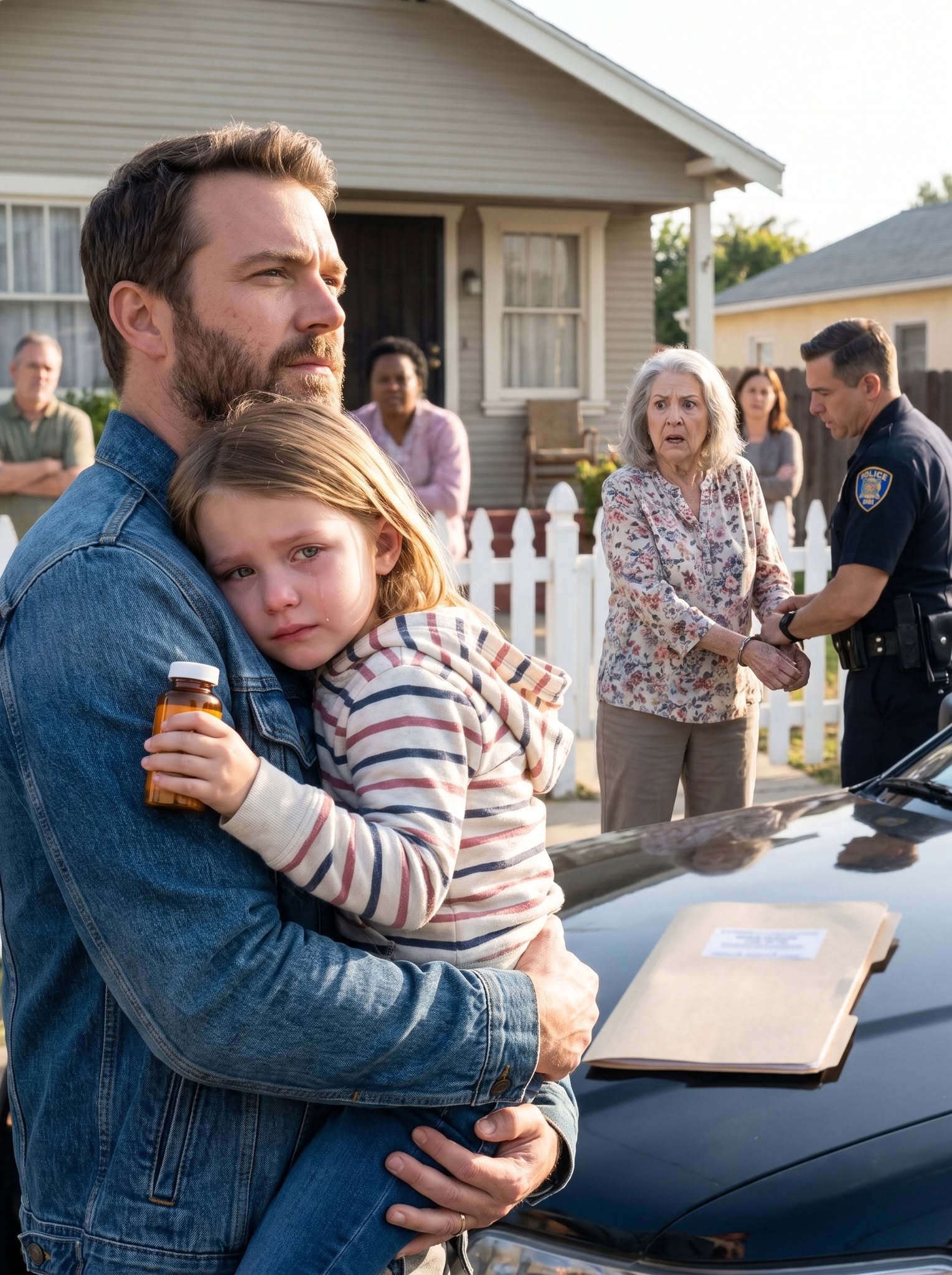
Emma led me to her purple backpack and removed a small amber prescription bottle.
The label carried Margaret’s name.
The medication was a strong adult sedative.
The bottle had been filled three weeks earlier with thirty tablets.
Only eight remained.
“How many does she give you?”
“One.”
Emma hesitated.
“Sometimes two if I don’t calm down.”
Anger rose so quickly that my vision narrowed.
But my daughter was watching my face.
“You are not in trouble,” I told her. “Put on your shoes. We’re going to see a doctor.”
At urgent care, I placed the bottle on the reception counter.
“Someone has been giving this to my child without my knowledge.”
The receptionist called a doctor immediately.
He examined Emma carefully.
He checked her breathing, reflexes and heart rate.
He asked how often she felt sleepy, dizzy or confused.
Then he asked me to step into the hallway.
“This medication was not prescribed for her,” he said. “A child this age should not be receiving it without direct medical supervision.”
“Is she in danger?”
“She appears stable now, but the fatigue and slowed reactions you described are concerning. Continued exposure could have caused serious harm.”
He held up the bottle.
“Who gave this to her?”
“Her grandmother.”
His expression hardened.
“I am required to report this.”
“Good.”
I looked through the doorway at Emma sitting on the examination table.
“Document everything.”
She fell asleep before we left the parking lot.
Her breathing was deep.
Her head leaned heavily against the car seat.
That night, I sat beside her bed and watched her chest rise and fall.
For months, I had thought she was becoming quieter because she was adjusting to kindergarten.
Her teacher had mentioned that she sometimes stared at the wall.
She stopped finishing her lunch.
She no longer ran toward the playground after school.
I had blamed grief.
Then shyness.
Then exhaustion.
Now I wondered how much of my daughter’s personality had been chemically pushed beneath a fog.
The following morning, I drove to Margaret’s house alone.
She opened the door wearing slippers and the gentle smile she used whenever neighbors were watching.
“Where is my granddaughter?”
“Why have you been giving her your prescription medication?”
The smile disappeared for half a second.
Then she denied it.
“I would never do such a thing.”
I showed her a photograph of the bottle.
Her explanation changed.
She claimed it was only a small dose.
She said Emma had become emotional, resistant and difficult to manage.
“You should be grateful,” Margaret told me. “I know what I’m doing.”
“The doctor said you could have seriously harmed her.”
“Doctors overreact now. I worked in healthcare before everyone became afraid of common sense.”
There was no apology in her voice.
No fear for Emma.
Only annoyance that I had questioned her authority.
“You will not see my daughter again,” I said.
Margaret’s face flushed.
“She is my granddaughter. You cannot keep her from me.”
“You gave an adult sedative to a five-year-old without permission. Whatever access you believed you had ended the moment she showed me that bottle.”
She accused me of being ungrateful.
She reminded me of every school pickup.
Every casserole.
Every favor after my wife’s death.
Then she said something that made me stop.
“You have no idea how difficult she is when no one is watching.”
I turned back toward her.
“She is five.”
“She needs structure.”
“She needed protection from you.”
Margaret stepped closer.
“I did what her mother would have wanted.”
The words landed harder than anything else she had said.
“My wife would never have drugged her child.”
Margaret’s mouth tightened.
“You did not know my daughter as well as you think you did.”
I walked away before anger made the decision for me.
During the following week, I rearranged my work schedule and handled every school pickup myself.
Emma became more alert each day.
She laughed louder.
She finished her meals.
She began singing while coloring at the kitchen table.
Her teacher said she had started participating again instead of staring sleepily at her desk.
I still did not understand why Margaret had taken such a risk.
The answer came from a laboratory technician at a private research facility outside town.
Her name was Dana Wells.
She called me at work.
“Are you Emma Carter’s father?”
“Yes.”
“I need to speak with you about information submitted under your daughter’s name.”
“What information?”
Dana lowered her voice.
“Your mother-in-law has been providing detailed observations about a child’s response to calming medication.”
My hand tightened around the phone.
“She claimed she had parental consent.”
“I never gave consent.”
There was a pause.
“What observations?”
“Dosages. Sleep patterns. Behavioral changes. Reaction times. Appetite. Speech. Mood.”
“Was this a medical study?”
“Not officially.”
“What does that mean?”
“The company operates a paid observational database. Caregivers submit monthly reports that are later sold as behavioral-response data.”
I stood from my desk.
“Was Margaret being paid?”
Dana hesitated.
“Five hundred dollars for every completed monthly data set.”
The office around me seemed to go silent.
“How many reports did she submit?”
“Seven.”
Seven months.
Margaret had not been trying to calm my daughter.
She had been documenting what the pills did to her.
And she had been paid every time Emma disappeared deeper into the fog.
PART 2 — The Consent Form Signed by a Dead Woman
Dana asked me to meet her after work.
She chose a coffee shop several miles from the research facility.
She arrived carrying a sealed envelope and looked over her shoulder before sitting down.
“I could lose my job for showing you this.”
“My daughter could have lost more than that.”
Dana lowered her eyes.
“I know.”
Inside the envelope were printed copies of Margaret’s reports.
Each page carried Emma’s initials, age and weight.
The reports began seven months earlier.
The first described half a tablet.
Emma became sleepy within forty minutes.
The second report recorded a full tablet.
Slurred speech.
Reduced activity.
Longer sleep.
The third documented two tablets after what Margaret called an episode of defiance.
Emma had slept for nearly six hours.
Margaret’s notes were calm.
Precise.
Almost clinical.
Subject became compliant after initial resistance.
Crying stopped after approximately eighteen minutes.
Verbal responses slowed significantly.
No vomiting observed.
I had to stop reading.
“She called my daughter a subject.”
Dana nodded.
“The database removes names before selling the information.”
“To whom?”
“Consultants. Pharmaceutical contractors. Behavioral-health companies. Anyone purchasing real-world response data.”
“Do they know how the information was collected?”
“They are told it comes from consenting caregivers.”
“I never consented.”
Dana removed one final page.
“This is the authorization form Margaret submitted.”
The signature at the bottom belonged to my wife.
Laura Carter.
My wife had been dead for two years.
For several seconds, I could not breathe.
Margaret had forged her daughter’s signature to authorize experiments on her granddaughter.
“She used a dead woman’s name.”
Dana looked ashamed.
“No one checked.”
The form also claimed Margaret was Emma’s court-appointed medical guardian.
She had attached a legal document bearing a judge’s signature.
It looked official.
It was not.
I photographed every page and called the detective assigned to the urgent-care report.
By the following morning, investigators had obtained a warrant.
They searched Margaret’s house.
In a locked filing cabinet, they found copies of Emma’s medical records.
School reports.
Photographs of her sleeping.
Charts recording how long she remained drowsy after each dose.
There were videos too.
In one, Emma sat at Margaret’s kitchen table trying to complete a puzzle.
Her fingers moved slowly.
Her head dropped forward twice.
Margaret’s voice came from behind the camera.
“Tell me how you feel.”
“Tired.”
“Can you finish the puzzle?”
“I want Daddy.”
“Answer the question.”
Emma began crying.
The recording continued for another eleven minutes.
Margaret never comforted her.
She measured how long the crying lasted.
Detectives also found prepaid cards loaded with money from the research company.
Margaret had earned thirty-five hundred dollars.
Most of it was still hidden inside the cabinet.
She had not needed the money.
Her house was paid for.
She received a pension.
She had more savings than I did.
The detective asked the question I could not answer.
“Then why did she do it?”
Margaret provided her explanation during an interview.
She said she wanted to prove that Emma had inherited behavioral problems from her mother.
According to her, Laura had been impulsive, emotional and difficult as a child.
Margaret claimed she had spent years trying to manage her.
After Laura died, she became convinced Emma would develop the same traits.
The research payments were secondary.
She wanted records.
Charts.
Numbers.
Something she could present as proof that Emma required long-term control.
Then investigators found an email Margaret had sent to a private residential treatment center.
My granddaughter has severe behavioral disturbances that her father refuses to acknowledge. I am gathering evidence to establish medical guardianship.
Attached were the sedative-response reports.
Margaret had been building a case to remove Emma from my care.
If she convinced a court that I had ignored serious behavioral problems, she planned to petition for guardianship.
The medication created the symptoms.
The reports documented them.
Margaret intended to use the damage she caused as evidence that I was failing my daughter.
That afternoon, a judge issued a protective order preventing her from contacting Emma.
The research facility turned over its internal records.
Dana’s warning had arrived just in time.
Another monthly report was due in six days.
Margaret had already requested a higher-payment category for what the company called an adjusted dosage cycle.
The application contained one question:
Is the caregiver willing to increase exposure under controlled home observation?
Margaret had checked:
Yes.
At the bottom, she had written:
Subject has developed some tolerance. A stronger response may require increased dosing.
I read the sentence in the detective’s office.
“How much was she planning to give her?”
“We do not know.”
The detective closed the file.
“But we know she intended to continue.”
That evening, Emma sat on the hotel bed coloring a picture of our old house.
She drew herself beside me.
Her mother stood on the other side.
Margaret was not in the picture.
“Daddy?”
“Yes?”
“Is Grandma mad because I showed you the bottle?”
“No.”
Emma kept coloring.
“Is she going to get in trouble?”
“Yes.”
Her crayon stopped.
“Because of me?”
I sat beside her.
“Because of what she did.”
“But she said I was helping people.”
My stomach tightened.
“What people?”
“She said the pills made doctors understand children better.”
Emma looked at me.
“She said Mommy would be proud if I was brave.”
For seven months, Margaret had used my dead wife’s memory to keep our daughter silent.
She had told Emma that feeling sick was part of helping others.
That crying meant she was being difficult.
That telling me would ruin important work.
Emma lowered her voice.
“Was I bad at helping?”
I took the crayon from her hand and held both of her small palms.
“You were never supposed to help that way.”
“But Grandma said—”
“Grandma lied.”
Emma looked toward the picture.
“Did Mommy know?”
“No.”
“Would Mommy have made me take them?”
My voice nearly failed.
“Never.”
Emma began to cry.
Not loudly.
She simply leaned against me and whispered the question she had been carrying alone.
“Then why did Grandma say Mommy wanted it?”
I held her and stared at the woman my daughter had drawn beside us.
“Because she knew you trusted your mother.”
Two days later, the attorney handling the protective order called me.
Margaret’s lawyer had submitted documents claiming I was emotionally unstable after my wife’s death.
The filing argued that I had misunderstood a legitimate caregiving arrangement.
Attached was a handwritten letter supposedly written by Laura before she died.
It granted Margaret authority to make medical decisions for Emma.
I recognized the paper immediately.
It came from a stationery set Laura kept in our bedroom.
The handwriting looked almost perfect.
Then I read the final line.
If anything happens to me, my mother will always know what is best for Emma.
Laura would never have written it.
She did not call her mother “Mother.”
She always called her “Mom.”
The forgery was good.
But Margaret had copied the wrong relationship.
PART 3 — The Recording Laura Left Behind
The letter changed the investigation.
Forgery became part of the case.
Detectives examined Margaret’s computer and found scanned samples of Laura’s handwriting.
Birthday cards.
Old school forms.
Notes from college.
She had practiced copying her daughter’s signature more than forty times.
Investigators also recovered searches about guardianship, parental incapacity and medication-related behavioral symptoms.
Margaret had not acted impulsively.
She had planned everything.
Still, her attorney insisted Laura had wanted her involved in Emma’s medical care.
He claimed the handwritten letter reflected a private agreement between mother and daughter.
Then I remembered the storage box.
After Laura died, I packed away her old phone, journals and photographs.
I had not opened the box in almost two years.
That night, after Emma fell asleep, I found it in the back of my bedroom closet.
Laura’s phone no longer held a charge.
A repair shop recovered its local voice recordings the following morning.
Most were ordinary.
Shopping reminders.
Ideas for Emma’s birthday.
A recording of Emma laughing when she was three.
Then the technician opened a file created six months before Laura died.
The title was simply:
For Daniel.
My name.
Laura’s voice filled the room.
She sounded tired.
“Daniel, I hope you never need this.”
I sat down.
“If my mother ever tells you I gave her permission to make decisions for Emma, she is lying.”
The technician stopped moving.
Laura continued.
“She did the same thing when I was young. She gave me medication that was never prescribed to me because she said I was too emotional. She kept notes about my behavior and showed them to doctors until they believed something was wrong with me.”
My hands began shaking.
Laura had never told me.
“She needs to feel necessary,” the recording continued. “And when people do not need her, she creates a reason.”
Laura paused.
In the background, I could hear three-year-old Emma singing.
“I have limited her time alone with Emma. If I get sicker, she may try to convince you that she knows better because of her healthcare experience.”
Laura’s voice broke.
“Please do not let her turn our daughter into another version of me.”
The recording ended.
For several minutes, no one spoke.
My wife had known what her mother was capable of.
She had tried to warn me.
But grief had buried the message inside a box I could not bear to open.
The recording destroyed Margaret’s final defense.
It proved the forged letter contradicted Laura’s stated wishes.
It also revealed a pattern stretching back decades.
Investigators reopened medical records from Laura’s childhood.
Several unexplained prescriptions appeared under Margaret’s insurance.
Teachers had reported Laura falling asleep in class.
Margaret described her daughter as unstable and defiant.
The same words now appeared in Emma’s research reports.
Margaret had not seen Emma becoming like her mother.
She had been recreating what she had done to Laura.
At the hearing, Margaret wore the same soft expression she used at school events and neighborhood gatherings.
Her attorney described her as a grieving grandmother who had made misguided decisions.
The prosecutor placed the prescription bottle on the evidence table.
Then the forged consent form.
The fake guardianship document.
The research reports.
The videos of Emma struggling to remain awake.
Finally, Laura’s recording played through the courtroom speakers.
Margaret’s face changed when she heard her daughter’s voice.
For the first time, she looked afraid.
Laura said:
Please do not let her turn our daughter into another version of me.
Margaret lowered her head.
After the recording ended, she asked to speak.
The judge allowed it.
“I loved my daughter,” she said.
No one answered.
“I was trying to help her.”
The prosecutor looked toward the photographs of five-year-old Emma asleep at Margaret’s kitchen table.
“And your granddaughter?”
Margaret hesitated.
“I was trying to prevent history from repeating itself.”
The prosecutor closed the folder.
“You repeated it yourself.”
Margaret pleaded guilty before the case reached trial.
The agreement included charges related to child endangerment, prescription misuse, forgery and fraud.
The research company also faced investigation for accepting pediatric data without verifying consent.
Dana left the facility.
She later told me that several other questionable caregiver accounts were discovered after Emma’s case.
Margaret sent letters from custody.
The first was addressed to me.
She said I had misunderstood her intentions.
The second was addressed to Emma.
It began:
Someday you will understand that Grandma was trying to make you better.
I never gave it to her.
Months passed.
Emma’s energy returned.
She gained weight.
She stopped falling asleep in class.
She began running toward the playground again.
But some things took longer.
She refused medicine whenever she became sick.
Even children’s fever medication frightened her.
I had to open every sealed bottle in front of her and let her watch me read the label.
One evening, she developed a fever.
The pediatrician recommended a standard children’s medicine.
Emma stared at the measuring cup in my hand.
“Will it make me fuzzy?”
“No.”
“Are you sure?”
“Yes.”
“Did Grandma give it to you?”
“No.”
She looked at me for several seconds.
Then she drank it.
That small act required more courage than anyone else would have understood.
On the second anniversary of Laura’s death, Emma and I visited the cemetery.
She placed yellow flowers beside her mother’s stone.
“Daddy?”
“Yes?”
“Did Mommy know Grandma was bad?”
I sat on the grass beside her.
“Your mother knew Grandma sometimes did dangerous things.”
“Why didn’t she tell us sooner?”
“She was frightened.”
Emma traced one finger across Laura’s name.
“Like me?”
“Yes.”
She thought about that.
“Did anyone believe Mommy?”
I looked at the grave.
“Not when she was little.”
Emma leaned against my shoulder.
“But you believed me.”
“I always will.”
She placed the final flower beneath the engraved date.
“Then maybe Mommy knows I stopped it.”
My throat tightened.
“I think she does.”
For months, I blamed myself for not seeing what was happening.
The sleepiness.
The silence.
The way Emma stopped laughing.
I had mistaken the effects of medication for grief because grief was the explanation I understood.
But children do not always reveal danger with a clear sentence.
Sometimes they become quieter.
Sometimes they stop eating.
Sometimes they stare at the wall while adults call them difficult.
And sometimes, while their father is making dinner, they ask whether they can stop taking the pills hidden inside their backpack.
Margaret had earned thirty-five hundred dollars from the reports.
She lost her freedom.
Her reputation.
And any place in Emma’s life.
But the greatest damage could not be measured in money.
She had used Laura’s name to frighten her daughter.
Then used Emma’s trust to harm her granddaughter.
Two generations of children had been told that chemical silence meant good behavior.
Laura never escaped that belief while she was alive.
Emma did.
Not because a laboratory discovered the truth.
Not because a court finally listened.
But because one evening, a five-year-old girl found enough courage to tug her father’s sleeve and ask a question.
“Daddy, can I stop taking the pills Grandma gives me?”
And this time, someone believed her.