Part 1: The Promise
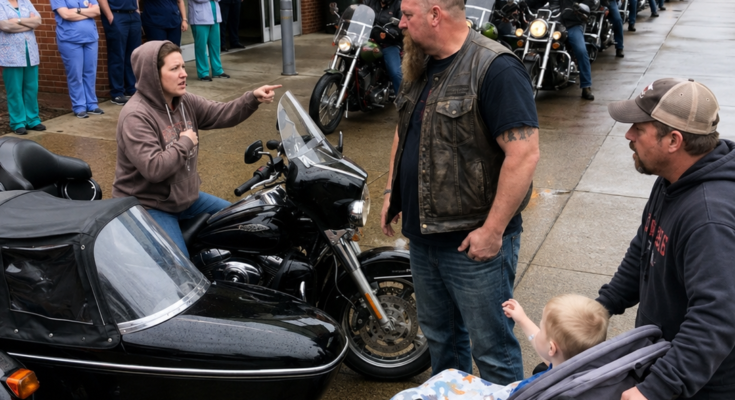
I counted the keys myself. Forty pieces of metal lay in a straight line beside the hospital curb, each placed there by a biker wearing black leather, worn denim, heavy boots, and an expression too solemn for the celebration my son expected. The motorcycles stood fifty yards away. Every engine was silent.
Eli had spent three months waiting to hear them. My son was ten years old and dying from a progressive neurological illness that had gradually taken his balance, strength, and ability to tolerate sudden sensory stimulation. He understood more about his condition than we wanted him to understand. He also loved Harleys. From his sixth-floor window at Mercy Children’s Hospital, he watched motorcycles move along Union Avenue and imagined where each rider was going.
Ray Dawson met him during a hospital toy drive. Ray stood six-foot-four, weighed nearly 285 pounds, and looked frightening enough that Eli’s nurse initially blocked the doorway. His shaved head, long black-and-gray beard, sleeve tattoos, knuckle ink, scarred hands, plain leather cut, silver skull ring, chain wallet, and motorcycle boots made him resemble trouble arriving without an appointment.
Eli pointed at his vest. “You got a bike?” Ray nodded. “Loud?” “Depends who’s complaining.”
That began their friendship. Ray returned every Friday. Eli made him describe the sound of a cold engine starting, the smell of rain on hot pavement, and the way a heavy touring motorcycle leaned beneath a rider.
When Eli’s doctors began discussing hospice care, he asked Ray for one thing. “Take me on a last ride.” Ray agreed. Hospital staff, therapists, local officials, and the Iron Lanterns spent weeks planning a short, medically supported route around the closed service road. Eli would sit in a secured sidecar while nurses remained within immediate reach.
Our family understood that plan. What we did not understand was why Ray refused to turn his key.
“Everybody is ready,” my husband told him.
Ray looked toward Eli’s neurologist. “No engines.”
“You cannot push that motorcycle with him in it.”
“Already tested.”
“This is supposed to be his ride.”
“It is.”
“No child asks for a silent Harley.”
Ray’s face tightened. “No child asks for seizures either.”
I heard cruelty in the sentence because grief had made every boundary feel like an enemy. Eli’s sensitivity had worsened. Sudden loud sound could provoke a seizure, and the combined rumble of forty motorcycles created an unacceptable risk. Ray learned that six days earlier.
Instead of canceling, he called the entire club. He ordered them to drain nothing, modify nothing unsafe, and improvise nothing near the child. They would follow the medical team’s directions, keep every engine off, and push the motorcycles along the approved flat route.
Several riders refused. “A Harley parade without engines ain’t a parade,” one man said. Ray removed the event patch from his vest and placed it on the table. “Then stay home.” Forty riders remained.
Part 2: The Secret
They practiced in an empty warehouse lot, learning to move heavy motorcycles at walking speed without starting them. They taped loose metal items, removed hanging bells, secured kickstands, checked brakes, and assigned additional pushers where sidecars required support. No one treated the ride like a stunt. It belonged to Eli.
Outside the hospital, Ray handed his key to my son. Eli closed his fingers around it. “You broke your promise,” he whispered.
Ray’s eyes moved toward the silent motorcycles. “Not yet.”
The forty riders stepped forward. Each retrieved a key from the pavement, slipped it into a pocket rather than an ignition, and took position beside a motorcycle.
Ray leaned close to Eli. “You wanted to know what a last ride sounds like.” The boy nodded. Ray began pushing. “Sometimes it sounds like everybody choosing you over the machines.”
The parade moved without engines. Forty bikers pushed their heavy Harleys along the service road while nurses walked beside the sidecar, monitoring Eli’s vitals. The silence was profound. It was reverent. It was the most beautiful sound I had ever heard.
Eli’s face relaxed. He closed his eyes and smiled. He wasn’t disappointed. He was at peace.
But Ray had one more surprise. Inside his saddlebag was a small box. Inside the box was a keychain—a miniature silver motorcycle with Eli’s name engraved on it.
“I had this made,” Ray said softly. “So when you can’t ride anymore, you can still hold a piece of the road.”
Eli clutched the keychain to his chest. “Thank you, Ray.”
“No, son. Thank you.”
The parade continued in silence. Eli’s face was peaceful, his eyes closed, his hand wrapped around the keychain.
Part 3: The Legacy
Eli passed away three days later. He died peacefully, holding the keychain Ray had given him. The last thing he heard before he closed his eyes was Ray’s voice, describing the sound of a cold engine starting, the smell of rain on hot pavement, and the way a heavy touring motorcycle leans beneath a rider.
At the funeral, forty bikers lined the road outside the church. Their engines rumbled in tribute—loud, proud, and full of grief. The sound echoed through the streets as Eli’s casket was carried inside.
Ray spoke at the service. He stood in front of the congregation, his voice cracking. “That boy taught me more about strength than anyone I’ve ever known. He faced death with a smile because he knew he was loved. And he loved motorcycles. He loved the freedom they represented. He loved the idea of a road that never ends.”
Ray paused. “I have something I want to do for him. Something I want to do for his family. For every child who dreams of a last ride.”
He announced that the Iron Lanterns would create a foundation in Eli’s name. Every year, they would take children with terminal illnesses on a “silent ride”—no engines, no noise, just bikers pushing their motorcycles so the kids could experience the freedom of the road without the risk.
“This is Eli’s legacy,” Ray said. “A reminder that sometimes, the most powerful thing you can do is choose silence. Choose love. Choose someone else over yourself.”
My husband and I wept. We had been so angry at Ray. We thought he had broken his promise. We thought he had abandoned our son. But he had done the opposite. He had given Eli the greatest gift anyone could give: the knowledge that he was worth more than any engine, more than any parade, more than any moment of glory.
The foundation grew. Dozens of children received their own silent rides. Bikers from across the country joined the cause. Every year, on the anniversary of Eli’s death, the Iron Lanterns and hundreds of other riders gathered at Mercy Children’s Hospital to honor his memory.
Eli’s keychain became a symbol of hope. Ray kept it in his saddlebag, touching it before every ride. “I carry him with me,” he told me once. “He’s still on the road. He’s just waiting for me to catch up.”
I visit Eli’s grave every month. I bring flowers. I bring the keychain Ray gave him. And I remember the silence of that ride—the forty bakers choosing a dying boy over their machines, choosing love over noise, choosing presence over performance.
Eli was only ten years old. But he taught us all something profound. He taught us that a last ride doesn’t have to be loud to be meaningful. Sometimes, the most powerful thing you can do is put your key in your pocket and push.
Ray and I became close friends. He’s still the big, intimidating biker he always was. But I see him differently now. I see the man who pushed a motorcycle for a child he barely knew because it mattered. I see the man who created a legacy that continues to bring joy to children who have no time left.
Eli’s silent ride was the most beautiful thing I’ve ever witnessed. It wasn’t a parade. It was a prayer. A sacrifice. A testament to what happens when people choose love over ego.
And every time I hear a Harley engine rumble, I remember the silence that saved my son’s spirit.
Sometimes, the loudest love is the quietest kind. ❤️