
Look across Europe and ask one simple question:
How do you say “God”?
The answers range from God, Gott and Gud in the Germanic north and west to Dieu, Dio, Dios and Deus across Romance-speaking Europe.
Travel east and another pattern appears:
Bóg, Bůh, Boh and Bog.
Farther north, Finnish gives us Jumala, while neighboring Estonian uses Jumal.
Hungarian stands apart with Isten.
Greek uses Θεός — Theós.
Turkish uses Tanrı.
Maltese uses Alla.
And tiny linguistic islands such as the Basque Country preserve completely different forms, including Jainkoa.
At first glance, this is simply a translation map.
But look more closely and it becomes something much more interesting.
The words reveal ancient language families, migrations, the Roman Empire, early Christianity and linguistic relationships stretching back thousands of years.
Some words that look almost identical are genuinely related.
Others developed separately.
And a few preserve linguistic roots older than many of Europe’s modern countries.
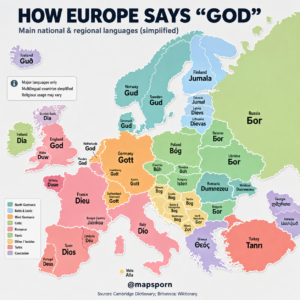
First: This Is a Language Map, Not a Religion Map
An important distinction should be made before comparing the words.
This map does not show how religious each country is.
It simply shows a common word used for “God” or “a god” in major national or regional languages.
Actual religious vocabulary can vary considerably.
A language might have separate words for:
- God
- a god or deity
- the Lord
- a supreme being
- a traditional pre-Christian deity
Capitalization can also matter.
English distinguishes between:
god — a deity in general
and
God — the proper designation commonly used for the deity of monotheistic religions.
Similar distinctions occur in many European languages.
Religious communities may also prefer traditional titles equivalent to Lord, Creator, Almighty or other sacred names.
So the map simplifies a much richer linguistic landscape.
But that simplification reveals some fascinating patterns.
The Germanic Family: God, Gott, Gud and Guð
One of the clearest language families appears across northern Europe.
England — God
English uses:
God
Netherlands — God
Dutch also uses:
God
German-speaking countries — Gott
German uses:
Gott
The same form is used in German-speaking Austria, Switzerland and neighboring German-speaking communities.
Denmark, Norway and Sweden — Gud
The Scandinavian mainland languages use:
Gud
Iceland — Guð
Icelandic preserves the visually distinctive:
Guð
These words are not merely coincidentally similar.
They descend from a common Proto-Germanic ancestor, often reconstructed as *gudą.
English god, German Gott, Dutch god and Scandinavian gud/guð are therefore linguistic cousins.
Imagine speakers living many centuries before the modern nations of England, Germany, Denmark or Sweden existed.
Their language already contained an ancestral version of this word.
As Germanic languages gradually separated, pronunciation and spelling changed.
But enough of the original form survived for us to recognize the relationship today.
That is why:
God → Gott → Gud → Guð
look like variations of the same idea.
Because historically, they are.
English “God” Is Not Related to “Good”
A popular folk explanation sometimes claims that the English words God and good must share an origin because they look similar.
Historical linguistics does not support that.
The resemblance is essentially accidental.
The Germanic word for God has a separate history from the word good.
Romance Europe: Dieu, Dio, Dios, Deus and Déu
Move south and west and another extremely recognizable pattern appears.
France — Dieu
French:
Dieu
Italy — Dio
Italian:
Dio
Spain — Dios
Spanish:
Dios
Portugal — Deus
Portuguese:
Deus
Catalonia — Déu
Catalan:
Déu
These words descend from Latin:
deus
meaning “god” or “deity.”
As spoken Latin evolved differently in various parts of the former Roman Empire, deus changed along separate paths.
Eventually it produced forms including:
- French Dieu
- Italian Dio
- Spanish Dios
- Portuguese Deus
- Catalan Déu
The relationship is especially obvious when the words are placed side by side.
This is one of the clearest reminders that the Romance languages are descendants of Latin.
Why Spanish Says “Dios” but Italian Says “Dio”
Languages do not normally transform through a single deliberate decision.
Sound changes accumulate gradually over centuries.
Vowels shift.
Consonants disappear.
Endings change.
Grammar evolves.
Local accents become dialects, and dialects eventually become separate languages.
That is how one Latin word could eventually become several different modern forms.
What looks like several unrelated words today can actually be different branches of the same linguistic family tree.
Romanian Has One of the Most Interesting Forms: Dumnezeu
Romanian is also a Romance language, but its word stands out:
Dumnezeu
At first glance it looks nothing like:
Dieu, Dio, Dios or Deus.
Yet Romanian preserves Latin ancestry here too.
The standard etymological explanation connects Dumnezeu with the Latin expression:
Domine Deus
roughly meaning:
“Lord God.”
Over centuries, the two elements fused and underwent Romanian sound changes until they became the modern word Dumnezeu. Romanian dictionaries trace the word to this Latin expression.
This is an excellent example of how a language can preserve an ancient phrase inside what eventually becomes a single ordinary word.
Romanian’s position in southeastern Europe also explains why its vocabulary and sound have been influenced by neighboring Slavic and Balkan languages.
But structurally and historically, Romanian remains a Romance language descended from Latin.
The Celtic Connection: Dia, Duw and Doue
The Celtic-speaking edges of Europe provide another fascinating pattern.
Ireland — Dia
Irish:
Dia
Scottish Gaelic — Dia
Scottish Gaelic also uses:
Dia
Wales — Duw
Welsh:
Duw
Brittany — Doue
Breton:
Doue
Again, these forms are historically related.
Irish Dia descends from Old Irish Día and ultimately from a Proto-Celtic form reconstructed as *deiwos.
Welsh Duw and Breton Doue belong to the same broad Celtic history.
And here things become even more interesting.
These Celtic forms are distantly related to the same ancient Indo-European root that lies behind Latin deus.
So the resemblance between:
Dia
Duw
Dieu
Deus
is not simply visual coincidence.
They connect deep in the prehistoric Indo-European language family.
Breton etymological sources explicitly compare Doue with Welsh Duw, Irish Dia, Gaulish forms and Latin deus.
Ireland’s “Dia” Survives in Everyday Greetings
The religious word is embedded deeply enough in Irish that it survives in traditional greetings.
Dia duit is a traditional Irish greeting literally invoking God, even though in everyday conversation it functions much like “hello.”
Ireland’s RTÉ notes the traditional response Dia is Muire duit, adding Mary to the blessing.
Language can preserve cultural history even when speakers no longer consciously think about the literal meaning of every phrase.
The Slavic World: Bóg, Bůh, Boh and Bog
Eastern and southeastern Europe reveal perhaps the most visually obvious language-family cluster.
The general Slavic root is:
Bog
but pronunciation and spelling vary.
Poland — Bóg
Polish:
Bóg
Czechia — Bůh
Czech:
Bůh
Slovakia — Boh
Slovak:
Boh
Slovenia — Bog
Slovenian:
Bog
Croatia — Bog
Croatian:
Bog
Bosnia and Herzegovina — Bog
Bosnian:
Bog
Serbia — Бог / Bog
Serbian:
Бог / Bog
North Macedonia — Бог / Bog
Macedonian:
Бог
Bulgaria — Бог / Bog
Bulgarian:
Бог
Russia — Бог / Bog
Russian:
Бог
Ukraine — Бог / Boh
Ukrainian:
Бог, commonly transliterated Boh
Belarus — Бог / Boh
Belarusian likewise uses:
Бог
These forms descend from reconstructed Proto-Slavic:
*bogъ
meaning “god.”
That means a traveler could cross a huge portion of Slavic Europe and repeatedly encounter recognizable descendants of essentially the same ancient word.
Why Does Czech “Bůh” Look So Different?
Czech underwent sound changes that transformed the old Slavic form dramatically.
The common Slavic root remained recognizable historically even though modern Czech Bůh looks less obviously like Russian Bog or Croatian Bog.
Slovak Boh provides something of an intermediate-looking example.
This illustrates an important linguistic principle:
Related words do not have to remain visually identical.
Consistent sound changes can make close relatives look surprisingly different.
Baltic Languages: Dievas and Dievs
Lithuania and Latvia provide another remarkable linguistic connection.
Lithuania — Dievas
Lithuanian:
Dievas
Latvia — Dievs
Latvian:
Dievs
These Baltic forms have ancient Indo-European roots.
Lithuanian Dievas and Latvian Dievs are descendants of a Proto-Baltic form related to the reconstructed Proto-Indo-European divine/sky vocabulary.
Now compare:
Lithuanian — Dievas
Latvian — Dievs
Latin — Deus
Irish — Dia
Welsh — Duw
The similarity becomes striking.
These languages did not borrow the modern word from one another.
Rather, they preserve different branches of an extremely old linguistic heritage.
It is like finding fragments of the same ancient word scattered across Europe.
Finland and Estonia: Jumala and Jumal
Finland and Estonia break away from Indo-European patterns because Finnish and Estonian belong to the Uralic language family.
Finland — Jumala
Finnish:
Jumala
Estonia — Jumal
Estonian:
Jumal
Their similarity is no accident.
The words share Finnic linguistic history and have long been associated with divine or sky-deity concepts.
Jumala in Finnish and Jumal in Estonian can refer to God, while related forms have older pre-Christian religious histories as well.
Finnish and Estonian are related languages, so the resemblance makes sense.
But another European Uralic language gives us a completely different-looking word.
Hungary — Isten
Hungarian uses:
Isten
Hungarian belongs to the Uralic language family alongside Finnish and Estonian.
But:
Isten
looks nothing like:
Jumala
or
Jumal.
That does not mean Hungarian is unrelated to Finnish or Estonian.
The Uralic language family separated extremely long ago.
The United Nations’ language-classification material notes that Hungarian, Finnish and Estonian all belong to the Uralic family, while also emphasizing how distant the branches have become.
This is a useful warning against assuming that related languages must always share similar words.
English and Hindi are both Indo-European too, yet most of their everyday vocabulary does not immediately look related.
Language families can survive for thousands of years while individual words are replaced.
Greece — Θεός, Theós
Greek uses:
Θεός
transliterated:
Theós
Greek occupies its own distinctive position in the European linguistic landscape.
It belongs to the Hellenic branch of the Indo-European language family.
The modern word Theós continues Ancient Greek θεός, meaning “god.”
English has borrowed many Greek-derived religious and philosophical words built from this element.
For example:
theology
ultimately combines Greek elements referring to God and study/discourse.
So even English speakers who never study Greek routinely use words carrying Greek religious vocabulary.
Turkey — Tanrı
Turkish uses:
Tanrı
This is especially interesting because Tanrı has a very old Turkic history.
It descends from earlier Turkic forms related to Tengri, an ancient word that could refer to the sky, heaven or a supreme divine being.
Turkish religious and linguistic sources trace modern Tanrı through historical teŋri forms.
Today, Turkish also uses Allah, particularly in Islamic contexts.
But Tanrı remains the general Turkish word for a god or deity and can also refer to God.
Thus modern Turkish preserves linguistic evidence of religious concepts that predate the arrival of Islam among Turkic peoples.
Malta — Alla
One of the map’s most fascinating words appears on one of Europe’s smallest countries.
Maltese:
Alla
Maltese is unique within the European Union because it is a Semitic language descended primarily from medieval Siculo-Arabic, although centuries of contact added enormous amounts of Italian, Sicilian and later English vocabulary.
Its word Alla is related to Arabic:
Allah
This sometimes surprises people because Malta is historically and overwhelmingly associated with Christianity.
But Allah is simply the Arabic word for God, and Arabic-speaking Christians use the word too.
Language and religion are not the same thing.
Maltese preserved its Semitic vocabulary even as Malta developed within a predominantly Catholic European cultural environment.
Historical linguistic descriptions classify Maltese within the Semitic linguistic tradition while noting its extensive contact with Italian.
Albania — Zot
Albanian uses:
Zot
The word can mean God, but it also carries meanings connected with “lord,” “master” or “owner.”
Albanian forms its own branch of the Indo-European language family, which is one reason much of its vocabulary does not closely resemble neighboring Greek, Italian or Slavic languages.
The history of Zot has attracted considerable linguistic study, with proposed connections to very old Indo-European sky and divine terminology.
Albanian also uses Perëndi for God or deity.
This is another reminder that selecting one word per country inevitably simplifies real usage.
Basque Country — Jainkoa
Basque gives us one of the most distinctive forms on the map:
Jainkoa
Basque is unlike almost every other major language shown because it is not Indo-European.
It is considered a language isolate, meaning no surviving language has been conclusively shown to belong to the same family.
Basque was already present in western Europe before Latin and later Romance languages came to dominate the surrounding territory.
That makes the language one of Europe’s greatest linguistic survivors.
So while neighboring Spanish says:
Dios
and French says:
Dieu,
Basque uses:
Jainkoa.
A political map barely reveals this linguistic boundary.
A vocabulary map makes it immediately visible.
Georgia — ღმერთი
Georgian uses:
ღმერთი
often transliterated approximately as:
ghmerti
Georgian belongs to the Kartvelian, or South Caucasian, language family.
It is not Indo-European and is unrelated to Russian despite centuries of geographic and political contact.
Kartvelian forms one of the world’s independent language families.
Georgia also uses its own distinctive alphabet, making its word for God visually unlike almost anything else on the map.
Armenia — Աստված
Armenian uses:
Աստված
usually transliterated:
Astvats or Astvats
Armenian is another important linguistic case.
Although geographically located in the Caucasus, Armenian is not a Caucasian language family member.
It forms its own branch within Indo-European.
Its unusual position reflects the extraordinary linguistic diversity found where Europe, Anatolia and the Caucasus meet.
One Ancient Root Appears Across Huge Parts of Europe
Perhaps the most remarkable pattern becomes visible when we compare these words:
Latin — Deus
Portuguese — Deus
Spanish — Dios
Italian — Dio
French — Dieu
Catalan — Déu
Irish — Dia
Welsh — Duw
Lithuanian — Dievas
Latvian — Dievs
Not all reached their modern forms through the same immediate path.
But many ultimately connect to ancient Indo-European vocabulary associated with divinity, brightness or the sky.
Latin deus is usually reconstructed from Proto-Indo-European deiwos, linked with an older root associated with the bright sky.
That same extremely old family of words is related to names and divine vocabulary found far beyond Europe.
It demonstrates how modern languages can preserve fragments of prehistoric belief systems.
A person saying Dieu in Paris and another saying Dievas in Vilnius are using words separated by thousands of years of linguistic evolution, yet deep history still connects them.
Christianity Did Not Erase Europe’s Older Words
Another fascinating feature is that conversion to Christianity often did not require inventing a completely new word for God.
Instead, languages frequently adapted their existing word for a deity or supreme divine power.
Germanic peoples already had an ancestral word behind God/Gott/Gud.
Slavic languages had bogъ.
Finnic languages had forms related to Jumal.
Turkic languages had Tengri/Tanrı.
Baltic languages had Dievas/Dievs.
When Christianity spread, many of these older religious terms were reused for the Christian God.
The religion changed.
The word often survived.
That is why a modern Christian prayer can contain vocabulary whose linguistic ancestry predates Christianity itself.
The Roman Empire Left a Huge Linguistic Footprint
Western and southern Europe tell a different story.
Rome spread Latin across enormous territories.
After the western Roman Empire disappeared politically, spoken Latin remained.
Over centuries it fragmented into the Romance languages.
That is why one Roman-era word eventually produced:
Deus → Dieu, Dio, Dios, Déu
while Romanian developed the remarkable Dumnezeu.
Political Rome disappeared.
Its language did not.
Hundreds of millions of people still speak descendants of Latin today.
National Borders Hide Europe’s Real Linguistic Map
Political maps encourage us to think:
One country = one people = one language.
Reality is much more complicated.
Spain contains Spanish, Catalan, Basque, Galician and other languages.
The United Kingdom includes English, Welsh and Scottish Gaelic.
Belgium has Dutch, French and German linguistic communities.
Switzerland has German, French, Italian and Romansh.
Regional languages cross national borders.
Some language families stretch across many countries.
Others survive in tiny isolated pockets.
This map becomes much more interesting when viewed as a map of linguistic ancestry rather than nationality.
A Corrected Linguistic Grouping
A more accurate simplified classification of the major languages represented on the map would look roughly like this:
Germanic
English, Dutch, German, Icelandic, Norwegian, Swedish and Danish.
Romance
French, Italian, Spanish, Portuguese, Catalan and Romanian.
Celtic
Irish, Scottish Gaelic, Welsh and Breton.
Slavic
Russian, Ukrainian, Belarusian, Polish, Czech, Slovak, Slovenian, Croatian, Bosnian, Serbian, Macedonian and Bulgarian.
Baltic
Latvian and Lithuanian.
Uralic
Finnish, Estonian and Hungarian.
Hellenic
Greek.
Albanian
Albanian forms its own Indo-European branch.
Turkic
Turkish.
Semitic
Maltese.
Kartvelian
Georgian.
Armenian
Armenian forms its own Indo-European branch.
Language isolate
Basque.
This classification shows just how linguistically diverse Europe really is.
One Word, Thousands of Years of History
The most striking lesson from the map is that a tiny piece of vocabulary can carry an enormous amount of history.
When an English speaker says God, they are using a word inherited from ancient Germanic speech.
When a Spaniard says Dios, they preserve Latin.
When an Irish speaker says Dia, the word reaches deep into Celtic and Indo-European history.
When a Pole says Bóg or a Russian says Бог, they preserve a common Slavic ancestor.
When a Finn says Jumala, an Estonian Jumal, or a Hungarian Isten, they reveal different paths within and around the Uralic world.
When a Turk says Tanrı, the word echoes ancient Turkic ideas of heaven and divinity.
And when a Maltese speaker says Alla, it reveals the remarkable survival of a Semitic language in the middle of the Mediterranean.
So this is not really a map about one religious word.
It is a map of migration, empire, language evolution and thousands of years of European history hidden inside everyday speech.
The borders may be modern.
Many of the words are ancient.
Source Note
The spellings and linguistic relationships discussed here draw on modern dictionaries and historical-linguistic references. Language maps necessarily simplify multilingual countries and regional variation. In particular, Slavic Бог should be transliterated as forms such as Bog or Boh, not “Bor”; Romanian is Romance; Hungarian, Finnish and Estonian are Uralic; Greek is Hellenic; Scottish Gaelic is Celtic; Georgian is Kartvelian; and Armenian is an Indo-European language.