
Look at southeastern Europe, Anatolia, the Black Sea and the eastern Mediterranean, and one thing becomes clear:
History here rarely belongs to only one civilization.
For thousands of years, Greek-speaking states, Hellenistic kingdoms, the Roman and Byzantine empires, Turkic dynasties, the Seljuk Turks and eventually the Ottoman Empire repeatedly expanded across many of the same regions.
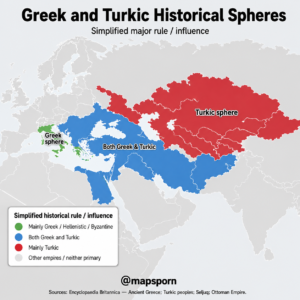
That is why the map above contains such a large blue zone representing places with significant historical connections to both Greek and Turkic worlds.
Anatolia is the clearest example.
For centuries it formed one of the most important centers of the Greek-speaking Byzantine Empire. Beginning in the Middle Ages, Turkic powers gradually established themselves across the peninsula. Eventually the Ottoman Empire grew from northwestern Anatolia, captured Constantinople and ruled a vast territory extending deep into southeastern Europe and the Middle East.
But Anatolia is only one piece of the story.
The Balkans, Black Sea coast, Cyprus, Levant and even parts of North Africa and Eurasia contain overlapping layers of Greek, Byzantine and Turkic history.
Understanding those layers helps explain why the cultural map of this region is far more complicated than today’s national borders suggest.
First: What Does “Greek Sphere” Mean?
The term Greek sphere on a map like this combines several very different historical periods.
It can include:
- Ancient Greek settlement
- Greek colonies
- Hellenistic kingdoms
- Greek language and culture
- The Greek-speaking Eastern Roman or Byzantine world
These were not all the same political entity.
Ancient Athens, Alexander the Great’s Macedonian empire and the Byzantine Empire existed centuries apart.
Yet Greek language and culture created connections between them.
Ancient Greek Civilization Was Larger Than Modern Greece
Modern Greece occupies only a relatively small portion of the territory historically influenced by Greek civilization.
Beginning especially during the great age of Greek colonization, Greek-speaking communities established settlements around much of the Mediterranean and Black Sea.
Greek cities appeared along the coasts of what are now:
- Turkey
- Italy
- France
- Spain
- Albania
- Bulgaria
- Romania
- Ukraine
- Libya
Southern Italy and Sicily became so heavily settled by Greeks that parts of the region were known collectively as Magna Graecia—“Greater Greece.”
Cities such as Syracuse, Taranto and Naples developed strong Greek connections.
This is one reason southern Italy appears naturally within the wider historical Greek world even though it is far from the modern Greek state.
Anatolia Was One of the Great Centers of the Greek World
Perhaps the most important place for understanding the map is Anatolia, modern Turkey.
Greek communities existed along its western coastline for thousands of years.
Famous ancient cities included:
- Ephesus
- Miletus
- Smyrna
- Halicarnassus
- Pergamon
Some of the most influential thinkers associated with ancient Greek civilization came from these communities.
Anatolia was therefore not simply a distant territory occasionally influenced by Greece.
Large parts of its western coast were central to the ancient Greek-speaking world.
Alexander Changed the Scale of Greek Influence
The conquests of Alexander the Great in the fourth century BCE expanded Greek and Macedonian power far beyond the Aegean.
After Alexander’s empire fragmented, successor kingdoms ruled enormous territories.
The Hellenistic world stretched across areas corresponding to parts of:
- Greece
- Turkey
- Egypt
- Syria
- Lebanon
- Israel and Palestine
- Iraq
- Iran
- Afghanistan
- Central Asia
Greek became an important language of administration, commerce and elite culture across large parts of this territory.
Cities such as Alexandria in Egypt became major centers of Hellenistic learning.
This is why Greek influence cannot be understood solely by looking at modern Greece.
For centuries, the Greek cultural world extended far to the east and south.
Then Came the Byzantine Empire
The next major layer is what historians commonly call the Byzantine Empire.
It was actually the continuation of the eastern Roman Empire.
Its inhabitants generally considered themselves Romans, but over time Greek became overwhelmingly dominant in administration and culture.
Constantinople—modern Istanbul—became its capital.
At its greatest extent, the eastern Roman/Byzantine world controlled territories in the Balkans, Anatolia, the Levant, Egypt and portions of the Mediterranean.
This explains much of the blue overlap on the map.
Many territories later associated with Turkish or Ottoman rule had previously spent centuries within a Greek-speaking Roman imperial world.
Constantinople Was the Center of That World
Few cities symbolize the overlap better than Istanbul.
Originally known as Byzantium, the city was transformed by Roman Emperor Constantine I into Constantinople.
For more than a thousand years it served as the capital of the eastern Roman Empire.
It became one of the world’s great centers of:
- Christianity
- Imperial government
- Commerce
- Architecture
- Greek learning
Then, in 1453, Ottoman Sultan Mehmed II conquered Constantinople.
The city subsequently became the capital of the Ottoman Empire.
Few places on Earth illustrate historical layering more clearly.
One city served first as the heart of a Greek-speaking Christian Roman Empire and later as the capital of one of history’s most powerful Turkic-led Muslim empires.
Where Did the Turkic World Begin?
The historical homeland of Turkic-speaking peoples lies much farther east than modern Turkey.
Early Turkic peoples emerged across the vast Eurasian steppe and Central Asia.
Over centuries, different Turkic groups migrated westward and southward.
They established states across regions that today include:
- Kazakhstan
- Uzbekistan
- Kyrgyzstan
- Turkmenistan
- Azerbaijan
- Russia
- Iran
- Turkey
This explains the large red zone across Central Asia on the map.
Countries such as Kazakhstan, Uzbekistan, Kyrgyzstan and Turkmenistan remain overwhelmingly associated with Turkic languages and historical traditions today.
“Turkic” and “Turkish” Are Not the Same Thing
This distinction is extremely important.
Turkish usually refers specifically to Turkey, its people and its language.
Turkic describes a much larger family of peoples and languages.
Turkic-speaking populations include:
- Turks
- Azerbaijanis
- Kazakhs
- Uzbeks
- Kyrgyz
- Turkmen
- Tatars
- Uyghurs
- Many smaller groups
So the red area on the map should not be interpreted as territory historically belonging to modern Turkey.
Instead, it represents the much broader historical world of Turkic peoples.
The Seljuks Changed Anatolia
One of the most important turning points occurred during the 11th century.
The Seljuks were a Turkic dynasty that had risen to power across parts of Iran, Iraq and Central Asia.
Their expansion brought them into conflict with the Byzantine Empire.
In 1071, Seljuk forces defeated the Byzantine army at the famous Battle of Manzikert.
The battle did not instantly transform Anatolia into a Turkish territory.
But it dramatically weakened Byzantine authority and helped open much of the peninsula to increasing Turkic settlement and political control.
During the following centuries, the Seljuk Sultanate of Rum became a major power in Anatolia.
This is one of the reasons Anatolia is perhaps the most important “blue zone” on the entire map.
It had been deeply connected to the Greek and Byzantine world but gradually became a major center of Turkic political and cultural life.
Anatolia Did Not Change Overnight
Historical maps often create the illusion that one empire disappears and another immediately replaces it.
Reality was far messier.
For centuries after Turkic expansion began, Anatolia contained:
- Greek-speaking Christians
- Armenian communities
- Turkic Muslims
- Kurdish populations
- Syriac Christians
- Jewish communities
- Other local peoples
Byzantine successor states survived in portions of Anatolia.
The Seljuk Sultanate fragmented.
Mongol influence arrived.
Numerous Turkish principalities, known as beyliks, emerged.
Out of that political landscape came one small principality that eventually became extraordinarily powerful.
The Ottomans.
The Rise of the Ottoman Empire
The Ottoman state began in northwestern Anatolia around the end of the 13th century.
Under Osman I and his successors, it gradually expanded into neighboring Byzantine territory.
Within generations, Ottoman forces crossed into southeastern Europe.
By the mid-14th century they were expanding through the Balkans.
Constantinople finally fell to Mehmed II in 1453, ending the Byzantine Empire.
But Ottoman expansion continued.
The empire eventually controlled large portions of:
- The Balkans
- Anatolia
- The Black Sea region
- The Levant
- Egypt
- Iraq
- Arabia
- North Africa
That expansion created one of history’s largest areas of overlap between earlier Greek/Byzantine civilization and later Turkic/Ottoman rule.
The Balkans Became a Major Overlap Zone
The Balkans are another enormous blue area on the map.
Before Ottoman expansion, much of the region had centuries of connections with the Roman and Byzantine worlds.
Greek cultural and religious influence was particularly important in areas connected with Eastern Orthodox Christianity.
Then Ottoman expansion changed the political map.
Over several centuries the Ottoman Empire ruled all or parts of modern:
- Greece
- Bulgaria
- Serbia
- Bosnia and Herzegovina
- Albania
- North Macedonia
- Kosovo
- Montenegro
- Romania
- Hungary
- Croatia
The exact duration of rule differed greatly from place to place.
Some regions remained under Ottoman control for centuries.
Others changed hands repeatedly.
Greece Itself Was Ruled by the Ottomans
Even the heartland of modern Greece became part of the Ottoman world.
After the decline of Byzantine and other Christian states, Ottoman forces gradually conquered most Greek territories during the 15th century.
Different areas remained under Ottoman, Venetian or other control at different times.
The Greek War of Independence eventually began in 1821 and led to the establishment of an independent Greek state.
So even territory shown as primarily “Greek” on a cultural map can contain centuries of Ottoman history.
That demonstrates why these categories must be treated as simplified historical summaries rather than exclusive zones.
Thessaloniki Is Another City of Overlapping Histories
Modern Thessaloniki is one of Greece’s most important cities.
Its history illustrates the same layering found in Istanbul.
Founded in the Hellenistic era, it later became a major Roman and Byzantine center.
The Ottoman Empire captured it in 1430.
It remained under Ottoman rule for nearly five centuries before becoming part of Greece during the Balkan Wars in 1912.
During its Ottoman centuries, Thessaloniki was home to:
- Greek Orthodox Christians
- Muslims
- Sephardic Jews
- Slavic-speaking populations
- Other communities
For long periods, it was one of the most culturally diverse cities in the Mediterranean.
The Black Sea Was Another Shared Historical Space
The Black Sea looks peripheral on many modern maps.
Historically, it was anything but peripheral.
Ancient Greeks established numerous colonies around its coastline.
Important Greek settlements existed in areas now belonging to:
- Turkey
- Bulgaria
- Romania
- Ukraine
- Russia
- Georgia
Centuries later, different Turkic-speaking peoples became major powers across the northern Black Sea and Eurasian steppe.
These included groups associated with:
- Cumans
- Kipchaks
- Tatars
- Crimean Tatars
- Ottomans
The Ottoman Empire eventually dominated much of the Black Sea’s southern and western coastline, while the Crimean Khanate became an important Ottoman ally and tributary state.
The result was another large region where Greek, Slavic, Turkic, Tatar and other influences overlapped.
Cyprus Shows the Same Pattern
Cyprus has exceptionally deep connections with the Greek world.
Greek language and culture became established on the island in antiquity.
Cyprus later belonged for long periods to the Byzantine world.
But in 1571, the Ottoman Empire conquered the island from Venice.
Ottoman rule introduced a substantial Turkish Muslim population whose descendants became the Turkish Cypriot community.
Today Cyprus remains culturally associated with both Greek and Turkish populations.
Its modern political division is the result of much more recent events, but the deeper historical roots of both communities reach back centuries.
The Levant Had Greek and Ottoman Chapters
The Levant—roughly modern Syria, Lebanon, Israel, Palestine and Jordan—also experienced layers associated with both traditions.
Following Alexander’s conquests, parts of the region became deeply integrated into the Hellenistic world.
Greek-speaking kingdoms ruled major territories.
Cities adopted Hellenistic institutions.
Greek remained influential under Roman rule and became especially important within the eastern Mediterranean Christian world.
Much later, the Ottoman Empire conquered most of the Levant during the early 16th century.
Ottoman rule continued across much of the region until World War I.
But calling the Levant simply “Greek and Turkic” would leave out enormous parts of its history.
The region was also shaped profoundly by:
- Phoenicians
- Jews
- Romans
- Arabs
- Persians
- Crusaders
- Mamluks
- Armenians
- Kurds
- Many other peoples
The blue color should therefore indicate historical overlap, not exclusive dominance.
Egypt Also Experienced Both Worlds
Egypt might initially seem unusual on this map.
Yet it too has substantial connections to both historical spheres.
Alexander the Great conquered Egypt in 332 BCE.
After his death, the Ptolemaic dynasty established a Greek-speaking kingdom centered on Alexandria.
Alexandria became one of the greatest cities of the ancient world.
The famous Library of Alexandria and the intellectual community surrounding it made the city a center of Hellenistic science and scholarship.
Centuries later, Egypt came under Byzantine rule as part of the eastern Roman Empire.
Arab armies conquered it in the seventh century.
Then, in 1517, the Ottoman Empire defeated the Mamluks and incorporated Egypt into the Ottoman imperial system.
Thus Egypt experienced important Greek/Hellenistic, Roman/Byzantine, Arab, Mamluk and Ottoman phases.
The Caucasus Is Much More Complicated
The map’s Caucasus region requires particular caution.
Modern countries such as:
- Georgia
- Armenia
- Azerbaijan
have extremely deep and distinctive histories of their own.
Greek and Byzantine influence reached parts of the Caucasus, especially through trade, Christianity and Black Sea connections.
Turkic influence also became enormously important.
Seljuk expansion affected the region.
Azerbaijan eventually developed a predominantly Turkic-speaking population.
Ottoman and Persian empires competed repeatedly for influence in the Caucasus.
But the region cannot accurately be reduced to either Greek or Turkic history.
Armenian, Georgian, Persian and Russian civilizations were also fundamental.
Iran Was Often Ruled by Turkic Dynasties Without Becoming “Turkish”
Another distinction is important when looking toward Iran.
From the medieval period onward, various dynasties of Turkic origin ruled large parts of Persia.
These included the Seljuks and later several other Turkic or Turkmen dynasties.
Yet Persian culture remained enormously influential.
In fact, many Turkic rulers became patrons of Persian language, literature and administration.
This produced a fascinating pattern historians sometimes describe as a Turko-Persian tradition.
So political rule by a Turkic dynasty did not necessarily mean that the population became culturally Turkish.
Identity, language and political power do not always move together.
Central Asia Is the Core of the Wider Turkic Sphere
Moving farther east, the Greek element diminishes while Turkic history becomes increasingly dominant.
Modern:
- Kazakhstan
- Kyrgyzstan
- Uzbekistan
- Turkmenistan
all have strong Turkic linguistic and cultural identities.
This is closer to the historical homeland of many Turkic-speaking peoples than modern Turkey itself.
Turkic migrations moved both west and east over enormous distances.
That is why related Turkic languages are spoken today from southeastern Europe all the way to western China and Siberia.
But Even Central Asia Had a Greek Chapter
This is where the map becomes especially interesting.
Even areas usually considered part of the Turkic or Persian historical world experienced episodes of Greek influence.
Alexander’s armies reached deep into Central Asia.
Hellenistic successor states appeared in regions corresponding to modern Afghanistan, Uzbekistan, Tajikistan and surrounding areas.
The Greco-Bactrian Kingdom is perhaps the most famous example.
For centuries, Greek artistic and political traditions existed astonishingly far from the Mediterranean.
So even the supposedly clean red and green boundaries become fuzzy when the timeline is extended far enough.
Why Anatolia Is the Ultimate Overlap Zone
If one region summarizes the entire map, it is Anatolia.
Its history includes:
Hittites
then numerous Anatolian kingdoms,
then extensive Greek settlement,
then Persian rule,
then Alexander and the Hellenistic kingdoms,
then Rome,
then the Greek-speaking Byzantine Empire,
then Seljuk Turkish states,
then competing Byzantine and Turkic principalities,
then the Ottoman Empire,
and finally modern Turkey.
No single label can represent all of that history.
The same landscape contains:
- Ancient Greek ruins
- Roman roads
- Byzantine churches
- Seljuk caravanserais
- Armenian churches
- Ottoman mosques
- Modern Turkish cities
This is precisely why maps of historical “spheres” are fascinating.
They reveal overlap rather than neat separation.
Greek and Turkish Cultures Also Influenced Each Other
Centuries of living within the same regions inevitably created cultural exchange.
Greek and Turkish cuisines share numerous dishes and culinary traditions.
Depending on the language and region, familiar foods appear under related or competing names.
Examples include traditions involving:
- Baklava
- Dolma
- Yogurt
- Grilled meats
- Stuffed vegetables
- Coffee
- Meze
- Pastries
Trying to assign every shared food exclusively to one modern nation can be historically difficult because Ottoman and eastern Mediterranean cuisine developed through centuries of exchange among Greeks, Turks, Armenians, Arabs, Persians, Jews, Balkan peoples and others.
Music shows similar overlap.
So do architecture, vocabulary, clothing and urban traditions.
Religion Created Both Boundaries and Connections
Religion became another defining feature.
The Byzantine world was predominantly Christian and eventually strongly associated with Eastern Orthodoxy.
The Ottoman state was Muslim, but it ruled enormous Christian and Jewish populations.
Orthodox Christians continued living throughout the Ottoman Balkans and Anatolia.
The Ecumenical Patriarchate of Constantinople itself continued operating under Ottoman rule.
Thus the Ottoman conquest did not simply erase Byzantine Christianity.
Institutions, communities and traditions survived within a new political system.
Modern National Borders Can Distort Ancient History
One of the biggest mistakes when reading a map like this is imagining today’s countries existing thousands of years ago.
They didn’t.
There was no modern Greece during Alexander’s lifetime.
There was no modern Turkey during the Byzantine era.
There was no modern Syria, Bulgaria, Serbia or Kazakhstan for most of the periods represented.
Even the concepts of Greek and Turkic identity changed dramatically over time.
Historical maps that color modern countries therefore translate an extremely complicated past into something understandable at a glance.
That is useful.
But it inevitably sacrifices detail.
This Is Not a Map of “Who Owns” the Past
Historical influence should never be confused with modern territorial claims.
Ancient Greek settlement in Anatolia does not make modern Turkey “Greek.”
Centuries of Ottoman rule in Greece do not make modern Greece “Turkish.”
Likewise, Byzantine rule in the Balkans does not erase Slavic, Albanian, Romanian or other histories.
Empires routinely ruled populations very different from the ruling dynasty.
Borders moved.
Languages changed.
People migrated.
Religions spread.
Communities mixed.
Modern countries inherited all of those layers.
The Map’s Blue Zone Is the Most Interesting Part
At first glance, the red and green areas may seem like the most important features.
But historically, the blue overlap zone tells the richer story.
It includes many of the places where civilizations repeatedly met:
- Anatolia
- The Balkans
- The Black Sea
- Cyprus
- The Levant
- Egypt
- Portions of the Caucasus and Middle East
These regions were not empty spaces passed back and forth between two peoples.
They were homes to enormous numbers of communities with their own histories.
Greek and Turkic powers were simply two particularly important layers.
Istanbul Is the Perfect Symbol
If the entire map had to be reduced to a single city, Istanbul would probably be the best choice.
It began as a Greek settlement.
It became a Roman imperial capital.
It became the center of the Greek-speaking Byzantine world.
It was conquered by the Ottoman Turks.
It became the Ottoman imperial capital.
And today it is Turkey’s largest city.
Its architecture physically displays those layers.
The Hagia Sophia began as a Byzantine Christian cathedral, later became an Ottoman mosque, subsequently became a museum and today functions again as a mosque.
Nearby stand Ottoman imperial monuments built centuries later.
Few cities better demonstrate that historical civilizations do not simply replace one another.
They leave layers behind.
The Bigger Lesson
The map may appear to divide Eurasia into:
Greek
Turkic
and
both
But the real lesson is almost the opposite.
History does not divide neatly.
The Mediterranean, Balkans, Anatolia and Eurasian steppe were enormous networks through which armies, merchants, religions, languages and families moved for thousands of years.
Ancient Greek colonists crossed the Mediterranean and Black Sea.
Alexander’s armies carried Hellenistic culture deep into Asia.
The Byzantine Empire connected southeastern Europe with Anatolia and the eastern Mediterranean.
Turkic peoples moved west from Eurasia.
The Seljuks transformed medieval Anatolia.
The Ottomans created an empire stretching across three continents.
Each civilization inherited something from those before it—and left something for those that followed.
That is why so much of the map is blue.
It does not show territory belonging to two modern nations.
It shows places where different historical worlds repeatedly overlapped.
And that overlap is one of the main reasons southeastern Europe and the eastern Mediterranean remain among the most culturally complex regions on Earth.
Source and Method Note
This map is a simplified visualization of major historical rule and cultural influence. It combines very different periods—including ancient Greek settlement, the Hellenistic world, the Greek-speaking Byzantine Empire, Turkic migrations, Seljuk rule and Ottoman expansion. Political boundaries and identities changed repeatedly, and many areas shown also had major Roman, Persian, Arab, Armenian, Slavic, Georgian, Mongol and other influences. It should therefore be read as an introductory historical comparison rather than a precise territorial or ethnic map. The Byzantine Empire’s historical core included portions of the Balkans, Anatolia, the Levant and Egypt, while the Ottoman Empire later expanded across southeastern Europe, Anatolia, the Middle East and North Africa.