
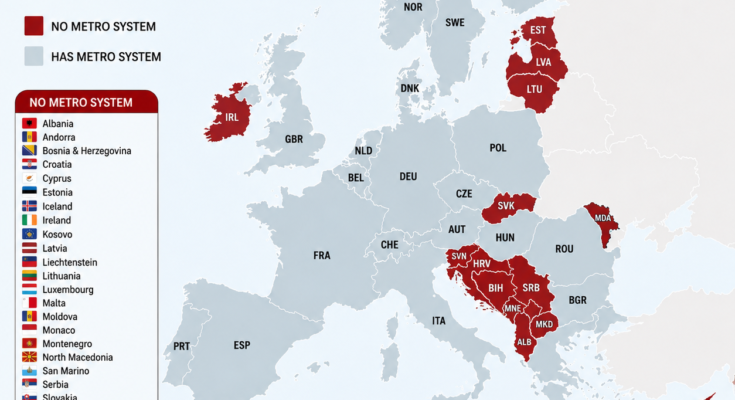
When people picture transportation in Europe, metro systems are often one of the first things that come to mind.
London has the Underground. Paris has the Métro. Madrid has one of Europe’s largest subway networks. Berlin has the U-Bahn, while cities such as Prague, Vienna, Budapest, Stockholm and Copenhagen all have extensive rapid-transit systems.
But a surprising number of European countries still do not have a single operating metro system.
Based on the definition of a metro as a high-capacity urban rapid-transit railway, there are roughly 23 European countries without an operating metro system.
They range from tiny states such as Vatican City and Monaco to countries with millions of residents, including Ireland, Serbia, Croatia and Slovakia.
And in many cases, the reason isn’t simply population.
The European Countries Without an Operating Metro
The countries shown on the map are:
- Albania
- Andorra
- Bosnia and Herzegovina
- Croatia
- Cyprus
- Estonia
- Iceland
- Ireland
- Kosovo
- Latvia
- Liechtenstein
- Lithuania
- Luxembourg
- Malta
- Moldova
- Monaco
- Montenegro
- North Macedonia
- San Marino
- Serbia
- Slovakia
- Slovenia
- Vatican City
Together, they show just how differently European countries have developed their public transportation networks.
Some are too small to justify a metro. Others rely heavily on trams, buses or suburban rail. A few are currently planning or constructing their first metro.
What Actually Counts as a Metro?
This distinction is important.
A country can have excellent public transportation without having a metro.
Metro systems generally operate on dedicated infrastructure that is separated from ordinary road traffic. Trains run frequently and are designed to move large numbers of passengers around densely populated urban areas.
The tracks may be underground, elevated or at ground level.
That means “metro” does not simply mean any train running through a city.
Trams, streetcars, commuter trains and many light-rail systems are normally treated as separate categories.
This explains why several countries on the map appear surprising.
Ireland
Ireland is one of the most notable examples.
Dublin is a major European capital, yet Ireland still has no operating metro.
That doesn’t mean Dublin lacks rail transportation. The city has the Luas tram/light-rail network and DART suburban rail, along with buses and conventional rail services.
What it lacks is a fully segregated metro.
That is expected to change eventually.
Ireland is developing MetroLink, a high-capacity rail line planned to connect Swords, Dublin Airport and central Dublin.
The project reached an important milestone in January 2026 when its Railway Order became operative. Procurement and preparatory work have also been moving forward.
Until passenger service actually begins, however, Ireland remains a country without an operating metro.
Serbia
Serbia presents a similar situation.
Belgrade is one of the largest European cities without an operating metro system.
For decades, different versions of a Belgrade Metro were discussed without becoming reality.
That is now changing.
Work on the future system is progressing, and in April 2026 officials announced factory testing of tunnel-boring machines intended for construction of the first line.
The project is therefore much more than a simple proposal, but passengers still cannot ride a Belgrade Metro today.
Until commercial service begins, Serbia remains in the “no operating metro” category.
Croatia
Croatia has no metro system despite having several important cities.
Zagreb instead relies heavily on its extensive tram network, combined with buses and suburban railway services.
For a city of Zagreb’s size and layout, trams have historically performed much of the role that underground trains perform in larger European capitals.
Building a metro would also require enormous investment.
This demonstrates an important point: not having a metro doesn’t necessarily indicate poor public transportation.
Sometimes another transportation system already fills much of the need.
Slovakia
Slovakia is another relatively populous European country without a metro.
Its capital, Bratislava, relies primarily on:
- Trams
- Trolleybuses
- Buses
- Regional trains
Bratislava’s population and urban form have generally made expanding surface transportation more practical than constructing an extremely expensive underground system.
Slovenia
Slovenia also has no metro.
Ljubljana is the country’s largest city, but it is relatively small compared with major metro-equipped capitals such as London, Paris, Madrid or Berlin.
Buses and conventional rail therefore remain more practical for its transportation needs.
The Baltic States
Perhaps one of the most interesting regions on the map is the Baltic.
None of the three Baltic states has an operating metro:
Estonia — no metro
Latvia — no metro
Lithuania — no metro
Tallinn, Riga and Vilnius all have substantial public-transportation networks, but none operates a conventional metro system.
Their comparatively modest metropolitan populations have made buses, trolleybuses and other surface transit more common solutions.
The Balkans Have a Large Metro-Free Zone
The map also reveals a large concentration of countries without metros across the Balkans.
They include:
- Albania
- Bosnia and Herzegovina
- Croatia
- Kosovo
- Montenegro
- North Macedonia
- Serbia
- Slovenia
Several factors help explain this pattern.
Many cities in the region are smaller than the huge metropolitan areas where metro networks usually make the most economic sense.
Construction costs are another major factor.
Underground metro lines can cost billions of dollars. Governments therefore have to weigh metro construction against improving roads, buses, railways, trams and other infrastructure.
Belgrade’s emerging metro illustrates how this pattern may gradually change.
Iceland
Iceland is one of the easiest cases to understand.
The entire country’s population is only a few hundred thousand people, with a large percentage concentrated in the Reykjavík region.
There simply isn’t the passenger volume normally associated with a full-scale underground metro.
Reykjavík therefore relies primarily on road-based public transportation.
Cyprus
Cyprus has no metro system either.
Its relatively small population and dispersed urban centers make metro construction difficult to justify economically.
Road transportation and buses remain much more important.
Malta
Malta is particularly interesting because it is densely populated.
However, density by itself does not guarantee a metro.
The country’s small geographic size, existing development patterns, construction challenges and enormous cost of underground infrastructure make a conventional metro a major undertaking.
Malta therefore continues to rely largely on buses and roads.
Luxembourg
Luxembourg may surprise some readers because it is one of Europe’s wealthiest countries.
But its national population remains relatively small.
Luxembourg City has instead invested heavily in trams, buses and conventional rail connections.
Again, this demonstrates that metro construction is not simply determined by how wealthy a country is.
Population, urban density, travel patterns and existing infrastructure all matter.
Europe’s Microstates
Several countries on the list are so small that constructing a traditional metro would make little sense.
These include:
Andorra
Andorra is a tiny mountainous country between France and Spain with a population of only around 80,000.
Liechtenstein
Liechtenstein has a population of roughly 40,000 and is served by road and regional railway connections.
Monaco
Monaco is extremely densely populated but covers only about two square kilometers.
It has railway infrastructure and extensive connections with neighboring France, but no conventional metro network of its own.
San Marino
San Marino has only around 30,000 residents and is completely surrounded by Italy.
Vatican City
Vatican City is the smallest independent state in the world.
A national metro network would obviously be unnecessary when the entire country occupies less than half a square kilometer.
Moldova
Moldova also has no metro.
Chișinău is by far the country’s largest city, but buses and trolleybuses remain the backbone of its urban transportation network.
Building underground rapid transit would require enormous investment relative to the city’s size and passenger demand.
Why Do Some Small Countries Have Metros While Larger Ones Don’t?
Population alone doesn’t determine whether a metro is practical.
The more important question is usually how many people are concentrated in one metropolitan area.
A relatively small country can support a metro if it has one extremely dense urban center.
Meanwhile, a larger country may have its population distributed among many smaller cities.
Other important factors include:
- Population density
- Commuter demand
- Traffic congestion
- Construction costs
- Geography
- Existing rail infrastructure
- Government investment
- Availability of trams and buses
- Historical development of the city
This is why simply comparing national populations can be misleading.
Having No Metro Doesn’t Mean Having Bad Public Transportation
This is probably the biggest misconception created by maps like this.
Some countries without metros still have efficient public-transport systems.
A city might rely on trams every few minutes instead of underground trains.
Another might use commuter rail.
Smaller cities may be well served by buses.
Metro systems become especially valuable when enormous numbers of people need to travel through the same dense corridors and surface streets no longer have enough capacity.
For smaller cities, constructing tunnels and underground stations can be unnecessarily expensive.
Greece Shows How the Map Can Change
Greece is not included among the metro-free countries.
Athens has long operated a metro network, while Thessaloniki opened its own metro in late 2024.
That provides a useful reminder that maps like this can change as new systems are completed.
Ireland and Serbia could eventually disappear from the list as their major metro projects progress.
Europe’s Metro Divide
The geographic pattern is fascinating.
Western Europe’s largest countries generally have multiple metro systems.
Germany, France, Spain, Italy and the United Kingdom all have several metro-equipped cities.
Northern Europe has a mixture: Sweden, Norway, Finland and Denmark operate metro systems, while Iceland does not.
Central Europe contains famous systems in Prague, Vienna, Budapest and Warsaw, while Slovakia and Slovenia remain without metros.
The Balkans contain the largest cluster of metro-free countries, although Serbia is now working to change that.
The Map May Look Simple, but the Story Isn’t
At first glance, the map appears to divide Europe into two categories:
Countries with metros and countries without them.
But the transportation reality is much more complicated.
Some countries without metros have excellent tram networks.
Others are simply too small to need underground rapid transit.
Some lack the population density required to justify the enormous construction cost.
And a few are already building the systems that could eventually remove them from the map.
So the most interesting question isn’t simply:
“Why doesn’t this country have a metro?”
It is:
“What transportation solution makes the most sense for the cities that people actually live in?”
That answer can be very different from one European country to another.
Source note: The original map uses UrbanRail.net’s European metro-system data. Metro status can change as projects open. As of 2026, Dublin’s MetroLink is progressing toward construction and Belgrade’s first metro is under development, but neither country currently has an operating metro system.