
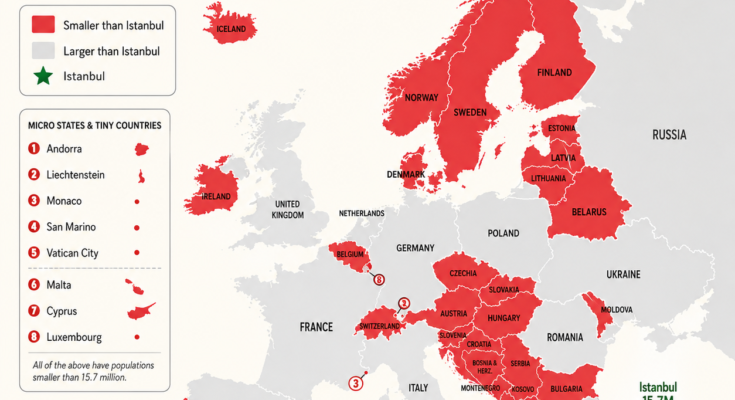
Istanbul is not a country, yet its population is larger than that of most individual countries in Europe.
According to Turkey’s official 2024 population statistics, Istanbul had roughly 15.7 million residents. Put that number on a map of Europe and the scale of the city becomes striking: countries stretching from Iceland to Bulgaria have fewer people than this single metropolitan province.
The comparison is a useful reminder that population and geographic size are very different things. Some European countries cover tens of thousands of square kilometers but still have fewer residents than Istanbul.
Istanbul: A City of 15.7 Million People
Istanbul is Turkey’s largest city and its economic and cultural center. It sits on both sides of the Bosporus, meaning the city physically spans Europe and Asia.
With approximately 15.7 million residents in 2024, Istanbul alone contains a population comparable to that of a medium-sized European country.
To put that into perspective, Istanbul has more residents than countries such as:
- Belgium
- Sweden
- Portugal
- Greece
- Hungary
- Austria
- Switzerland
- Bulgaria
- Denmark
- Finland
- Norway
- Ireland
And those are only some of the examples.
Northern Europe: Almost Every Country Is Smaller Than Istanbul
The comparison is especially dramatic in Northern Europe.
Sweden
Sweden has roughly 10.5–10.6 million people, meaning Istanbul contains several million more residents despite Sweden occupying an enormous territory.
Sweden covers about 450,000 square kilometers, while Istanbul Province is only a tiny fraction of that area.
Norway
Norway has approximately 5.5 million residents.
That means Istanbul has close to three times Norway’s population.
Norway’s long coastline, mountainous geography and relatively low population density help explain why such a geographically large country has far fewer residents.
Finland
Finland has around 5.6 million people, also far below Istanbul’s population.
Denmark
Denmark has about 6 million residents, less than half Istanbul’s population.
Iceland
Iceland provides one of the most extreme comparisons. The country has fewer than 400,000 residents.
Istanbul therefore has roughly 40 times Iceland’s population.
The Baltic States Are Much Smaller
All three Baltic countries have populations far below Istanbul’s.
Estonia has roughly 1.3 million residents.
Latvia has fewer than 2 million.
Lithuania has fewer than 3 million.
Combined, the three Baltic states still have substantially fewer residents than Istanbul.
Central Europe Shows the Same Pattern
Several prosperous and highly developed Central European countries also fall below Istanbul’s population.
Austria
Austria has approximately 9 million residents.
Istanbul therefore has around 6 million more people than the entire country.
Switzerland
Switzerland has close to 9 million people, making its population significantly smaller than Istanbul’s despite being one of Europe’s most economically important countries.
Czechia
Czechia has approximately 10.9 million residents, again several million below Istanbul.
Slovakia
Slovakia has roughly 5.4 million people.
Hungary
Hungary has around 9.5 million residents, meaning Istanbul exceeds it by more than 6 million people.
Slovenia
Slovenia has just over 2 million residents.
The Balkans Contain Many Countries Smaller Than Istanbul
The population contrast becomes even more noticeable across southeastern Europe.
Greece
Greece has approximately 10 million residents, despite being an entire country with dozens of inhabited islands and major cities such as Athens and Thessaloniki.
Bulgaria
Bulgaria’s population is roughly 6.4 million.
Istanbul therefore has more than twice as many residents.
Serbia
Serbia has roughly 6.6 million people, excluding Kosovo in many international population datasets.
Croatia
Croatia has fewer than 4 million residents.
Bosnia and Herzegovina
Bosnia and Herzegovina has roughly 3 million people.
Albania
Albania has fewer than 3 million residents.
North Macedonia
North Macedonia has fewer than 2 million people.
Montenegro
Montenegro has only around 600,000 residents.
Kosovo
Kosovo’s population is also far below Istanbul’s, at roughly 1.5–1.6 million people, depending on the source and population estimate used.
Portugal Has Fewer People Than Istanbul
Portugal is particularly interesting because it is a well-known Western European country with several major urban centers.
Portugal has roughly 10.5 million residents.
Istanbul alone therefore has about five million more people than all of Portugal.
Ireland Is Also Much Smaller
The Republic of Ireland has approximately 5.4 million residents.
Even if the entire island of Ireland were considered, including Northern Ireland, its combined population would still remain far below Istanbul’s.
Belgium Is Smaller Too
Belgium has around 11.8 million residents.
Despite being home to Brussels—the headquarters of major European Union institutions—and having one of Europe’s highest population densities, Belgium still has several million fewer residents than Istanbul.
Which Major European Countries Are Larger Than Istanbul?
Not every European country falls below the 15.7-million threshold.
Countries clearly more populous than Istanbul include:
- Germany
- France
- United Kingdom
- Italy
- Spain
- Poland
- Romania
- Ukraine
- Russia
- The Netherlands
These countries remain above Istanbul’s population individually.
The Netherlands is particularly close compared with Europe’s largest countries, with a population of roughly 18 million.
Europe’s Microstates Make the Comparison Even More Extreme
Europe also contains several tiny sovereign states whose populations are minuscule compared with Istanbul.
Vatican City
Vatican City has fewer than 1,000 residents, making it the world’s smallest sovereign state by population.
San Marino
San Marino has only around 34,000 residents.
Monaco
Monaco has roughly 39,000 residents.
Liechtenstein
Liechtenstein has approximately 40,000 people.
Andorra
Andorra has roughly 80,000 residents.
Istanbul’s population is therefore hundreds—or in some cases thousands—of times larger than Europe’s smallest countries.
Mediterranean Island Countries
Several European island nations also have dramatically smaller populations.
Malta
Malta has roughly half a million residents.
Despite being one of Europe’s most densely populated countries, its total population remains tiny compared with Istanbul.
Cyprus
Cyprus has roughly 1.3 million residents, depending on the population definition and territory included in the estimate.
Again, Istanbul is many times larger.
Why Is Istanbul So Populous?
Istanbul’s enormous population is the result of centuries of geographic and economic importance.
The city occupies one of the world’s most strategically valuable locations. The Bosporus connects the Black Sea with the Sea of Marmara, which in turn connects to the Mediterranean.
For centuries, Istanbul—formerly Constantinople—served as the capital of major empires.
Today it remains Turkey’s largest center for:
- Finance
- Trade
- Manufacturing
- Tourism
- Transportation
- Education
- Media
- Technology
- Culture
Millions of people have migrated to Istanbul from other parts of Turkey in search of employment, education and economic opportunity.
That long-term internal migration helped transform Istanbul into one of Europe’s largest urban concentrations.
A City Larger Than Entire Nations
What makes this comparison fascinating is not simply that Istanbul is large.
It demonstrates how unevenly Europe’s population is distributed.
Norway is hundreds of times larger than Istanbul geographically but has only around one-third as many people.
Sweden has vast forests, thousands of lakes and enormous territory, yet Istanbul still contains several million more residents.
Meanwhile, countries such as Montenegro, Iceland and Malta contain only a tiny fraction of Istanbul’s population.
The comparison shows why population maps can sometimes be more revealing than political maps.
Borders make countries appear dominant because of their physical size, but land area tells us very little about how many people actually live there.
The Bigger Picture
With around 15.7 million residents, Istanbul functions on the demographic scale of an entire European nation.
If Istanbul were hypothetically treated as an independent country and compared purely by population, it would rank above a large majority of European states.
Only Europe’s larger nations would clearly surpass it.
That is remarkable for a single city.
And it helps explain why Istanbul feels less like an ordinary metropolitan area and more like a country-sized urban world of its own.
Source note: Istanbul’s 2024 population figure is based on official Turkish population statistics. Individual European country populations vary slightly depending on the reference year and whether estimates, census results or official national statistics are used.