PART 1: The Girl Behind The Windshield
“Open the gate, Paige. We’ve been driving for three hours, and the kids are exhausted.”
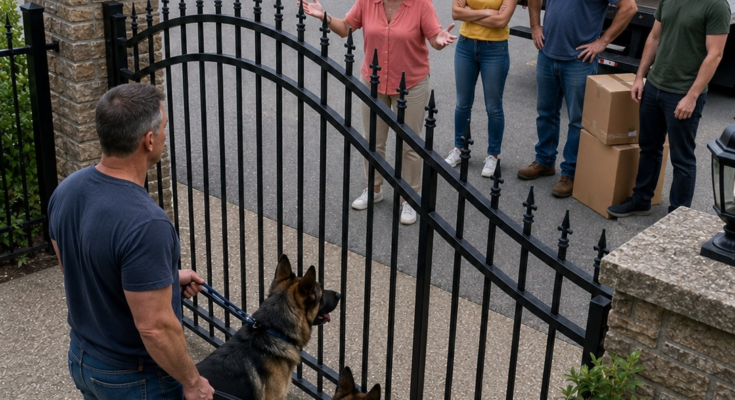
My mother’s voice came through the intercom while I was reviewing payroll for my twelve employees. On the monitor, she stood in her beige coat beside my twin sister Mallory, her husband Grant, and their three kids — a rented moving truck blocking half my entrance, boxes already stacked at the gate.
“The downstairs suite should be perfect for us,” Mallory said into the intercom, already assigning rooms.
“Is that building heated?” Grant asked, eyeing my workshop. “I could set up a furniture business in there.”
They were dividing my property before I’d said a single word.
Mallory and I were born seven minutes apart, but Mom treated that gap like proof my sister deserved everything first — the bedroom with the window, the dance lessons, the birthday parties. I got her old clothes and constant reminders that I was “easier.” Only my grandmother Elaine ever really saw me, until she died my senior year.
Months after graduation, Mallory got pregnant, and Mom decided my room was needed for the crib. When I asked where I was supposed to sleep, Mom said flatly, “You’re nineteen, Paige. At some point, you have to stop being my responsibility.”
I packed two trash bags and left with canned soup and a sentence: “Tell people you chose to move out. It sounds more responsible.”
I lived in a tent behind a flea market, cleaned up in gas station bathrooms, and one rainy afternoon, collecting shopping carts outside a grocery store, I locked eyes with my mother through her windshield.
Mallory was laughing at her phone beside her.
Mom saw me. And she drove away.
That night, holding my prepaid phone, I made myself a promise.
✨ Don’t stop at the best part! Facebook limits long stories, so switch “Most Relevant” to “All Comments” and continue reading below. 👇
PART 2: The Promise I Kept In Silence
The promise was simple, and I said it out loud to no one but the inside of that tent: I will never again need anyone in that family to let me exist.
I didn’t have a plan yet, not really — just a grocery store job, a library card I used every day the branch was open, and a stubborn refusal to call anyone I knew for help. I started with the flea market itself, the place I’d been hiding my tent behind. An old vendor named Corrine sold furniture she picked up from estate sales, half of it damaged, most of it priced to move fast because she didn’t have the patience or knowledge to see what any of it was actually worth. I remembered Grandma Elaine’s voice at her kitchen table: Don’t be ashamed of a crack. Pay attention to what created it.
I asked Corrine if I could help restore a few pieces in exchange for a cut of the sale. She agreed mostly out of pity, I think, at first. But the first piece I fixed — a water-damaged oak dresser with dovetail joints she’d priced at twenty dollars — sold for two hundred and forty once I’d repaired the veneer and refinished it the way Grandma had taught me. Corrine started paying attention after that.
I spent two years learning everything I could about restoration, appraisal, and small-scale antique dealing, sleeping in increasingly less desperate places as I saved every dollar. By twenty-two, I had my own booth. By twenty-four, my own small shop. By twenty-six, I’d bought my first piece of property — five acres outside Ridge Hollow with a falling-down farmhouse and a barn I could see, the way Grandma had taught me to see things, past what it currently was and toward what it could become.
I never called my mother. I never called Mallory. I built a restoration and estate-sale business from a flea market booth to twelve employees, a renovated farmhouse, and a heated workshop building — the very one Grant was now eyeing through a security camera as a potential furniture business site, twelve years after the family that assigned me to a tent had never once wondered where I’d ended up.
They found me, it turned out, through a magazine feature — a regional lifestyle piece on emerging entrepreneurs in restoration trades, my photo standing in front of the workshop, my full name printed underneath it. Mom recognized the address before she recognized anything else.
Now she stood at my gate with a moving truck, my sister’s family already dividing rooms I hadn’t offered, my mother’s voice sharp with the same impatience I remembered from a windshield twelve years earlier.
I looked at the monitor for a long moment. Then I picked up the intercom.
PART 3: What The Locked Gate Meant
“Mom,” I said, my voice steady in a way that surprised even me. “You’re not coming in.”
There was a pause on the other end, the kind of silence that told me she genuinely hadn’t considered this as a possible outcome. “Paige, don’t be dramatic. We drove three hours. The children are tired.”
“I understand,” I said. “There’s a hotel about fifteen minutes back toward the highway. I can give you the name if you’d like it.”
“Paige.” Mallory’s voice now, sharper, closer to the intercom. “This is ridiculous. We’re family. You have all this space and you’re going to make us drive back with three exhausted kids?”
“You assigned yourselves rooms in my house before I said a single word,” I said. “Grant already picked out my workshop for a business. Nobody asked me anything. You just packed a truck and drove here, the same way you packed my things into two trash bags twelve years ago and told me to say I chose it.”
The silence that followed had weight to it, the kind I recognized from every conversation in that family that ran straight into a wall the moment I refused to make myself smaller.
“That was different,” Mom said finally, her voice thinner now. “You were young. You had options we didn’t know about.”
“I had a tent behind a flea market,” I said. “You saw me collecting shopping carts in the rain. You looked right at me through your windshield, and you kept driving.”
I heard my mother’s breath catch through the intercom speaker. Whatever version of that afternoon she’d told herself over twelve years, it apparently hadn’t included the detail that I remembered exactly which car, exactly which moment, exactly how slowly she’d driven away.
“I built everything behind this gate myself,” I continued. “The house, the workshop, the business, all twelve jobs I created for people who actually show up for their work. None of it was built with room reserved for people who show up expecting rooms.”
Grant tried once, awkwardly, to interject something about the kids needing somewhere to stay that night, and to that, at least, I had an answer that wasn’t simply “no.” I told them the hotel fifteen minutes back had reasonable rates, and that I’d cover two nights for the children specifically — not for the adults, not as an invitation back into any part of my life, just so three kids who hadn’t chosen any of this wouldn’t spend a night in a truck cab because the adults around them had assumed a locked gate would open the way one always had for them before.
Mom tried a few more angles over the following days — voicemails alternating between wounded and demanding, a long message from Mallory insisting I was “punishing children for adult problems,” which I noted, without much surprise, was the first time either of them had framed anything in that family as an adult problem rather than simply my problem to solve quietly.
I didn’t return most of the calls. The ones I did answer, I kept short, clear, and entirely unmoved by the tone shifts that used to work on me at nineteen. Mallory and her family found an apartment in a nearby town within a few weeks, Grant apparently finding work unrelated to furniture. My mother went back to wherever she’d been living before, and our contact since then has amounted to a handful of terse, mostly transactional messages, nothing resembling the relationship either of them seemed to think they could simply resume by driving up with a truck.
I still keep Grandma Elaine’s advice framed in my workshop, the same words she gave me at her kitchen table years before any of this: Don’t be ashamed of a crack. Pay attention to what created it. I think about it every time I look at the gate now — not as something I built to keep my family out, exactly, but as the first boundary in my life I ever got to set myself, on land that was entirely, unmistakably mine.