
PART 1: The Gate
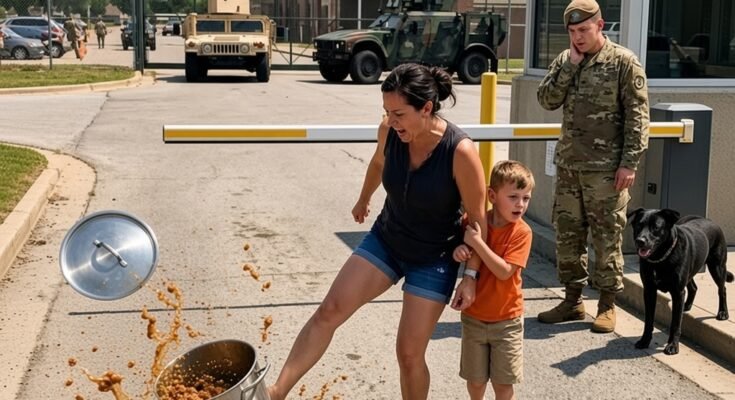
I brought our six-year-old son Noah and a pot of beef stew to the Army post because my husband said he was too sick to eat. At the gate, a young sergeant lowered his voice and told me, “Ma’am… Lieutenant Colonel Mercer asked that you not be allowed in while Vanessa Cole is with him.”
Vanessa. Ryan’s childhood best friend. The woman his mother still called “the one who understood military life.”
I didn’t scream. I didn’t demand entry. I called my brother Daniel, an attorney and co-trustee of our family’s estate.
“Did Ryan tell you anything about Meridian Life?” Daniel asked, out of nowhere.
“No. Why?”
“Don’t sign anything he gives you tonight.” Then he hung up.
I stared at the pot of stew I’d started cooking at five that morning, the one Noah had peeled carrots beside me for. Then I set it on the pavement and kicked it over.
“Daddy can figure out dinner,” I told my son.
That evening, Ryan walked in still in uniform, more concerned that Vanessa had been embarrassed than about his own family. “Why is your brother involved?” he demanded, right as the doorbell rang.
Daniel walked in with a sealed blue envelope. Beside him stood a woman named Rachel Kim — senior fraud counsel for Meridian Life.
“Mrs. Mercer,” Rachel said, “our office received an attempted ownership and beneficiary amendment involving a thirty-eight-million-dollar insurance policy connected to the Hale Family Trust.”
My signature was on the first page. A signature I never wrote.
“You probably should have told Vanessa whose name appears on the next page,” Daniel said to Ryan.
My husband went completely still.
PART 2: The Second Page
Rachel turned the page over slowly, giving me a moment to brace before I read it, which told me she’d done this before — delivered news like this to people who had no idea their marriage had been quietly restructured around a fortune they never knew existed.
The thirty-eight-million-dollar policy had originally named me as primary beneficiary, structured that way by my father years earlier as part of the Hale Family Trust, meant to protect Noah’s future regardless of what happened to Ryan’s military career or our marriage. Ryan had known about the policy’s existence for years — he’d simply never known, until recently, exactly how large it had grown, folded as it was into a trust structure Daniel managed and rarely discussed outside formal estate meetings.
The proposed amendment would have removed me entirely as beneficiary.
In my place: Vanessa Cole.
I read the name twice before it fully landed, the way you read a word in a language you technically know but can’t quite process at first. Ryan’s mouth opened, some explanation forming, but nothing came out that sounded like it would survive contact with the papers sitting on our dining table.
“Ryan,” I said quietly. “How long?”
“Emma, it’s not what you think—”
“How long has this document existed?”
Rachel answered instead, her voice level and clinical in the way I imagine kept her sane doing this job. “The amendment request was submitted six weeks ago. It required notarization and a secondary verification call, which is standard for changes of this size. The notary’s records didn’t match the caller’s voice pattern against our file for Mrs. Mercer. That flagged it for fraud review before it could process.”
Six weeks. Vanessa had been “helping with a veterans charity project” for at least that long, based on what Ryan had casually mentioned over dinner a handful of times, always vague, always brief.
Daniel set a second folder on the table — bank records he’d pulled as co-trustee, showing a joint charge account Ryan had opened without my knowledge, funding what looked like a security deposit on an apartment two towns over, in Vanessa’s name, paid from an account technically still tied to the trust’s operating funds.
Noah wandered in from the living room just then, still in his pajamas, holding the crooked-soldier drawing he’d made that morning. “Is Daddy still sick?” he asked.
I picked him up and told him to go finish his cartoon. Ryan didn’t look at either of us as we left the room.
PART 3: What Thirty-Eight Million Couldn’t Buy
Rachel Kim stayed another hour, walking me through exactly what Meridian’s fraud department needed from me to formally block the amendment and flag the account for a full audit — my signature, verified in person this time, a police report given the forged document, and a formal notice to the trust naming Ryan’s access as compromised pending investigation. I signed everything Daniel put in front of me that night, my hand steadier than I expected it to be.
Ryan tried, over the following days, every version of damage control a man in his position could reach for. He said the amendment was “just paperwork Vanessa suggested to help streamline things.” He said the apartment was “temporary, for the charity work, nothing romantic.” He said I was “turning a misunderstanding into a scandal,” the same accusation he’d leveled at me outside the gate before he knew what was actually sitting in that blue envelope.
None of it survived contact with Daniel’s bank records, or with the notary’s flagged file, or with the simple, unavoidable fact that somewhere along the way, my husband had decided the easiest path forward was forging my signature to redirect thirty-eight million dollars away from our son and toward a woman he’d apparently been building a second life with, two towns over, funded quietly by a trust my late father built specifically to protect us.
The military’s own investigative process moved separately from Meridian’s, once the fraud complaint and financial records made their way, through Daniel’s formal notice, to Ryan’s chain of command. Forging a spouse’s signature on a financial instrument of that size isn’t the kind of thing that stays contained to a marriage — it touches conduct unbecoming, it touches his security clearance, and within two months, Ryan was facing both a formal Article 15 inquiry and a fraud investigation that Meridian’s legal team pursued independently, given the attempted forgery.
I filed for divorce before either investigation concluded. Daniel handled the trust side personally, ensuring the beneficiary structure reverted fully to its original terms, with additional protections added — protections that, going forward, required both my signature and independent notarized verification for any changes at all, a safeguard my father, I suspect, would have insisted on immediately if he’d ever imagined a son-in-law capable of this.
Ryan’s relationship with Vanessa didn’t survive the fallout either, as far as I know — hard to build a future on an apartment deposit paid with money that was never actually his to spend, and harder still once she understood exactly what she’d nearly become the beneficiary of, and how.
Noah asked me, a few weeks into all of it, why Daddy didn’t live with us anymore. I told him the truth in the smallest, gentlest version I could manage — that sometimes grown-ups make choices that mean they can’t live together anymore, and that none of it was anything he did or could have stopped. He still draws soldiers holding hands sometimes. These days, there are only two of them in the picture, and somehow, that feels like exactly the right number.
The stew pot, for what it’s worth, got a good scrubbing and went right back into my kitchen cabinet. I made a fresh pot two weeks later, and Noah and I ate all of it ourselves, sitting at our own table, in a house that was — for the first time in longer than I want to admit — entirely, honestly ours.