While my husband fought for his life in intensive care, his son secretly took the Farmall tractor he’d spent years restoring to an auction. My stepson insisted his father would never operate it again. But before lot forty went up for bidding, I climbed onto a hay wagon and told three hundred farmers the truth. When the auctioneer asked for $5,000, something happened that nobody expected.
I’d only gone to the auction yard to purchase a livestock water tank.
Nothing more.
Then I spotted those familiar tractor wheels.
Earl had personally ground down the wheel weights.
There was a small silver mark in the red paint, shaped like a thumbprint.
I’d recognized that mark for nineteen years.
A tag marked LOT 40 hung from the wheel.
It was attached with baling wire.
The same kind we kept in our barn.
I stood there in my church shoes, trembling.
A young fellow walked past.
“That’s a nice old Farmall M. Planning to bid?”
“That tractor isn’t supposed to be sold,” I answered.
He gave me a puzzled look and continued walking.
I hurried to the auction office.
The young woman behind the desk refused to identify who’d brought the tractor.
But Doyle, the yard manager, checked the consignment list.
His expression hardened.
“Kevin brought it in Thursday.”
Thursday.
Only two days after his father had been rushed to the hospital.
Earl suffered a stroke on Tuesday.
Then his heart stopped.
Now he was sixty miles south, unconscious and breathing through a ventilator.
Kevin had sat beside me in the hospital waiting room.
I’d watched him cry over his father.
Then he’d returned home and loaded the tractor onto a trailer.
He could get into the equipment shed because we’d trusted him with a key.
He was family.
I begged Doyle to remove the tractor from the sale.
He shook his head.
The machine was so old it had no title.
Earl couldn’t sign anything in his condition.
Kevin had signed the consignment papers.
When I contacted a deputy, he called it a family dispute.
A judge might resolve it eventually.
But that could take weeks.
The auction was only an hour away.
I called Kevin from the parking area.
I could hear a baseball game playing in the background.
“Bring your father’s tractor back home,” I told him.
“He’s never going to drive that thing again,” Kevin replied.
Then he admitted he was behind on a loan payment.
“Besides, half of it belongs to me anyway.”
Before I could respond, he hung up.
I had no legal solution that could stop the auction in time.
Only the people who might buy the tractor could help me.
Earl had rebuilt that Farmall M over four winters.
He’d separated the tractor to replace its clutch.
Applied three careful coats of International red paint.
And proudly driven it in the Labor Day parade every year.
That machine meant more to him than money.
I couldn’t sleep that night.
Before sunrise, I returned to the auction grounds.
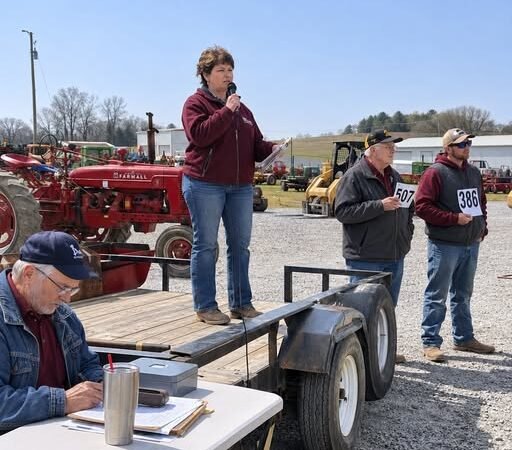
Around three hundred farmers were gathering, carrying coffee and wearing their usual caps.
The auctioneer’s voice echoed across the rows of equipment.
Lot twelve.
Lot thirty.
Lot thirty-six.
Every number made my heart beat harder.
I approached the hay wagon beside Earl’s tractor.
Rested my hand against its cold wheel.
Then climbed onto the wagon.
My knees felt barely strong enough to hold me.
I raised my hands toward the crowd.
“Excuse me, everyone.”
The talking gradually stopped.
“Before anybody bids on this tractor, there’s something you need to know.”
Hundreds of faces turned toward me.
The auctioneer lowered his microphone.
“My name is Darlene,” I began.
“This is a 1948 Farmall M that belonged to Earl’s father.”
I swallowed.
“Earl is my husband. Right now, he’s lying in intensive care.”
My voice cracked.
I didn’t try to hide it.
“His son brought this tractor here while his father was fighting for his life.”
The crowd remained silent.
“I can’t produce the paperwork today to prove it belongs to us.”
I looked across the rows of farmers.
“But I can stand here and tell you the truth.”
Then I climbed down from the wagon.
My legs were still shaking.
The auctioneer waited several moments before raising his microphone.
Nobody spoke.
Finally, his voice carried across the yard.
“Folks, we’re moving to lot forty.”
He paused.
“Who’ll start me at five thousand dollars?”
Not one hand went up.
The auctioneer waited.
I’d been to enough farm auctions to know silence had a weight to it. Usually there was coughing, joking, the scrape of boots, men pretending not to be interested in something they intended to buy.
This silence was different.
Three hundred people had heard me.
And three hundred people were looking at the tractor.
The auctioneer cleared his throat.
“Five thousand?”
Nothing.
“Four thousand?”
A man near the front folded his bidder card and stuck it into his shirt pocket.
“Three thousand?”
Another man shook his head.
The auctioneer glanced toward Doyle.
Doyle stood beside the office trailer with his arms crossed.
“Two thousand to get us moving?”
Not a hand.
For a terrible second, I thought I had made things worse. If nobody bid, perhaps Kevin would simply take the tractor somewhere else.
Then a voice came from behind me.
“Five thousand.”
I turned.
An elderly man in faded denim overalls stood beside the fence.
His name was Caleb Mercer.
Everyone within twenty miles knew Caleb. He had farmed the same ground since Eisenhower was president and still insisted on repairing machinery rather than replacing it.
The auctioneer pointed.
“Five thousand. Thank you, Caleb. Five thousand. Do I hear fifty-five?”
Nobody moved.
“Five thousand once.”
My heart began pounding again.
“Twice.”
Caleb wasn’t looking at the auctioneer.
He was looking at me.
“Sold.”
The gavel struck the wooden podium.
“To Caleb Mercer for five thousand dollars.”
A murmur rolled across the crowd.
I felt sick.
Someone had bought Earl’s tractor after all.
I pushed between two men and hurried toward Caleb.
“What did you do?”
He didn’t answer immediately.
He walked to the Farmall and placed one weathered hand against the hood.
Up close, I noticed his eyes were wet.
“You don’t recognize me very well, do you, Darlene?”
“I know who you are.”
“No. I mean you don’t remember me.”
I searched his face.
Then something returned to me.
A Labor Day parade twelve or thirteen years earlier.
Caleb standing beside Earl beneath the shade of the grain elevator, the two of them talking quietly while children scrambled for candy thrown from parade floats.
“You knew Earl’s father,” I said.
Caleb nodded.
“Clyde and I grew up together.”
The auction clerk approached holding a clipboard.
“Mr. Mercer, we’ll need you inside for settlement.”
“In a minute.”
He reached into his shirt pocket and withdrew a folded check.
Then he handed it to me.
The payee line was blank.
The amount was five thousand dollars.
I stared at him.
“I don’t understand.”
“I didn’t buy Earl’s tractor for myself.”
“Then why did you bid?”
“Because somebody had to make sure it didn’t leave this county.”
I looked toward the office.
“But Kevin gets your money.”
“Not yet.”
Caleb nodded toward Doyle.
“Settlement checks to consignors aren’t issued until Monday. Doyle already knows there’s a dispute. I’ve told him I won’t take possession until Earl can speak for himself.”
“You planned this?”
“Not exactly.”
He hesitated.
“Earl did.”
Every sound around me seemed to recede.
“What did you say?”
Caleb looked past me toward the Farmall.
“Your husband came to my place Monday evening.”
Monday.
The day before the stroke.
“He was at your farm?”
“For almost two hours.”
“Why?”
Caleb removed his cap and rubbed a hand across his white hair.
“He asked me something strange.”
“What?”
“He asked whether I’d be attending this auction.”
A chill ran through me.
Earl had never mentioned it.
“He knew about the auction?”
“No. Not this tractor. At least I don’t think so.”
Caleb looked troubled.
“He told me he had an uneasy feeling about Kevin. Said the boy was in financial trouble again and was asking questions about what he’d inherit.”
I felt anger rising again.
But Caleb raised a hand.
“Don’t decide what that means yet. Earl wasn’t angry when he said it.”
“What was he?”
“Sad.”
That stopped me.
Caleb continued.
“He said he’d made mistakes with Kevin. Said some of them went back thirty years.”
I stared at him.
Earl rarely spoke about Kevin’s childhood.
I knew there had been a difficult divorce. I knew Kevin’s mother had moved away for several years. I knew father and son had never found an easy way to talk.
But Earl had never called those years mistakes.
“What did Earl ask you to do?”
Caleb looked directly at me.
“He said if anything happened to him, I was to make sure nobody took that Farmall out of the county until you knew the whole story.”
“The whole story about what?”
“That,” Caleb said, “is the part he wouldn’t tell me.”
The auction continued behind us.
Lot forty-one.
A grain drill.
Lot forty-two.
A stock trailer.
Ordinary business resumed while my world seemed to stand still.
Caleb turned toward the tractor.
“He did tell me one more thing.”
“What?”
“He said there was something underneath the seat.”
We both looked at the Farmall.
I climbed onto the drawbar.
My fingers were shaking as I reached beneath the metal seat.
Nothing.
I tried the other side.
My knuckles brushed something that didn’t feel like steel.
Tape.
Caleb found a pocketknife.
Together we peeled away three strips of black electrical tape holding a narrow brown envelope against the underside of the seat.
My name was written across the front.
DARLENE.
Earl’s handwriting.
I could recognize the crooked D anywhere.
I tore open the envelope.
Inside was a single folded sheet of yellow legal paper.
There were only six lines.
Darlene,
If you’re reading this, something has happened before I could explain it myself.
Don’t blame Kevin until you know everything.
He believes the Farmall belongs to him.
There is a reason.
Ask June Calder what happened in the summer of 1987.
I read it twice.
Then a third time.
Caleb stood silently beside me.
I had heard the name June Calder only once in nineteen years of marriage.
At a Christmas dinner long ago, when I had asked Earl about an old photograph.
His face had changed.
He had taken the photograph from my hand and put it back into the drawer.
“Some things belong to another life,” he had said.
I had never asked again.
Now, standing beside the tractor that had nearly been sold while my husband lay unconscious, I realized another life had just reached forward and taken hold of mine.
And somewhere inside it was the reason Kevin believed Earl’s tractor belonged to him.
I folded the note.
“Do you know June Calder?”
Caleb looked away.
That was enough.
“You do.”
“Yes.”
“Where is she?”
He hesitated so long that I felt my stomach tighten.
Finally he answered.
“About twelve miles north of you.”
“Twelve miles?”
“She never left.”
I stared at him.
For nineteen years, Earl had never once told me that.
Caleb put his cap back on.
“If you’re going to see June, Darlene, there’s something you ought to know first.”
I waited.
He looked at Earl’s red tractor.
Then at me.
“Whatever you think happened in 1987,” he said quietly, “you’re probably wrong.”
-END OF Chapter 1–