Part One — Temporary
“Hold on, buddy!”
Evelyn Carter was already running before she realized she had left her car door open.
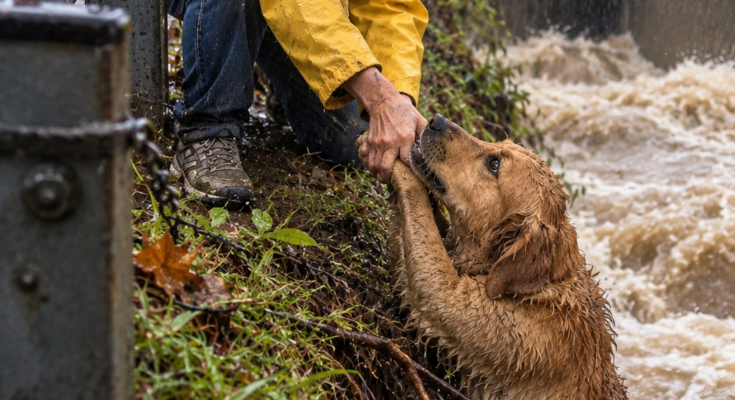
The golden-brown dog was halfway down the muddy embankment beside the county road, his collar pulling tight against a chain attached to the guardrail.
Below him, stormwater rushed through the drainage channel.
His back legs slipped again.
The dog barked sharply, twisted toward the road, and tried to claw his way upward.
Evelyn dropped to one knee.
Her yellow raincoat was soaked through at the shoulders. Mud covered her blue jeans almost immediately.
“I’ve got you,” she said.
She grabbed his collar with both hands.
The frightened dog scrambled harder, but the wet ground collapsed beneath his paws.
For one terrible second, his body dropped lower.
Evelyn planted one sneaker against the guardrail post and pulled.
At seventy, she knew better than to pretend she was still thirty.
Her knees complained every morning. Her right shoulder had bothered her for years. Her daughter had recently made her promise to stop carrying heavy grocery bags in one trip.
None of that mattered now.
The dog whimpered.
“I know, buddy. Hold on.”
Evelyn reached for the chain.
It was wrapped around the guardrail and slick with rain.
Her first attempt slipped from her fingers.
The dog’s paws scraped desperately against the mud.
Evelyn tried again.
This time, she freed the chain.
“Come on.”
She pulled backward with everything she had.
The dog kicked against the slope.
His front paws reached the pavement.
Then his chest.
Then, suddenly, his whole body slid onto the roadside beside her.
Evelyn fell backward with him.
For a moment, neither moved.
Then the dog crawled into her lap.
He was shaking.
Evelyn wrapped both arms around his wet body.
“You’re safe,” she whispered.
The dog pressed his head against her chest, lifted his face, and licked her cheek.
Evelyn laughed.
It surprised her.
She had not heard herself laugh like that in months.
Six months earlier, Evelyn’s husband, Ray, had died after forty-six years of marriage.
There had been no dramatic final speech.
No perfect goodbye.
One day they were arguing about whether the kitchen needed repainting, and a few weeks later Evelyn was sitting alone at the same table, staring at his empty chair.
Ray had always been the social one.
He waved at neighbors.
He remembered birthdays.
He talked to strangers in grocery-store lines as though he had known them for years.
Evelyn loved people too, but she had always been quieter.
After Ray died, quiet became silence.
Her daughter, Melissa, called every evening.
Friends invited her to lunch.
A woman from the community center asked whether Evelyn wanted to return to helping with the weekly food pantry.
Evelyn always found a reason not to go.
“I’m doing fine,” she would say.
She wasn’t miserable every minute.
That was almost the problem.
Life had simply become smaller.
Breakfast.
Laundry.
Grocery store.
Television.
Bed.
Repeat.
She had begun to believe this was what the rest of her life would look like.
That rainy afternoon, Evelyn had only left home because the refrigerator was nearly empty.
She was driving back with two bags of groceries when she noticed something moving near the guardrail.
She almost kept going.
People sometimes dumped trash along that road.
But then she saw a dog’s head rise above the muddy slope.
And she heard him cry.
Evelyn pulled over.
Now the dog sat beside her on the wet pavement, trembling against her leg.
She looked around.
No owner.
No house nearby.
No vehicle.
Just the loose chain, the rain, and the road.
“All right,” Evelyn said. “We’re not staying here.”
She took him to the county animal shelter.
A worker dried him with towels and checked him for identification.
There was none.
The dog seemed healthy aside from exhaustion, cold, and a few minor scrapes.
Evelyn stood beside him while he drank an entire bowl of water.
When she finally stepped toward the door, the dog immediately stopped drinking.
He watched her.
Evelyn took another step.
He whined.
“Oh, don’t do that,” she said.
His tail tapped once against the floor.
“I can’t take you home.”
Another tap.
“I’ve never owned a dog.”
The tail moved faster.
The shelter worker smiled.
“We could list you as a temporary foster.”
Evelyn looked at the dog.
“Temporary?”
The worker nodded.
“Just until we find out whether someone is looking for him.”
Evelyn looked down.
The dog rested one paw on her shoe.
She sighed.
“Fine.”
The shelter worker smiled.
“We’ll send you home with food, a leash, and instructions.”
Evelyn pointed at the dog.
“You hear that? Temporary.”
His tail thumped against the floor.
That evening, she drove home with a wet dog sitting awkwardly in the back seat.
Halfway there, she realized she had forgotten the groceries beside the shelter reception desk.
For the first time in months, she didn’t care.
━━━━━━━━━━━━━━━━━━━━
Part Two — Ray’s Chair
Evelyn named him Buddy because she refused to name him properly.
“You don’t name temporary dogs,” she told Melissa on the phone.
Melissa was silent.
Then:
“Mom, you literally named him Buddy.”
“That is not a real name.”
“Sure.”
Buddy slept beside Evelyn’s bed that first night.
At 2:13 in the morning, she woke to the sound of him pacing.
She turned on the lamp.
He stood in the hallway staring toward the kitchen.
“What?”
He looked back at her.
Then toward the kitchen again.
Evelyn followed.
Buddy walked to Ray’s chair.
It was still pushed beneath the table exactly where Ray had left it.
Evelyn had never sat there.
Had never moved it.
Had barely looked directly at it.
Buddy sniffed the chair.
Then lay underneath it.
Evelyn stood frozen.
“No.”
Buddy rested his head between his paws.
“That’s his chair.”
The dog looked at her.
Something broke.
Evelyn sat down on the kitchen floor.
She cried harder than she had at Ray’s funeral.
Not because of the dog.
Because grief had spent six months waiting for one small thing to give it permission to move.
Buddy crawled across the floor and pressed his body against her.
Evelyn buried her hands in his fur.
“I miss him.”
Buddy said nothing.
That helped.
The next morning, she moved Ray’s chair two inches away from the table.
It was the first thing in the house she had changed since he died.
Buddy stayed.
One week became two.
The shelter found no owner.
Someone had clearly chained him beside the road, but there was no reliable way to determine who.
Evelyn was furious.
The shelter worker said:
“You can foster until he’s adopted.”
Evelyn nodded.
“Good.”
Then:
“But not by just anybody.”
The worker smiled.
“Of course.”
Evelyn created standards.
A yard.
No chaining outside.
Someone home often.
References.
By the time she finished, the shelter worker leaned across the counter.
“You know, most adopters don’t undergo a mortgage application.”
“I want him safe.”
“I know.”
Three families expressed interest.
Evelyn rejected the first because the father joked that Buddy would “live outdoors where dogs belong.”
The second had two large dogs, and Buddy became visibly anxious during the meeting.
The third seemed perfect.
A retired couple.
Fenced yard.
Kind voices.
They sat on Evelyn’s porch while Buddy accepted treats.
Then the woman said:
“We’d love him.”
Evelyn smiled.
“That’s wonderful.”
Buddy walked over and rested his head on Evelyn’s knee.
The woman watched.
Then she smiled too.
“I think perhaps he already has a home.”
Evelyn looked down.
“Oh, no.”
Buddy’s tail tapped.
“He’s temporary.”
The couple left without him.
That night, Melissa came over carrying takeout.
She looked at Buddy asleep beneath Ray’s chair.
“Mom.”
“No.”
“I didn’t say anything.”
“You were about to.”
Melissa sat down.
“Dad would have loved him.”
Evelyn looked toward the chair.
“Your father said dogs shed.”
“He also fed every stray cat in the neighborhood behind your back.”
“That was different.”
“How?”
“He claimed they were independent contractors.”
Melissa laughed.
Evelyn did too.
Then both of them became quiet.
Melissa reached across the table.
“You seem different.”
Evelyn stiffened.
“I’m fine.”
“That’s what you’ve been saying for six months.”
“I am fine.”
“I know.”
That surprised her.
Melissa squeezed her hand.
“Fine isn’t the same as alive.”
Evelyn looked away.
Buddy shifted beneath the table and sighed.
Melissa continued.
“You leave the house now.”
“For his walks.”
“You talked to Mrs. Holloway yesterday.”
“Buddy likes her.”
“You went back to the food pantry.”
“They needed help carrying boxes.”
“Buddy wasn’t even allowed inside.”
Evelyn frowned.
Melissa smiled.
“You’re coming back, Mom.”
The words frightened Evelyn.
“Don’t say that.”
“Why?”
“Because I’m not coming back.”
Melissa’s smile disappeared.
Evelyn looked toward Ray’s empty chair.
“The woman I was with your father is gone. That life is gone.”
Melissa nodded slowly.
“Yes.”
No false reassurance.
No Dad would want you happy.
Just yes.
Then Melissa said:
“But gone isn’t the same as finished.”
Evelyn looked at Buddy.
He opened one eye.
That night, she completed the adoption paperwork.
Under Dog’s Name, she wrote:
Buddy Carter.
Then she stared at the surname.
“Don’t get sentimental about it,” she told him.
Buddy rolled onto his back.
━━━━━━━━━━━━━━━━━━━━
Part Three — The People Who Stopped
A year after the rescue, the county shelter asked Evelyn to speak at a volunteer event.
She refused immediately.
“I don’t speak.”
“You talk constantly,” Melissa said.
“To people I know.”
The shelter worker convinced her to attend anyway.
They had enlarged the photograph taken on Buddy’s intake day.
Evelyn barely recognized herself.
Yellow raincoat.
Wet gray hair plastered to her forehead.
Mud to her knees.
Buddy wrapped in towels beside her.
At the bottom someone had printed:
SOMETIMES RESCUE STARTS WITH SOMEONE STOPPING.
Evelyn stared at it for a long time.
Then she noticed something else.
A man standing near the refreshments was crying.
Late fifties, maybe early sixties.
He approached carefully.
“Mrs. Carter?”
“Yes?”
“My name is Leonard.”
He looked toward Buddy.
“I think I know that dog.”
Evelyn immediately stepped closer to Buddy.
Leonard raised both hands.
“I’m not here to take him.”
“What do you mean, you know him?”
Leonard swallowed.
“My brother owned him.”
Evelyn went still.
“Owned?”
“Buddy’s name was Rusty.”
Buddy’s ears lifted at the sound.
Evelyn felt sick.
Leonard continued quickly.
“My brother died about two weeks before you found him.”
“What happened to the dog?”
Leonard closed his eyes.
“My nephew was supposed to take him.”
The answer came before Evelyn asked.
“He didn’t.”
Leonard nodded.
“From what I learned later, he drove Rusty out there and chained him by the road because he didn’t want to bring him to his apartment.”
Evelyn’s face went cold.
“He left him there?”
“Yes.”
“In a storm?”
“I don’t know if the storm had started yet.”
“It doesn’t matter.”
“No.”
Leonard wiped his eyes.
“I found out months later. By then my nephew said the dog probably ran away.”
Evelyn looked down at Buddy.
“Rusty,” she whispered.
His tail moved.
That hurt strangely.
As though Buddy had just revealed a whole life she hadn’t known.
Leonard knelt several feet away.
“Hey, Rusty.”
Buddy approached cautiously.
He sniffed the man’s hand.
Then wagged.
Leonard began crying.
“He remembers me.”
Evelyn’s throat tightened.
For ten minutes, Leonard told her about Buddy’s first owner.
His brother, Samuel.
A retired mail carrier.
Widower.
No children.
Buddy had been his constant companion for seven years.
“He slept beside Sam’s recliner every night.”
Evelyn looked toward Buddy.
Of course he had.
“After my brother died, I thought my nephew had taken care of everything. I should have checked.”
Evelyn heard the familiar tone.
The dangerous one.
The voice people use when grief turns hindsight into a courtroom.
She said:
“You didn’t chain him there.”
“No. But I should’ve—”
“You didn’t know.”
Leonard nodded, though he clearly didn’t forgive himself.
Then he reached into his jacket.
“I brought something.”
It was a photograph.
Samuel sitting on a porch.
Buddy—Rusty—beside him.
Around the dog’s neck was a red bandanna.
On the back Samuel had written:
Best company I ever had. Doesn’t argue about baseball.
Evelyn laughed through tears.
She looked at Leonard.
“Can I keep this?”
“That’s why I brought it.”
She held the photograph against her chest.
For the first time, she understood something about the day she stopped beside the road.
Buddy had not been unwanted his whole life.
He had been loved.
Then the person who loved him disappeared.
And afterward, the world became dangerous.
Evelyn understood that better than she wanted to.
Leonard asked:
“Is he happy?”
Evelyn looked at Buddy.
He was leaning against her leg.
“Yes.”
“Good.”
Then Leonard smiled sadly.
“Sam would’ve liked knowing somebody stopped.”
That phrase stayed with her.
Over the next several years, Evelyn and Buddy became familiar around town.
She volunteered at the shelter twice a week.
Then at the food pantry again.
Buddy became certified through a local therapy-dog program after trainers determined he enjoyed people and handled calm indoor environments well.
They visited a senior living center.
At first, Evelyn thought Buddy was doing all the work.
Then one afternoon, she sat beside a newly widowed woman named Margaret who had refused to leave her room for weeks.
Buddy rested his chin on Margaret’s knee.
She stroked his ears.
“He belonged to your husband?”
“No.”
Evelyn smiled.
“He found me afterward.”
Margaret looked at her.
“Does it get easier?”
Evelyn considered lying.
Instead she said:
“It changes.”
“How?”
“At first everything reminds you they’re gone.”
Margaret nodded.
“Later, some things start reminding you they were here.”
The woman began crying.
Evelyn stayed.
That evening, driving home, she suddenly remembered Harold—the shelter worker who had first suggested temporary fostering.
She called him.
“Do you remember telling me Buddy could be temporary?”
He laughed.
“I’ve regretted that lie for years.”
“So have I.”
Buddy lived with Evelyn for nine more years.
His muzzle turned white.
His walks became shorter.
He stopped jumping onto the sofa and began waiting for Evelyn to lift his back legs.
By then, Evelyn was seventy-nine.
Her knees complained more.
Her shoulder had been repaired.
Sometimes Melissa teased that neither Evelyn nor Buddy could decide which one was supposed to be taking care of the other.
Then came the day Buddy stopped eating.
The veterinarian found cancer.
Advanced.
There were treatments they could try.
Possibly months.
Maybe less.
Evelyn listened.
Asked questions.
Then looked at Buddy lying with his head across her shoe.
She remembered mud.
Rain.
A chain.
A terrified animal fighting not to slide into rushing water.
She had promised him safety.
Safety did not mean keeping him alive at any cost because she wasn’t ready to lose him.
So when the veterinarian said Buddy was beginning to hurt, Evelyn made the decision.
Melissa sat beside her.
Leonard came too.
He had stayed in their lives after that shelter event.
Buddy lay on his favorite blanket.
Evelyn held his face.
“You’re safe,” she whispered.
The same words she had said beside the road nine years earlier.
Buddy lifted his head weakly.
Licked her hand.
Then relaxed.
Evelyn cried harder than she had in years.
Grief came again.
But this time, she knew something she hadn’t known after Ray.
Grief did not mean life had become empty forever.
It meant something had occupied real space.
Weeks later, the county shelter installed a small wooden bench beside its walking trail.
A plaque was attached to the back.
Melissa had arranged it.
Evelyn discovered it when she arrived to volunteer.
She stood reading the inscription.
IN MEMORY OF RAY CARTER AND BUDDY
Then beneath:
FOR THE ONES WE COULDN’T KEEP—AND THE PEOPLE WHO STOPPED ANYWAY.
Evelyn sat down.
For a while, she cried.
Then a shelter volunteer came walking past with a nervous black dog who kept pulling away from strangers.
“Mrs. Carter?”
Evelyn wiped her face.
“Yes?”
“He won’t let anyone near him. Would you mind sitting with him for a little while?”
Evelyn looked at the dog.
Then at the empty place beside her on the bench.
“Bring him over.”
The volunteer hesitated.
“He may not come close.”
“That’s all right.”
Evelyn patted the bench.
“I know how to wait.”
The dog stopped several feet away.
Evelyn didn’t reach for him.
Didn’t call.
Didn’t try to rescue anything.
She simply stayed.
Eventually, the dog took one cautious step toward her.
Then another.
Evelyn smiled.
Years earlier, she had believed stopping beside that flooded ditch saved one abandoned dog.
Maybe it did.
But Buddy had done something quieter in return.
He had taken a woman whose world had become breakfast, laundry, television, and bed—
and led her back toward people.
Toward laughter.
Toward usefulness.
Toward grief she could survive without hiding from it.
The split-second decision that changed both their lives wasn’t pulling the chain loose.
It happened a few minutes earlier.
When Evelyn saw something suffering beside the road—
and chose not to keep driving.