Part One — The Curl in Leo’s Hand
My son Leo had golden curls that caught the sunlight every time he ran.
To me, they were beautiful.
To my mother-in-law, Brenda, they were apparently an insult.
“He looks like a little girl,” she would say.
Sometimes she tried to disguise it as a joke.
Sometimes she didn’t bother.
“Boys need proper haircuts.”
My husband, Mark, shut her down every time.
“Leo’s hair belongs to Leo, Mom.”
Brenda would smile that tight little smile of hers.
“Of course.”
But she never meant it.
Last Thursday began like any other day.
I dropped Leo at kindergarten, kissed the top of his curls, and drove home to work while our baby daughter, Lily, napped.
At noon, the school secretary called.
“Mrs. Carter? I just wanted to make sure everything is okay. Leo’s grandmother picked him up about an hour ago because of a family emergency.”
Everything inside me went cold.
“What family emergency?”
There was silence.
“She said you were unavailable.”
“I did not authorize her to take him today.”
Brenda had been listed as an emergency contact from months earlier.
She had used that access and lied.
I called her.
Again.
Again.
Again.
No answer.
The school began reviewing exactly what had happened while I called Mark and, on their advice, contacted police because I could not reach the adult who had removed my five-year-old from school.
For nearly two hours, I stood at the front window.
Then Brenda’s car appeared.
I was outside before she turned off the engine.
Leo climbed from the back seat.
He was sobbing.
In one tiny fist he clutched a single golden curl.
Everything else was gone.
His beautiful hair had been cut down into an uneven buzz.
Some places were shorter than others, as though he’d moved while somebody held clippers against his head.
“Leo.”
I dropped to my knees.
“What happened?”
He threw himself against me.
“Grandma cut it.”
I held him while his entire body shook.
Brenda got out of the car and calmly smoothed her cardigan.
“Oh, stop making such a production out of it.”
I looked at her.
“What did you do?”
“Exactly what you and Mark should have done months ago.”
She smiled at Leo.
“There. Now he looks like a proper little boy.”
Leo buried his face against my shoulder.
I could feel him crying through my shirt.
“You took him out of school by lying.”
“I am his grandmother.”
“You cut his hair while he was telling you no.”
“Oh, Sarah, it’s hair.”
Her tone was almost bored.
“It grows back.”
That sentence would become Brenda’s defense for everything.
It grows back.
As if the problem were the speed of human hair.
Not the fact that a five-year-old had begged an adult to stop touching his body and had been ignored.
I didn’t argue further.
I took Leo inside.
Police documented what had happened and spoke with us. The school immediately removed Brenda from every authorized pickup list while administrators reviewed their release procedures.
Then I sat on the bathroom floor with my son.
“Were you hurt anywhere?”
He shook his head.
“Did Grandma hold you down?”
His breathing changed.
I stopped.
I had enough to know he was frightened. I wasn’t going to question him repeatedly and accidentally turn him into the investigator of his own experience.
“We’re not going to talk about it anymore right now,” I said. “You’re safe with me.”
He opened his fist.
Inside was the curl.
“She dropped it.”
I stared at it.
“Can I keep it?”
“Of course.”
Then he asked:
“Daddy’s going to be sad, isn’t he?”
That nearly broke me.
Because Leo knew something Brenda did not.
When Mark came home, Leo was asleep on the couch wearing his favorite baseball cap.
Mark saw my face.
“What happened?”
I lifted the cap.
He stopped breathing for a second.
“My mother?”
I nodded.
“She took him from school. She cut it even though he told her to stop.”
Mark knelt beside the couch.
He didn’t shout.
He didn’t punch anything.
He simply touched the edge of Leo’s uneven hair with two fingers.
Then he saw the curl lying on the coffee table.
His face collapsed.
Brenda had never understood why Mark rarely joked about Leo’s hair.
Thirty-three years earlier, when Mark was five, his younger brother Julian developed leukemia.
Julian was three.
The boys both had thick blond curls.
People used to mistake them for twins.
Chemotherapy took Julian’s hair.
Mark remembered sitting beside him in the hospital while Julian rubbed his bald head and asked:
“When will mine look like yours again?”
Mark told him soon.
Children promise things because children still believe love can negotiate with reality.
Julian’s hair never grew back.
He died before his fifth birthday.
Afterward, Brenda removed almost every photograph of him from the house.
Nobody was allowed to say his name without watching her face close.
Mark learned that grief was something you hid.
Then Leo was born.
And when the curls appeared, Mark cried the first time he brushed them.
He never tried to turn Leo into his dead brother.
That mattered.
Leo wasn’t a replacement.
But those curls reminded Mark of someone he had loved before he understood what death meant.
When Leo was old enough, Mark showed him a photograph.
“This is your Uncle Julian.”
Leo had stared at the picture.
“He has my hair.”
Mark smiled.
“Actually, I think you have his.”
From then on, Leo became proud of it.
He sometimes called them his “Uncle Julian curls.”
Brenda knew none of this.
Not because Mark had deliberately hidden it.
Because every time Julian’s name surfaced, she ended the conversation.
Now she had cut away something she didn’t understand because she had decided understanding was unnecessary.
Mark remained beside the sofa for a long time.
Then his phone buzzed.
A message from Brenda.
Sunday roast at 4. Bring Leo. Everyone wants to see his handsome new haircut. You’ll thank me once you calm down.
Mark read it twice.
Then he looked at me.
“She wants an audience.”
“I’m not taking Leo there.”
“Neither am I.”
That surprised me.
Mark picked up the golden curl.
“But I’m going.”
━━━━━━━━━━━━━━━━━━━━
Part Two — The Box on Brenda’s Table
Sunday afternoon, Leo stayed with my sister.
He chose that himself.
When we asked whether he wanted to see Grandma, he immediately said no.
That was enough.
Mark and I went to Brenda’s house alone.
She had invited her two sisters, three friends from her bridge club, and several neighbors.
Exactly as Mark expected.
Brenda was telling the story when we arrived.
“I finally took matters into my own hands.”
People laughed awkwardly.
Then she noticed Leo wasn’t with us.
“Where is he?”
“Safe,” Mark said.
The room went quiet.
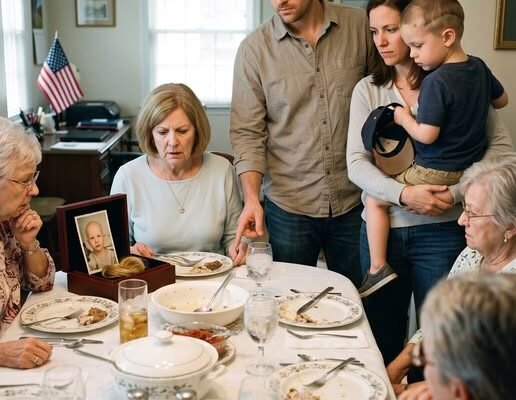
He carried a wooden box under one arm.
He placed it beside Brenda’s dinner plate.
She frowned.
“What is that?”
“A family memory.”
Inside were three things.
A photograph of Mark and Julian as little boys, both with almost identical blond curls.
A hospital photograph of Julian after chemotherapy.
And Leo’s severed curl.
Brenda stared.
All color left her face.
Mark sat across from her.
“When I was five, Julian asked me when his hair would grow back.”
Nobody spoke.
“I told him it would.”
Brenda whispered:
“Mark.”
“He died waiting.”
Her eyes immediately filled.
“Don’t.”
“No, Mom.”
His voice remained gentle.
“That’s the problem. For thirty years, nobody has been allowed to say his name because you couldn’t bear it.”
Brenda stared at the hospital photograph.
Mark continued.
“When Leo’s curls came in, I remembered my brother before the hospital. Leo knows that story. He liked knowing he shared something with an uncle he never met.”
Brenda began crying.
“I didn’t know.”
Mark nodded.
“You didn’t.”
For a second, I thought he might soften.
Instead he said:
“But that’s not why what you did was wrong.”
Brenda looked up.
Mark pointed toward the curl.
“Even if those curls meant absolutely nothing to me, you still had no right to take my son from school under false pretenses and cut his hair after he told you no.”
Silence.
“If Leo had straight brown hair with no story behind it, it would still be his body.”
That was the sentence Brenda needed to hear.
Not that she had accidentally destroyed a memorial.
That she had violated a boundary before knowing the memorial existed.
Brenda wiped her face.
“I was only trying to help.”
“You were trying to win.”
She flinched.
Mark continued:
“You’ve spent months arguing with Sarah and me about his hair. You couldn’t persuade us, so you waited until neither of us was there.”
One of Brenda’s sisters quietly said:
“Brenda, is that true?”
Brenda looked furious now.
“He looked ridiculous.”
There it was.
Even after seeing Julian’s photograph.
Even while crying.
She still needed to be right.
Mark stood.
“The school has removed you from every pickup list. We’ve changed the children’s emergency contacts. You will not pick them up, babysit them, or be alone with them.”
Her mouth fell open.
“You can’t keep my grandchildren from me.”
“We can decide who has unsupervised access to our children.”
“I am their grandmother.”
“And he is their father.”
Brenda turned toward me.
“You did this.”
Mark immediately stepped between us.
“No.”
His voice sharpened for the first time.
“Don’t do that.”
Brenda stared at him.
“Sarah did not make this decision. I did. We did.”
He picked up the photograph of Julian but left Leo’s curl inside the box.
Then he pushed the box gently toward her.
“You wanted a Sunday dinner celebrating what you did.”
His eyes filled.
“Now you can remember what you were actually celebrating.”
Then we left.
No screaming.
No overturned table.
No public humiliation beyond the truth Brenda herself had invited into the room.
That was Mark’s revenge, if you wanted to call it that.
Not destruction.
Consequence.
For once, his mother did not get to hurt someone and then control how the story was told.
━━━━━━━━━━━━━━━━━━━━
Part Three — When Leo’s Hair Grew Back
For several weeks, Brenda sent messages.
First angry ones.
You’re overreacting.
Then defensive ones.
I was raised differently.
Then sentimental ones.
Children need their grandparents.
Mark answered none of them.
Finally, a letter came.
Not to us.
To Leo.
We did not give it to him immediately.
We read it first.
The first version still contained too many excuses.
Grandma only wanted you to look handsome.
Mark mailed it back.
Attached was one sentence:
An apology that explains why the other person should understand you is not yet an apology.
Three months passed.
Leo’s hair began growing back.
At first, he hated looking in the mirror.
So we didn’t make his hair the center of his life.
We let him choose hats when he wanted them.
We told the kindergarten teacher not to encourage classmates to question him about the haircut.
When his curls began returning, Mark did not tell him:
“Good, now you look like Julian again.”
That would have made Leo responsible for healing his father’s grief.
Instead Mark simply asked:
“How do you want your hair?”
Leo thought.
“Long again.”
“Okay.”
A few months later, he changed his mind and wanted the sides shorter.
Mark smiled.
“Okay.”
That was the point.
His hair.
His choice.
Brenda eventually began therapy.
We knew because Mark’s aunt told us, not because Brenda used it as leverage.
Almost a year after the haircut, another letter arrived.
It was addressed to Mark and me.
This one was different.
I kept saying it was just hair because admitting what I actually did was harder. Leo told me no, and I decided being his grandmother meant my opinion mattered more than his no.
Mark stopped reading for a moment.
Then continued.
I also blamed Sarah because it was easier to believe another woman had changed my son than admit my son had grown up and could disagree with me.
Then came Julian.
When you showed me his picture, I wanted to say you had never told me what Leo’s curls meant. But the truth is you tried to talk about Julian many times and I stopped you because I could not survive hearing his name. I made my grief a rule everyone else had to obey.
At the bottom:
I am sorry for frightening Leo. I am sorry for taking him from school dishonestly. I am sorry for cutting his hair after he said no. I understand that being sorry does not entitle me to see him.
For the first time, Mark cried over one of her letters.
Not because everything was repaired.
Because she had finally named the actual harm.
We asked Leo months later whether he wanted to see Grandma.
He frowned.
“Will she cut my hair?”
“No.”
“Can you stay?”
“Yes.”
“Can I leave if I want?”
“Yes.”
He thought for a while.
“Okay. At the park.”
So the first meeting happened at a public park.
Ten minutes.
Then twenty.
Brenda did not touch his hair.
She did not ask for a hug.
She knelt several feet away and said:
“I scared you. I shouldn’t have taken you from school, and I shouldn’t have cut your hair when you said no. I’m sorry.”
Leo studied her.
Then asked the question only a child would ask.
“Do you still think I look like a girl?”
Brenda’s face crumpled.
“No.”
Leo waited.
She corrected herself.
“Actually, it doesn’t matter what I think your hair makes you look like. It’s yours.”
Leo nodded.
Then ran toward the swings.
That was it.
No dramatic forgiveness.
Children don’t owe adults emotional closure.
Brenda slowly earned limited contact.
Never unsupervised.
Not for years.
Trust returned in teaspoons.
When Leo was nine, he decided to cut his curls much shorter.
This time, he wanted it.
Mark took him to the barber.
I wondered whether seeing those curls fall would hurt.
Apparently Mark wondered too.
Leo sat in the chair and grinned while the barber worked.
Afterward, Mark swept one curl from Leo’s shoulder.
Leo looked at him.
“You sad?”
Mark smiled.
“A little.”
“Because of Uncle Julian?”
“Maybe a little.”
Leo considered that.
Then said:
“But I’m still me.”
Mark went completely still.
Then he hugged him.
“Yes.”
His voice broke.
“You are.”
That became the real healing.
Not Leo growing Julian’s curls back.
Not Brenda being punished.
Not preserving a hairstyle forever because it carried a memory.
Mark finally understood that loving what reminded him of his brother could never mean asking his son to remain a memorial.
Julian belonged to Mark’s past.
Leo deserved his own future.
We still have that single curl from the day Brenda cut his hair.
It’s inside an envelope in Mark’s desk beside one photograph of Julian.
Not because we want Leo to remember what Grandma did.
He remembers enough.
We keep it because it eventually came to represent something larger.
For Brenda, it became proof that love does not create ownership.
For Mark, it became the moment he stopped letting silence decide how his brother was remembered.
And for Leo, when he became old enough to understand the entire story, it meant something wonderfully simple.
He once asked:
“Why did everyone care so much about my hair?”
Mark laughed.
“Because adults are complicated.”
Leo rolled his eyes.
Then Mark told him:
“But the important part is that it was always yours.”
Leo smiled.
“I know.”
That was the ending Brenda could never have imagined when she proudly drove away after cutting his curls.
She thought she had finally taught us what a “real boy” should look like.
Instead, she taught our entire family something else.
A child does not become more masculine because an adult ignores his no.
A grandparent does not love more deeply because she overrules the parents.
And a painful family history does not make one hairstyle sacred forever.
The curls grew back.
Eventually, Leo chose to cut them himself.
The difference was everything.
Because the lesson was never about hair.
It was about who gets to decide what happens to a child’s body.
This time, it was Leo.