Part One — The Photograph in the Bag
“Excuse me, sir… do you know anyone who might help me?”
I sighed, tearing my eyes away from a multi-million-dollar email on my phone, fully prepared to dismiss whoever had interrupted me on that freezing Chicago street.
Then I looked down.
She couldn’t have been older than five.
She wore a faded pink summer dress beneath a thin sweater and sandals far too large for her feet. A dirty fabric bag was crushed against her chest as though everything she owned was inside it.
“Where are your parents?”
“My mommy fell down.”
“Where?”
“At work. She hit her head really hard. Then I was by myself.”
She said it without crying.
That frightened me more than tears would have.
“What’s your name?”
“Lauren Fitzgerald.”
The surname touched something buried in me.
I ignored it.
“When did you last eat?”
She stared at her bare toes inside those oversized sandals.
“I had a cracker yesterday.”
Ten minutes later, we were sitting near Millennium Park with a warm pretzel, soup, and hot chocolate between us.
Lauren ate carefully.
Tiny bites.
Almost as though she believed eating too quickly might make me change my mind.
My phone vibrated repeatedly.
Board members.
Attorneys.
My chief financial officer.
For the first time in years, I ignored all of them.
“What’s in the bag?” I asked.
Lauren immediately pulled it closer.
“You don’t have to show me.”
She studied me.
Then slowly unzipped it.
Inside was a battered blue Bible, a clean handkerchief, two pairs of children’s socks, a folded sheet of paper worn soft at the edges, and an old photograph placed facedown.
“Mommy says if I keep the Bible with me, God stays with me.”
I swallowed.
“Do you believe that?”
She nodded.
“Do you believe in God, mister?”
I looked away toward the frozen trees.
“I’m not sure anymore.”
Lauren considered that with the seriousness only small children can manage.
“That’s okay. Mommy says people forget things when they’re really scared.”
Before I could answer, a scream tore through the afternoon.
“Lauren!”
An older woman came running toward us.
She nearly fell when she reached the bench.
“Oh, thank God.”
Lauren jumped up.
“Miss Evelyn!”
The woman collapsed onto her knees and pulled Lauren close.
I stood.
“Who are you?”
“Evelyn Higgins. I live beside Lauren and her mother.”
She was crying so hard she could barely speak.
“I’ve been looking everywhere for her.”
“For how long?”
“Almost two days.”
My stomach tightened.
Evelyn explained.
Lauren’s mother cleaned offices downtown at night.
Two evenings earlier, she had fallen from a ladder while washing interior windows.
She struck her head and was taken unconscious to the hospital.
Nobody at the job realized her five-year-old daughter had been waiting in the employee break room for her shift to end.
By the time someone went looking for Lauren, she had already tried to get home on her own.
Their building manager had changed the apartment lock during a dispute over overdue rent—something Evelyn said was already being reported and challenged.
Lauren found some of their belongings in the hallway, grabbed her little bag, and disappeared before anyone understood what had happened.
Police had been notified.
Hospitals contacted.
Evelyn had been walking blocks for hours.
“Her mother is still unconscious?” I asked.
“She woke briefly this morning. Then went back under sedation.”
“What’s her name?”
Evelyn answered.
“Mara Elizabeth Fitzgerald.”
Everything around me seemed to disappear.
Traffic.
Wind.
People.
All of it.
“Mara?”
Evelyn looked at me.
“You know her?”
I couldn’t answer.
Because suddenly Lauren Fitzgerald’s last name wasn’t familiar.
It was devastating.
Mara Fitzgerald had been twenty-eight when I met her.
I had been thirty-two.
Before private jets, board meetings, and a company people now valued in nine figures, I was building software from a rented office above a laundromat.
Mara worked at a small community clinic.
She was funny.
Stubborn.
Incapable of pretending to admire anyone simply because they had money.
I loved her.
Or at least I said I did.
Then my company received its first major investment offer.
The deal required me to move to New York for a year.
Mara’s mother had just been diagnosed with cancer.
She refused to leave Chicago.
I told her she was choosing her family over our future.
She told me there should have been room for both.
We fought.
I said things I still remembered because cruelty has excellent memory.
I’m not spending my life being dragged backward by everybody you feel responsible for.
She slapped me.
I left.
Blocked her number.
Changed apartments.
Buried myself in work.
Within three years, I was rich enough to convince myself that everything I had sacrificed had been necessary.
Mara became one of those memories I visited only when something went wrong.
Evelyn was still looking at me.
“How do you know her?”
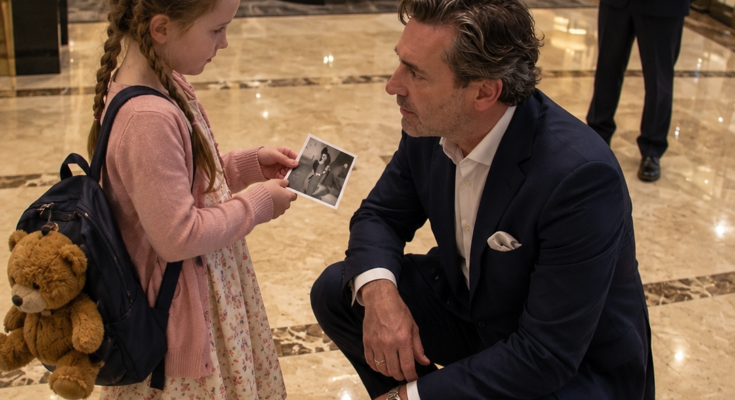
Before I could answer, Lauren picked up her bag.
The old photograph slipped out.
It landed faceup on the pavement.
I stopped breathing.
There I was.
Ten years younger.
Standing beside Mara at Navy Pier.
Her arms around my waist.
My face pressed against her hair.
Lauren picked it up.
“That’s Mommy.”
I crouched.
My fingers trembled.
“Who is the man?”
Lauren shrugged.
“I don’t know.”
Then she turned the photograph over.
Mara’s handwriting covered the back.
Graham and Mara — June 2019. Before everything got complicated.
My name is Graham Hale.
I sat down hard on the bench.
Evelyn stared at me.
“Oh.”
That single word contained recognition.
Then suspicion.
Then anger.
Lauren looked between us.
“Mister Graham?”
“Yes?”
She touched the picture.
“Mommy says this man used to make her laugh.”
My throat closed.
“Did she tell you who he was?”
Lauren shook her head.
“No.”
Then she unfolded the worn piece of paper from her bag.
It was a letter.
On the front:
FOR LAUREN, WHEN YOU’RE OLD ENOUGH TO ASK ABOUT YOUR FATHER.
I couldn’t move.
Lauren looked at Evelyn.
“Am I old enough?”
Evelyn covered her mouth.
I stared at the five-year-old girl sitting beside me.
Same dark eyes as Mara.
But the shape of her chin—
My chin.
I did the math.
Mara and I had separated a little over six years earlier.
I whispered:
“Lauren, how old are you?”
“Five and three quarters.”
The world tilted.
I had walked away from Mara.
But apparently, I had left behind far more than I knew.
━━━━━━━━━━━━━━━━━━━━
Part Two — The Question I Wasn’t Allowed to Buy My Way Out Of
I wanted to open the letter.
Evelyn stopped me.
“No.”
I looked at her.
“If Mara wrote it for Lauren, then it belongs to Lauren.”
She was right.
That mattered.
For most of my adult life, money had allowed me to skip uncomfortable limits.
Hire someone.
Buy access.
Move faster.
This was different.
The first thing I did was call the police contact handling Lauren’s missing-child report.
Then Evelyn and I took Lauren to the hospital and explained exactly where she had been found.
A hospital social worker became involved immediately.
I was not allowed to simply announce that I might be her father and take over.
Again, that mattered.
Lauren stayed with Evelyn under arrangements made with the appropriate authorities while Mara recovered.
I paid for nothing that first night except the food Lauren had already eaten.
Not because I didn’t want to.
Because Evelyn looked at me and said:
“Don’t turn money into another way of taking control before Mara can speak for herself.”
Nobody had spoken to me like that in years.
Three days later, Mara woke fully.
I waited until she was medically stable and until the social worker confirmed she wanted to see me.
Then I entered her hospital room.
She stared at me for a very long time.
“You look expensive,” she finally said.
I laughed once.
Then started crying.
Mara didn’t.
“You met Lauren.”
“Yes.”
“You figured it out?”
“I think so.”
She looked toward the window.
“You’re her father.”
The sentence landed quietly.
No music.
No dramatic revelation.
Just five words that rearranged my life.
“Why didn’t you tell me?”
Mara looked at me.
“I tried.”
She had emailed.
Called.
Sent a letter to my old apartment.
Then she discovered I had blocked her number and changed addresses.
One email came back from an assistant at my company saying personal correspondence could not be forwarded.
“I was pregnant and terrified,” she said. “And I had just watched you tell me everyone I loved was baggage.”
I lowered my head.
“I would’ve helped.”
“Financially?”
I looked up.
She wasn’t being cruel.
That was worse.
“You probably would have.”
Then she said:
“But I didn’t need a wire transfer from a man who had made it clear he didn’t want my life.”
I had no defense.
Mara had raised Lauren with help from her mother until her mother died two years earlier.
After that came medical bills, unstable cleaning work, rent problems, and eventually the accident.
She had never told Lauren I was dead.
Never told her I was evil.
She simply said her father wasn’t part of their life.
“Why keep the photograph?”
Mara looked away.
“Because I didn’t want my anger to decide what Lauren was allowed to know someday.”
Then:
“She deserved the truth when she was old enough.”
I swallowed.
“And now?”
“Now everything is a mess.”
That was accurate.
I wanted to say:
I’ll fix it.
The words reached my mouth.
I stopped them.
Instead I asked:
“What do you need from me right now?”
Mara looked surprised.
Then she answered.
“Don’t make promises to her yet.”
So I didn’t.
━━━━━━━━━━━━━━━━━━━━
Part Three — What Lauren Actually Needed
A paternity test confirmed what we already knew.
Lauren was my daughter.
I thought that fact would instantly turn me into something.
A father.
It didn’t.
Biology can establish a relationship on paper.
It cannot manufacture five missing years.
The first time Lauren understood who I was, she stared at me for a while and asked:
“So you’re the picture man?”
“Yes.”
“Are you my dad?”
“Yes.”
She considered it.
Then:
“Do I have to call you Dad?”
“No.”
That answer came easily.
Maybe because I finally understood I had not earned the title.
She called me Graham for almost a year.
People found that sad.
I didn’t.
It was honest.
Mara recovered slowly from her head injury.
Her first weeks out of the hospital were difficult.
I offered to pay her rent.
She refused.
I offered a new apartment.
She refused that too.
Finally she said:
“You keep offering things that let you feel useful.”
That stung.
“What am I supposed to do?”
“Ask.”
So I asked.
She wanted an attorney.
Not mine.
Her own.
She wanted formal child support established properly.
Medical coverage for Lauren.
A college account structured so I could not use it as leverage.
She wanted me to attend parenting counseling before taking Lauren overnight.
And she wanted no surprise gifts worth more than what she and I agreed was reasonable.
I signed everything.
Not because Mara had defeated me.
Because she was right to build protections around a man who had once disappeared the moment life became inconvenient.
I also helped with the apartment dispute through a legal-aid organization rather than sending my corporate attorneys to crush everyone involved.
The lockout was addressed through the proper process.
Mara eventually found another apartment.
Smaller than anything I would have chosen.
Perfectly adequate.
The first time I visited, I tried not to stare at the old furniture.
Mara noticed anyway.
“If you buy me a sofa, I will throw you out.”
“I wasn’t going to.”
“You were mentally replacing it.”
“I absolutely was.”
She laughed.
It was the first time I heard that laugh in six years.
It hurt.
In a good way.
We did not get back together.
That surprises people when they hear the story.
They expect the rich man to rediscover his lost love, rescue her from poverty, and build the perfect family he should have built before.
Mara did not owe me that ending.
She had changed.
So had I.
And regret is not a romance.
It is information.
What I could do was become the father Lauren needed going forward.
That happened slowly.
Saturday breakfasts.
Playgrounds.
School pickup.
A disastrous attempt at braiding her hair.
Being corrected by a five-year-old because I cut her sandwich into rectangles instead of triangles.
The first time she stayed overnight at my apartment, I had spent ridiculous amounts of money preparing.
New bed.
Books.
Night-light.
Clothes.
Toys.
Lauren walked into the bedroom and ignored all of it.
“Where’s my bag?”
“The old one?”
“Yes.”
Mara had brought it.
Lauren placed it beside the bed.
That battered fabric bag remained more important than everything I had purchased.
I eventually understood why.
It contained the life she already had before I entered it.
The Bible.
The photograph.
Her mother’s handkerchief.
The letter.
Things with history.
I had spent years believing money was what separated helplessness from safety.
Sometimes it does.
Food costs money.
Housing costs money.
Medicine costs money.
Pretending otherwise is sentimental nonsense.
But money couldn’t do the part I found hardest.
It couldn’t make Lauren trust that I would still arrive next Saturday.
It couldn’t erase the years Mara raised her without me.
It couldn’t turn apology into history.
Only time could do that.
Consistency.
Showing up when nothing dramatic was happening.
When Lauren was seven, she finally asked Mara to read the letter from the bag.
She wanted me there.
I sat across the room.
Mara unfolded it.
The letter did not tell Lauren I was a monster.
That would almost have been easier.
Mara had written:
Your father and I loved each other once. We were young enough to think love meant wanting the same future at the same time. When things became hard, he left. I don’t know what kind of man he will be if you ever meet him. I only know his leaving was about who he was then, not about anything missing in you.
I covered my face.
Mara continued.
If someday he comes into your life, you are allowed to know him. You are allowed to love him. You are also allowed to be angry. Nobody gets to choose those feelings for you, including me.
Lauren sat quietly.
Then she looked at me.
“Were you mean to Mommy?”
Children have a way of making adults abandon elegant language.
“Yes.”
“Why?”
“Because I cared more about getting what I wanted than understanding what she needed.”
She thought about that.
“Are you still mean?”
Mara looked away to hide a smile.
“I try not to be.”
Lauren nodded.
“Okay.”
Then she asked for ice cream.
That was it.
No magical forgiveness.
No speech.
Just a child absorbing one difficult fact and moving on because there were sprinkles available.
Years passed.
Lauren began calling me Dad without announcement.
The first time happened at a school recital.
She came running out afterward and yelled:
“Dad, did you see me?”
I answered before I even realized the word had changed.
“Every second.”
Mara heard it.
Our eyes met.
Neither of us said anything.
That title meant more because I had not asked for it.
When Lauren was twelve, she finally retired the old fabric bag.
The zipper broke.
I offered to have it professionally restored.
She rolled her eyes.
“Dad. It’s a bag.”
I laughed.
She had no idea how sacred I had once considered it.
She transferred the Bible, photograph, and letter into a wooden box at Mara’s apartment.
Then she gave me the empty bag.
“You can throw it away.”
I couldn’t.
It is still in my closet.
I have bought companies for more money than most people will earn in a lifetime.
I have signed deals that filled newspapers.
I have stood in rooms where everyone waited for me to speak before making a decision.
None of those things humbled me like a five-year-old girl guarding a torn bag on a freezing sidewalk.
Because when I first saw Lauren, I thought her problem was obvious.
She was cold.
Hungry.
Alone.
All things money could immediately improve.
I thought helping meant reaching into my wallet.
Then the bag opened.
And I discovered the person with the largest unpaid debt on that street was me.
Not money.
Years.
Truth.
Presence.
Things no fortune lets you purchase retroactively.
I could not go back and answer Mara’s calls.
I could not stand beside her when Lauren was born.
I could not hold my daughter during her first fever or hear her first word.
Those years stayed gone.
What I could do was stop treating regret like payment.
And show up for the years still available.
Lauren is seventeen now.
Last winter, we walked past the same corner where I first met her.
I pointed toward the bench.
“You remember that?”
“Not really.”
I smiled.
“Good.”
She looked at me.
“Do you?”
“Yes.”
“What do you remember?”
I thought about the pretzel.
The cold.
Mara’s photograph landing faceup on the pavement.
The moment my carefully organized life broke open.
Then I said:
“I remember thinking I was helping you.”
Lauren laughed.
“You were.”
“I know.”
I put my hands in my coat pockets.
“But not in the way I thought.”
She slipped her arm through mine.
And we kept walking.
The secret in that ragged bag nearly brought me to my knees.
But the lesson took much longer to understand.
A child can need food, shelter, and money.
She can need all of those things desperately.
But she should never have to be grateful enough to turn the person providing them into a hero.
Lauren didn’t need a wealthy man to save her.
She needed adults who would keep her safe.
A mother who already had.
A neighbor who kept searching.
Social workers and doctors who did their jobs.
And eventually, a father willing to understand that loving his daughter meant something much harder than writing a check.
It meant staying.