Part One — The Permit Marjorie Never Read
The county courthouse basement smelled like bureaucratic dust and forgotten history.
It was 2:47 on a Thursday morning, and I hadn’t slept.
For twelve weeks, Marjorie Whitman—the president of the Millbrook Heights HOA—had made my quiet twelve acres her personal development obstacle.
She wanted the land for Phase 2.
More condos.
More parking.
A new private clubhouse.
The preliminary numbers floating around put the expansion near $2.3 million.
I had no moral objection to condominiums.
I objected to hers being built on my property.
When I refused to sell, Marjorie became creative.
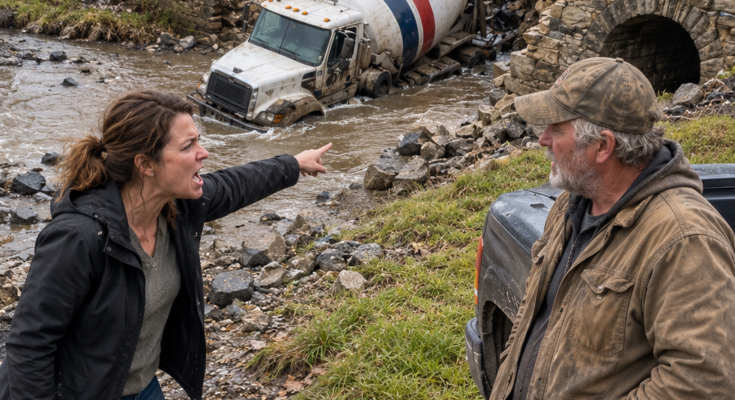
Her nephew Derek owned a commercial construction company working on Phase 1. Soon his forty-ton cement mixers began crossing the narrow fieldstone bridge my grandfather built in 1923.
The bridge was posted for fifteen tons.
I knew because I had inspected it myself.
I spent thirty-six years as a civil engineer before retiring. Bridges had paid my mortgage, put my children through school, and permanently ruined my ability to drive across one without looking at expansion joints.
The first overloaded truck cracked mortar near the eastern abutment.
The fifth widened an existing fissure.
By the second week, fragments of century-old masonry were falling into Willow Creek.
I blocked the approach one morning.
Marjorie arrived ten minutes later holding a clipboard.
“We voted on this.”
I stared at her.
“Your HOA cannot vote itself ownership of my bridge.”
“We have community access authority.”
“You have an easement across your subdivision roads. This isn’t one of them.”
“You’re being hostile.”
“I’m being accurate.”
She smiled.
That fake, patient smile people use when they want witnesses to remember them as reasonable.
“These trucks are necessary for community development.”
“They’re trespassing.”
She laughed.
Then things escalated.
Noise complaints against me when I ran farm equipment.
Letters claiming my fence violated HOA aesthetic standards even though my land had never joined the HOA.
Derek’s crews parked equipment near my property line and ran generators late into the night.
Finally, Marjorie began lobbying county officials.
Her argument was clever.
My bridge was deteriorating.
It was allegedly a public-safety hazard.
My land, she claimed, obstructed a logical transportation corridor for the growing development.
If the county acquired an access strip through the proper public process, the HOA expansion could proceed.
Marjorie liked using the phrase eminent domain as if saying it loudly enough made her personally capable of exercising it.
She wasn’t.
Only a government body with proper authority, procedure, and a genuine public purpose could even attempt something like that.
But she did not need to own the power herself.
She only needed to convince people who did.
So I stopped arguing and started documenting.
Four motion cameras.
Truck plates.
Timestamps.
Axle configurations.
A licensed structural engineer who had never met me before.
His report was blunt:
Accelerated structural distress consistent with repeated loading substantially exceeding posted capacity. Immediate restriction of heavy vehicle traffic recommended.
Then I checked Derek’s transportation records.
Several weight declarations did not match what his equipment should have weighed loaded.
That information went to my attorney.
Still, I wanted to understand one thing.
Why had my grandfather’s original permit referred to the bridge as an infrastructure corridor?
So I went to the courthouse.
At 2:47 a.m., under a reading lamp in the records room, I found the 1923 permit.
My grandfather’s handwriting appeared beside the county engineer’s.
Private bridge construction permit for Kellerman property.
Then underneath:
Permanent utility easement provisions. Infrastructure corridor designation.
Attached was a survey.
And a maintenance agreement.
I read it once.
Then again.
Then I called my attorney even though it was almost three in the morning.
“Samuel?”
“You better be dying.”
“Not yet.”
I read him the provision.
He became very awake.
In 1923, the county had approved my grandfather’s bridge because the county itself needed something from him.
A water transmission line crossed Willow Creek at that exact point.
Instead of trenching beneath the creek, the county had negotiated permission to carry the pipe through protected channels built into the stone abutments.
The bridge remained private.
The roadway remained private.
But the utility infrastructure running through its stonework belonged to the county, and the recorded agreement required county approval for any activity likely to endanger the abutments or alter the loading conditions around them.
Then came the sentence Marjorie had apparently never found:
No public roadway dedication shall be inferred from the utility easement.
I actually laughed.
The document she needed to support her theory of public access said the opposite.
But there was something else.
The old drawing showed inspection chambers inside both stone pillars.
I had seen the iron covers my whole life and assumed they were drainage cleanouts.
At sunrise, with my attorney present and after contacting the county public-works office, we opened one.
Inside was the old pipe sleeve.
And bolted to the masonry beside it was a bronze county survey plate stamped:
UTILITY STRUCTURE — COUNTY ACCESS ONLY — 1923.
The second pillar contained the same thing.
The pipes had been replaced decades ago, but the active modern water line still used essentially the same protected crossing.
Derek’s overweight trucks hadn’t merely damaged my decorative old bridge.
They had been repeatedly loading a structure containing protected county water infrastructure.
At nine-thirty, Marjorie arrived with a county code inspector.
She leaned against her SUV.
“There it is,” she said loudly. “Exactly what I’ve been telling everyone. Dangerous. He refuses to maintain it, and the whole community suffers because one selfish old man is standing in the way of progress.”
I stopped defending myself.
I simply handed the inspector a folder.
Then I stepped back.
Marjorie smiled.
She thought I had surrendered.
The inspector read the first page.
Then the second.
His expression changed.
He walked toward the eastern pillar.
“Mr. Kellerman, is the utility vault accessible?”
“Yes.”
He called somebody.
Then somebody else.
Within forty minutes, two county public-works trucks arrived.
Marjorie stopped smiling.
By lunch, the bridge had been formally closed to all heavy traffic.
Not seized.
Not handed to the HOA.
Closed.
And every construction truck on Derek’s schedule suddenly had nowhere lawful to cross my property.
That was only the beginning.
━━━━━━━━━━━━━━━━━━━━
Part Two — The Damage They Had Documented for Me
The county ordered an emergency inspection of the utility crossing.
My engineer attended.
So did theirs.
The results were uncomfortable for Marjorie.
The water line itself had not ruptured, but one support bracket had shifted, and cracking around the eastern masonry chamber required stabilization.
Then investigators reviewed my camera footage.
Forty-ton mixers.
Dump trucks.
A crane carrier.
Again and again.
All crossing a fifteen-ton private bridge after written warnings.
Derek tried saying he believed the HOA had authorization.
Marjorie tried saying the route had “always been community access.”
The 1923 records answered both arguments.
The bridge had never been dedicated as a public road.
And the utility easement did not grant general vehicle access.
Then the county transportation office began examining Derek’s weight filings.
The HOA’s expansion also faced a separate problem.
Its engineers had designed Phase 2 assuming future vehicular access could be obtained through my land.
That assumption had never become a legal right.
The county did not condemn my twelve acres.
Instead, the development application was paused while access, utility protection, drainage, and permitting issues were reevaluated.
Marjorie called me that evening.
“You’ve ruined this entire project.”
“No.”
“You know exactly what you did.”
I looked through my window at the bridge.
“I kept records.”
She hung up.
━━━━━━━━━━━━━━━━━━━━
Part Three — What Actually Collapsed
The bridge never collapsed.
That is important.
I had spent my career around structural failures. I would never knowingly allow people to cross something I believed could kill them just to prove a point.
The collapse was Marjorie’s plan.
Once county engineers understood the history of the crossing, the narrative changed completely.
She had spent months telling officials:
Old man refuses to maintain dangerous bridge.
The records showed:
Private owner repeatedly warned development traffic not to overload protected structure.
She had described me as obstructing public infrastructure.
The records showed her construction traffic had endangered public infrastructure.
She had implied the bridge was already effectively public.
The recorded agreement explicitly said otherwise.
My attorney filed claims related to the physical damage and unauthorized use.
The HOA’s insurer became involved.
So did Derek’s commercial carrier.
Nobody wrote me a giant check the following afternoon.
There were inspections.
Depositions.
Engineering estimates.
Arguments over how much deterioration predated the trucks.
That last part mattered.
My bridge was a hundred years old.
I refused to claim every crack belonged to Derek.
My engineer separated ordinary age-related deterioration from damage that could reasonably be attributed to recent overloading.
That credibility helped more than exaggeration ever would have.
Eventually, the responsible parties contributed to repairs under a settlement.
The bridge was rebuilt internally without destroying its historic appearance.
Steel reinforcement was hidden within the deck.
The stonework was repointed.
The county utility supports were upgraded.
The fifteen-ton limit remained.
And I installed a locked gate rated for something substantially larger than Marjorie’s SUV.
Phase 2 did not disappear.
It changed.
The developer redesigned access from the opposite side of the subdivision.
That cost money.
A lot of it.
The project became smaller.
Some units were removed.
The proposed route across my acreage vanished from the plans.
Marjorie remained HOA president for another six months.
Then homeowners began asking questions.
Not because I launched some campaign against her.
Because insurance deductibles, legal expenses, delayed construction, and board records tend to make people curious.
Minutes from old HOA meetings showed Marjorie had repeatedly described my permission as “basically settled” before she actually had it.
One board member testified that he believed the trucks had written authorization.
Another said Marjorie had assured them the county considered my bridge a public access structure.
Neither was true.
At a packed HOA meeting, someone finally asked:
“Did Mr. Kellerman ever give us permission to use the bridge?”
Marjorie gave a six-minute answer.
The homeowner interrupted.
“So that’s a no?”
She resigned before the next election.
Derek had his own consequences to deal with regarding vehicle records and the civil claims.
I did not follow every detail.
By then I was tired of having those people occupy so much space in my life.
Six months later, Marjorie came to my property.
She stopped outside the new gate.
I walked down.
She looked older.
Not defeated.
Just tired.
“I suppose you’re happy.”
“No.”
That seemed to irritate her more than if I had gloated.
“You cost us hundreds of thousands.”
“You tried to route commercial construction over a bridge that couldn’t safely carry it.”
“We were building homes.”
“I know.”
“For families.”
“I know.”
She stared at me.
“You always have an answer.”
“No.”
I looked back toward the bridge.
“I just knew that one.”
She was silent.
Then she said:
“I really thought the county would take the strip.”
That was the first honest thing I’d heard from her.
“I know.”
“You would have been paid.”
“That wasn’t the issue.”
She glanced toward my fields.
“Then what was?”
I thought about my grandfather.
Dad teaching me to fish in Willow Creek.
My wife walking across that bridge with our infant daughter.
All the mornings I had crossed it without once asking what the land beneath my boots was worth.
“It was mine to decide what happened to it until a lawful process said otherwise.”
She looked down.
For once, she didn’t argue.
Years later, people still tell the story as if I found some magical deed that destroyed an HOA.
That isn’t what happened.
The 1923 agreement did not make me untouchable.
An LLC wasn’t hiding my property.
A forgotten clause did not somehow outlaw development.
And eminent domain is not defeated by yelling private property at the government.
What saved me was less dramatic.
A valid recorded history.
Independent engineering.
Video.
Weight records.
A lawyer who kept telling me not to do anything stupid.
And the fact that Marjorie had become so certain of the story she wanted to tell that she stopped checking whether the documents agreed with her.
The strangest part came two summers later.
The county historical society asked permission to place a small plaque near the bridge.
I almost said no.
Then they showed me the wording.
KELLERMAN BRIDGE — 1923
Privately constructed in cooperation with county water infrastructure. Restored 2027.
Nothing about Marjorie.
Nothing about the lawsuit.
Nothing about me “winning.”
Good.
I approved it.
My grandson asked why the bridge mattered enough to have a plaque.
“Because your great-great-grandfather built it.”
“Did he know about the pipes?”
“He designed around them.”
“Was he an engineer like you?”
“Better.”
My grandson ran his fingers across the stone pillar.
Then pointed toward the bronze plate inside the inspection chamber.
“Is that the secret thing?”
I smiled.
“Sort of.”
The real secret wasn’t hidden inside the stone.
It was sitting in the courthouse basement for a hundred years, available to anyone patient enough to read it.
Marjorie thought power meant having the board votes, the development money, the construction crews, and enough confidence to tell everyone else what would happen next.
For twelve weeks, I tried to fight that confidence with anger.
It got me nowhere.
The night I found my grandfather’s permit, I finally understood something.
I didn’t need to outshout her.
I needed to stop helping her turn the argument into a contest of personalities.
So the next morning, when she stood beside her luxury SUV and called me a selfish old man standing in the way of progress, I stopped defending myself.
I handed the inspector the records.
Opened the stone pillar.
And stepped aside.
Because sometimes the strongest position isn’t proving you’re harder to move.
It’s knowing exactly what the ground beneath you says.