Part One — The Promise I Couldn’t Keep
My name is Evelyn. I’m seventy-four years old, widowed for nine years, and I live alone in a small town where people still wave from their cars and notice when your porch light stays off too long. For a long time, I liked it that way. Quiet felt safer. Quiet meant nobody asked how I was doing, and I didn’t have to lie.
My days were simple. Coffee at six. The television on for background noise. A slow walk to the mailbox. Something small for dinner. Bed before ten, whether I was tired or not. The only person who ever stepped into that quiet like she belonged there was my friend Dorothy.
We had known each other most of our lives. Back when our children were young, back when our husbands were alive, back when our plans stretched farther than next Tuesday. Time took a great deal from both of us, but somehow it left us each other.
Dorothy lived three blocks away in a pale blue house with too many flowerpots on the porch and a front step that leaned slightly to the left. And Dorothy had Pepper.
Pepper was an old gray cat with a torn ear, cloudy green eyes, and slow, careful movements. She wasn’t the kind of cat that climbed into strangers’ laps. She watched. She waited. And when she finally trusted you, she sat nearby—never on you, just close enough that you could feel her warmth.
I never thought much about Pepper until Dorothy got sick.
At first, it was doctor visits and quiet reassurances. Then it became unopened mail, meals untouched in the refrigerator, and the kind of silence that settles around a room before everybody is brave enough to say what is happening.
The last time I sat beside Dorothy’s bed, she reached for my hand. Her fingers felt lighter than I remembered.
“If I go first,” she said, “take Pepper to the shelter.”
I frowned. “Dorothy.”
“I mean it.”
“She’s been with you twelve years.”
“And you don’t need a twelve-year-old cat tying you down.”
“I’m already tied down. I’m seventy-four.”
She almost smiled.
“Promise me, Evie. Find somewhere safe. Then go home.”
I should have argued.
Instead, I said, “I promise.”
Dorothy died four days later, just before sunrise.
After the small funeral, after her daughter Claire flew back to Oregon, after neighbors carried casseroles into a kitchen where nobody was hungry, I went to Dorothy’s house to get Pepper.
She was sitting in Dorothy’s chair.
Same cushion.
Same corner.
Same place she always sat when Dorothy read in the evenings.
Pepper looked at me, then toward the front door behind me.
Waiting.
“She’s not coming back, sweetheart.”
Pepper blinked.
Then looked toward the door again.
I brought her home for one night.
Just one.
That was what I told myself.
I put water in one of my cereal bowls and food on a saucer because I didn’t own anything meant for cats. Pepper drank, ate a little, and spent fifteen minutes inspecting every room in my house.
Then she found my bedroom.
That night, she slept at the foot of my bed.
I woke twice because I wasn’t used to hearing anything breathing nearby.
The strange part was that I liked it.
For the first time in nine years, the house did not sound empty.
The next morning, I put Pepper into the carrier.
I had the shelter paperwork ready. Dorothy had already written down Pepper’s veterinary information, medications, age, and food preferences. Everything was organized exactly the way Dorothy organized everything.
The drive felt longer than it was.
Pepper didn’t cry.
Didn’t scratch.
Didn’t complain.
She just watched me through the metal door.
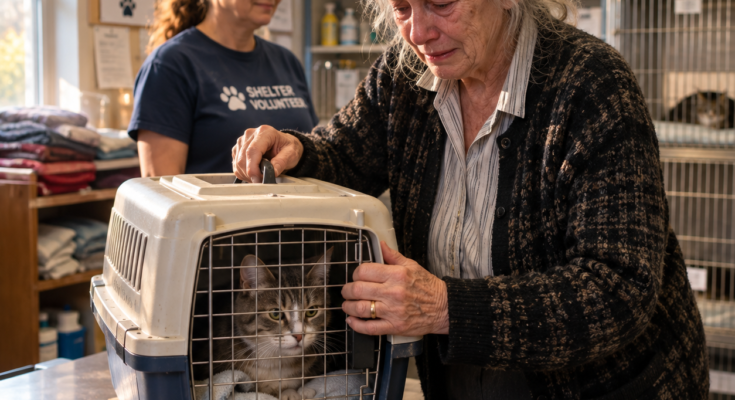
When we arrived, the shelter was clean and quiet. Warm blankets were stacked behind the counter. A young woman named Nina smiled and said, “Whenever you’re ready.”
I put the carrier down.
But my hands stayed on the handle.
Nina waited.
“She’s twelve,” I said.
“We place senior cats.”
“She has arthritis.”
“We have adopters who understand that.”
“She’s picky.”
Nina smiled. “Most cats consider that part of the job description.”
I almost laughed.
Then I reached for the carrier door.
Pepper moved.
For the entire drive, she had barely made a sound.
Now she pushed one gray paw through the narrow opening.
Her claws stayed tucked away.
She simply reached.
Her paw touched the back of my hand.
Then curled around one finger.
And she started purring.
Not loudly.
Just a faint vibration through the metal door.
I stood there staring at her paw around my finger.
Nine years earlier, when my husband died, people had surrounded me for about three weeks. They brought food. Sent cards. Called.
Then life resumed.
The phone rang less.
The casseroles stopped.
My children lived in different states.
Dorothy remained.
She never asked whether I was “moving on.” She just appeared every Tuesday with coffee and some unnecessary complaint about the price of tomatoes.
When I didn’t answer my phone, she came over.
When I forgot my wedding anniversary and then remembered halfway through breakfast, she sat at my table while I cried.
She never fixed my loneliness.
She simply refused to let me disappear inside it.
Now her cat had one paw wrapped around my finger.
Nina asked quietly, “Are you sure you want to surrender her?”
I looked at Pepper.
Then I heard Dorothy’s voice in my head.
Don’t let her tie you down.
For the first time, I wondered whether Dorothy had misunderstood something.
Maybe Pepper wasn’t tying me down.
Maybe she was giving me something to stay for.
I closed the carrier.
Nina looked confused.
“I’m sorry,” I said.
“About what?”
“I’ve changed my mind.”
I picked up the carrier.
“I made a promise to my best friend.”
Nina smiled gently. “And?”
I looked down at Pepper.
“And apparently I’m breaking it.”
━━━━━━━━━━━━━━━━━━━━
Part Two — Why Dorothy Made Me Promise
I felt guilty almost immediately.
By the time Pepper and I reached home, I had convinced myself I had betrayed Dorothy’s last request. So that evening, I called Claire.
“I kept Pepper.”
There was a pause.
Then Dorothy’s daughter laughed.
Actually laughed.
“What?”
“Mom knew you would.”
I sat up straighter. “Excuse me?”
“She told me you might.”
“Then why did she make me promise?”
Claire became quiet. “Because she was afraid you’d keep Pepper out of obligation.”
I said nothing.
“She knew you, Evelyn. She knew you’d spend the next six years saying, ‘I can’t visit my kids because Dorothy’s cat needs me,’ or ‘I can’t do this because I promised Dorothy.’ She didn’t want her death to become another excuse for you to stop living.”
That irritated me because it sounded exactly like Dorothy.
Claire continued, “Mom didn’t want Pepper abandoned. She wanted Pepper somewhere safe. She just didn’t want you believing you had to be that place.”
I looked toward the living room.
Pepper was asleep in Dorothy’s old knitted blanket, which I had brought home with her.
“So I’m still breaking my promise.”
“A little.”
“Thank you.”
“But you’re choosing her. That’s different.”
After we hung up, I sat beside Pepper.
“You hear that?”
She opened one eye.
“I’m apparently allowed to keep you, but only if I admit this was my idea.”
Pepper closed her eye again.
“Your mother was difficult too.”
Her tail moved once.
That was the beginning.
━━━━━━━━━━━━━━━━━━━━
Part Three — The House That Started Making Noise Again
Pepper changed my life in embarrassingly small ways.
She needed breakfast at seven, which meant I had to get out of bed whether I felt like it or not. She required medication every evening, so I had to remember what day it was. She hated an empty water bowl and announced this by sitting beside it and staring at me as if I had failed morally.
She also hated closed doors.
That became a problem.
For nine years, I had closed doors without thinking.
Bedroom.
Bathroom.
Spare room.
Pepper considered this unacceptable.
She scratched once.
Waited.
Then scratched again.
Eventually I stopped closing most of them.
It sounds silly, but my house began opening up.
So did I.
My neighbor Carol noticed Pepper in the front window and came over with cat treats. Then she stayed for coffee. A week later she invited me to a library book group.
My first instinct was no.
Then I looked at Pepper.
“You’re turning me into a social person.”
She yawned.
I went.
I hated the first meeting.
Then I went again.
My daughter started calling more often because she wanted pictures of Pepper. My grandson taught me how to send videos. I learned that the camera on my phone could accidentally point upward and show an elderly woman far more chin than any human should see.
Pepper appeared in almost every video.
Within six months, she became the excuse that connected me to people instead of the excuse that kept me away from them.
That was the opposite of what Dorothy had feared.
Then came December.
My first Christmas without her.
I had been dreading it since October.
Dorothy and I had spent every Christmas Eve together for seventeen years. After our husbands died, we developed a tradition of making too much soup, exchanging one deliberately terrible gift, and complaining about television Christmas movies.
That year, there was no Dorothy.
I considered ignoring Christmas.
Then Pepper knocked a glass ornament off the table.
It shattered.
I stared at her.
“You’re costing me money now.”
She looked deeply satisfied.
So I put up a tree.
A small one.
Carol helped.
Claire mailed me one of Dorothy’s old ornaments—a ridiculous wooden angel with crooked wings.
I hung it near the top.
Pepper immediately tried to attack it.
“Your mother loved that.”
Pepper tried again.
Christmas Eve came.
I made soup.
One bowl.
Then I looked at the second bowl sitting in my cupboard.
For a moment, grief arrived so quickly that I had to grip the counter.
Pepper walked into the kitchen.
She didn’t jump onto me.
She didn’t perform some miraculous act of understanding.
She simply sat beside my foot.
Close enough that her side touched my ankle.
Exactly the way she used to sit beside Dorothy.
I cried.
Pepper stayed.
That was enough.
A year passed.
Then another.
Pepper slowed down.
Her arthritis worsened. She stopped jumping onto the windowsill and started using a little carpeted step my grandson ordered online.
The veterinarian adjusted her medication.
“She’s an old lady,” he said.
“So am I.”
He smiled.
“You’re doing better.”
“Debatable.”
Pepper made it to fifteen.
Then one morning, she did not come into the kitchen for breakfast.
I found her in my bedroom.
She was lying on Dorothy’s blanket.
When I touched her, she lifted her head but didn’t stand.
I knew.
Or maybe I didn’t know yet.
Maybe I simply knew we were close.
The veterinarian examined her that afternoon. Kidney disease had progressed. Her weight had dropped. We could try additional treatments, but he was honest about what they were likely to accomplish.
“How much time?”
“I can’t tell you.”
“Would she be comfortable?”
“For a while, perhaps.”
I looked at Pepper.
She was tired.
That was the word.
Not dying.
Not suffering dramatically.
Just tired in a way that went all the way through her.
I took her home for one more night.
I called Claire.
“I think it’s time.”
Claire began crying.
“So do I.”
We talked about Dorothy.
About Pepper.
About the promise.
Then Claire said, “Mom would be glad you broke it.”
I smiled through my tears.
“No. Your mother would spend at least twenty minutes telling me I was stubborn.”
“That too.”
That night, Pepper slept beside me.
Not at the foot of the bed.
Beside me.
At some point, I woke and felt her paw resting against my wrist.
The same paw that had reached through the shelter carrier years earlier.
I didn’t sleep after that.
I just listened to her breathe.
The veterinarian came to my house the following afternoon.
Pepper was on Dorothy’s blanket in my lap.
I whispered things I knew she could not understand.
That Dorothy had loved her.
That I had loved her too.
That she had done enough.
Then I told her the truth.
“I thought I was keeping you because Dorothy left you behind.”
My voice broke.
“But I think you kept me because she did.”
Pepper died quietly.
My house became silent again.
The silence was terrible.
But it was different this time.
Because I was different.
Carol came over that evening.
My daughter called.
Claire called.
The women from the book group sent flowers.
My grandson stayed on video with me for almost an hour even though neither of us had much to say.
Nine years earlier, after my husband died, I had responded to grief by becoming smaller.
After Pepper died, I let people in.
That may have been the greatest thing she gave me.
A month later, I took Pepper’s unopened food and medications to the same shelter where I had almost surrendered her.
Nina still worked there.
She recognized me.
“Pepper?”
I shook my head.
Her expression softened.
“I’m sorry.”
“Thank you.”
I handed over the supplies.
Then I made the mistake of looking toward the cat rooms.
There was an old orange cat sitting by himself.
One eye.
Bent ear.
Sixteen pounds of apparent dissatisfaction.
“No.”
Nina smiled.
“I didn’t say anything.”
“I know what you’re doing.”
“I’m standing here.”
“He looks unpleasant.”
“His name is Walter.”
“Of course it is.”
I walked closer.
Walter stared at me.
I stared back.
Then he turned around and showed me his rear end.
“Absolutely not.”
Nina laughed.
I went home alone.
For three days.
On the fourth, I returned.
Walter came home with me.
I told everybody he was temporary.
Nobody believed me.
Today I am seventy-eight.
Walter is asleep in Dorothy’s chair as I write this.
Yes.
I kept the chair too.
Claire visited last summer and sat in it without realizing.
Walter immediately climbed beside her.
She cried.
Then she laughed and said, “Mom really would find this funny.”
I think she would.
For a long time, I believed breaking a promise meant betraying the person who trusted you enough to ask for it.
Now I think sometimes promises are made out of fear.
Dorothy feared leaving me with a burden.
I feared admitting that I needed something alive in my empty house.
We were both trying to protect me.
Pepper ignored us.
That morning at the shelter, she reached one paw through a metal door and held onto my finger.
Such a small thing.
But that is often how life changes.
Not with revelations.
Not with grand gestures.
A paw.
A chair no longer empty.
A food bowl that needs filling tomorrow morning.
Dorothy asked me not to let her cat tie me down.
I broke that promise.
Pepper didn’t tie me down.
She tied me back to the world.