Part One — The Car That Kept Going
My name is Marshall Voss. I’m fifty-three, and until that afternoon, I would’ve told you I was the kind of man who minded his own business. Then I saw Riley.
I was driving home through central Ohio when a white sedan passed me. Maybe ten seconds later, something black and white appeared along the shoulder. A dog. He was running hard—not wandering, not confused. Running like his life depended on catching that car.
I slowed down and watched him stumble, recover, then keep going. His tongue hung from one side of his mouth. One back leg looked stiff. The sedan kept getting smaller. “Come on,” I muttered. “Stop.” It didn’t.
The dog tried to run faster.
That was when I pulled over.
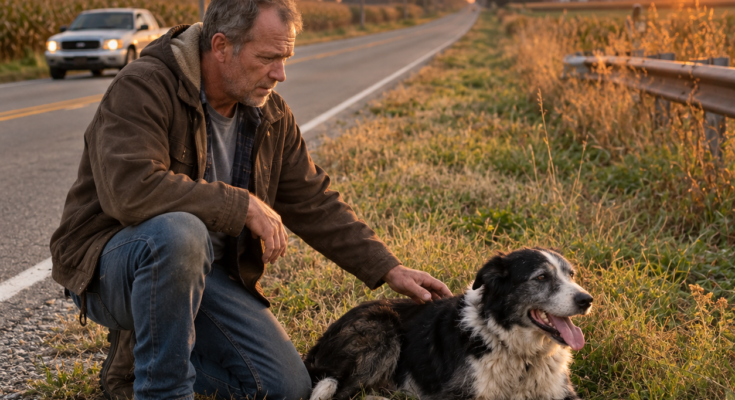
It took several minutes to get close enough to him. Every time I reached out, he dodged me and looked back toward the highway. Finally, his legs gave out. He sank onto the grass, still staring after that car.
I knelt beside him. “Easy, buddy.”
He didn’t growl. He just made this low sound in his throat I’d never heard from a dog before.
It sounded like heartbreak.
His tag said RILEY. There was a phone number underneath. I called three times.
No answer.
So I brought him home.
I figured somebody would call within an hour.
Nobody did.
Riley drank nearly an entire bowl of water but barely touched the food. He walked through my living room once, sniffed the couch, then went straight to the front door and lay down beside it.
That night, I woke around two and found him in exactly the same place.
“Your people aren’t coming tonight,” I told him.
A truck passed outside. Riley’s ears shot up. He stood, tail moving, and stared through the glass.
Then the sound faded.
He lay down again.
I don’t know why that got to me.
Maybe because I’d spent seven years telling myself there was something peaceful about living alone. My marriage ended after my wife, Susan, told me she was tired of feeling lonely while sitting in the same room with me. Our daughter, Emily, lived in Colorado now. I saw her maybe twice a year and called that enough.
No one waiting for me.
No one needing me.
No one I could disappoint.
Riley seemed to believe the opposite.
Waiting was all he had.
The next morning, I called again.
Nothing.
By afternoon, I was angry. I had built an entire story about Riley’s owner in my head. Somebody got tired of an old dog. Somebody pulled over, opened a door, and drove away. People can be cruel when something that once brought them joy becomes inconvenient.
That evening, my phone finally rang.
“Is Riley with you?”
The voice belonged to an older man.
“Yes.”
There was a long breath.
“Oh, thank God.”
I didn’t share his relief.
“Were you driving the white sedan yesterday?”
Silence.
“Yes.”
My jaw tightened.
“I watched him chase you.”
“I know.”
“And you kept driving.”
Another silence.
“What kind of person does that?”
The man on the other end began crying.
Not quietly.
“I didn’t know what else to do.”
“You stop the car.”
“I couldn’t.”
“You absolutely could.”
“No,” he said. “I couldn’t.”
Then he told me what had been in the passenger seat.
His wife.
Riley’s person.
Her name was June. She had late-stage ovarian cancer and had been receiving hospice care at home. That afternoon, her breathing suddenly changed. She became frightened and begged her husband, Harold, to drive her to the hospital instead of waiting for an ambulance.
Riley climbed into the back seat because he always went wherever June went.
Halfway there, June became unresponsive.
Harold panicked.
He pulled onto the shoulder long enough to check her and grab her medication bag from the back. When he opened the door, Riley jumped out.
“I called him,” Harold whispered. “I swear I called him.”
I said nothing.
“Then June opened her eyes and said she couldn’t breathe.”
Harold climbed back into the car.
Riley was still outside.
He drove.
Riley followed.
“I saw him in the mirror.”
His voice broke.
“I watched him running after us.”
My anger began slipping into something worse.
Understanding.
“What happened to your wife?”
Harold went quiet.
Then he said, “She died forty-one minutes later.”
I sat down.
The room around me seemed to disappear.
“I didn’t answer your calls because my phone was in her hospital bag. I didn’t even find it until this afternoon.”
I looked toward the front door.
Riley was still lying there.
Waiting.
Harold whispered, “The last thing June asked me before she stopped talking was whether Riley had gotten back into the car.”
I closed my eyes.
“What did you tell her?”
Another long silence.
“I lied.”
His voice cracked.
“I told her yes.”
━━━━━━━━━━━━━━━━━━━━
Part Two — June’s Dog
Harold came to my house the next morning.
The moment his white sedan turned onto my street, Riley stood. I opened the door, and he shot past me.
Harold barely made it three steps before Riley crashed into his legs. The old man dropped to his knees and buried his face in Riley’s fur.
“I’m sorry, boy,” he kept saying. “I’m sorry.”
Riley searched the car next.
Back seat.
Passenger side.
Around the trunk.
His tail slowed.
June wasn’t there.
Harold sat at my kitchen table afterward and told me Riley had been June’s dog for twelve years. During chemotherapy, he slept beside her recliner. When she was too weak to walk, he stayed beside her bed. “He knew when she was having a bad day before I did,” Harold said.
Then he looked at me.
“I can’t take him home.”
I stared at him.
“What?”
“My daughter wants me to move to Arizona. The house is being sold. Riley’s old, his hips are bad, and the trip will be hard.”
“So you’re giving him away?”
“No. I’m asking if you’ll keep him.”
I laughed once. “You don’t know me.”
Harold looked beneath the table.
Riley’s head was resting on my boot.
“He seems to.”
Then Harold gave me a folder with veterinary records and a handwritten list titled RILEY THINGS.
At the bottom, in June’s handwriting, was one line:
When Riley waits by a door, sit with him. He’s not waiting for the door. He’s waiting not to be alone.
I read it twice.
“I need time.”
Harold nodded.
So Riley stayed temporarily.
That was what I told myself.
On the third night, he stopped sleeping beside the front door and slept beside my bed.
On the fifth day, I bought him an orthopedic dog bed.
On the sixth, I called my daughter.
“I think I might be keeping a dog.”
Emily went silent.
“You hate dogs.”
“I don’t hate dogs.”
“Mom begged you for one for fifteen years.”
“That was different.”
“How?”
I had no answer.
I sent her a picture of Riley.
Five seconds later, she replied:
HE IS PERFECT. I’M COMING HOME NEXT MONTH.
Emily had not visited me in almost a year.
I looked down at Riley.
“You did that on purpose?”
His tail tapped once against the floor.
━━━━━━━━━━━━━━━━━━━━
Part Three — The Person Who Came Back
Harold buried June three weeks later.
I went to the funeral because he asked if Riley could come. Riley sat beside the grave quietly, his black-and-white body pressed against Harold’s leg. When most people had left, Harold knelt beside him.
“She’s not in the car anymore, boy.”
Riley licked his wrist.
I turned away.
A week later, Harold was ready to leave for Arizona.
He came to my house carrying Riley’s red ball, June’s old blanket, and a photograph of June sitting on their porch with Riley’s head across her lap.
“You keep this.”
“Harold…”
“Please.”
I took it.
He hugged Riley for a long time before standing.
“If you change your mind, call me.”
“You’re seventy-six and moving across the country.”
“I can still drive.”
“Your recent record is questionable.”
Harold laughed.
Then his face grew serious.
“Marshall, don’t confuse him loving you with him forgetting her.”
I looked at Riley.
“I won’t.”
Harold nodded and walked toward his sedan.
When he pulled away, Riley ran after him.
My stomach dropped.
For about fifteen feet, that old dog chased the white car again.
Then he stopped.
He stood in the driveway watching until Harold disappeared around the corner.
I almost called him.
Then I remembered June’s note.
So I walked over and sat on the curb.
I didn’t tell Riley Harold wasn’t coming back.
I didn’t tug his collar.
I didn’t ask him to move on.
I just sat beside him.
After a minute, Riley walked over and leaned his entire body against my shoulder.
We stayed there for nearly half an hour.
That was the day he became my dog.
Or maybe I became his person.
I’m still not sure how that works.
Emily visited the next month.
Within fifteen minutes, Riley was lying with his head in her lap.
“Traitor,” I said.
Emily laughed. “You’re jealous of your own dog.”
“I feed him.”
“Congratulations on parenting.”
The words landed harder than she meant them to.
She saw my face.
“Dad…”
“No. You’re right.”
Susan and I had divorced because I was good at being physically present and terrible at letting anyone close. When Emily moved away, I did the same thing with her. I told myself grown children had their own lives. I waited for her to call, but rarely called first.
Riley had spent one day chasing someone he loved down a highway.
I had spent years convincing myself not chasing anyone was strength.
That night, Emily and I stayed up until almost midnight. I learned things I should already have known. She had changed jobs. Her apartment lease was ending. She had been dating a man named Caleb for nine months.
“Nine months?”
She looked at me.
“You never ask anything beyond ‘Everything okay?’”
That hurt.
So I started asking better questions.
We began talking every Sunday.
Not long calls every time.
Just consistent ones.
The following spring, I drove to Colorado to visit her.
Riley came with me.
Harold called almost every week too. Sometimes I put the phone near Riley.
“Hey, boy,” Harold would say.
Riley’s ears always lifted.
He remembered.
Two years passed.
Riley slowed down.
His hips worsened. His kidney numbers changed. Our walks became shorter until walking to the mailbox counted as exercise.
Then one October morning, Riley refused breakfast.
I knew.
Our veterinarian examined him and gently explained that we were getting close to the end.
I called Harold.
“I’m coming.”
“You don’t have to.”
“Yes, I do.”
His daughter drove him from Arizona.
When Harold entered my living room the following evening, Riley had been asleep on June’s blanket.
He opened his eyes.
For the first time in weeks, he stood without help.
Slowly, painfully, he crossed the room and pressed his head into Harold’s chest.
Harold broke down.
“You remembered me.”
Of course he had.
That night, Harold slept on my couch. I stayed in my recliner. Riley lay on June’s blanket between us.
Around three in the morning, I heard Harold talking softly to him.
“You found another one, didn’t you?”
Riley’s tail moved weakly.
Harold looked over at me.
“He always collected lonely people.”
I laughed.
“June first?”
Harold shook his head.
“Me.”
The veterinarian came to the house the following morning. Emily joined by video because she couldn’t get there in time.
Riley rested with one paw against Harold’s shoe and his head in my lap.
Before the medication, I leaned close.
“You don’t have to chase anybody this time.”
His eyes stayed on mine.
“Everybody’s here.”
Riley died with both of us touching him.
For months afterward, I kept expecting to hear his nails clicking through my hallway.
I still looked at the place beside the front door where he had spent that first night waiting.
Harold and I stayed friends.
Eventually, I apologized to him.
“For what?” he asked.
“For deciding what kind of man you were based on the worst-looking thirty seconds of your life.”
He was quiet for a moment.
“If I’d seen what you saw, I probably would’ve thought the same thing.”
Then he said, “But you stopped.”
“I had time.”
“So did every car behind you.”
That stayed with me.
The photograph of June and Riley still sits on my bookshelf.
Beside it is another one Emily took the Christmas before Riley died. I’m sitting in my chair, and Riley is asleep with his head across my boot. I look irritated in the photograph.
I wasn’t.
People sometimes ask whether Harold should have stopped on that highway.
Maybe.
Maybe not.
I know what I saw: an old dog chasing a white sedan while the driver kept going.
Harold saw something entirely different: his dying wife struggling to breathe beside him while the dog they both loved disappeared in the mirror.
Same road.
Same moment.
Two different kinds of heartbreak.
I learned something from that.
Sometimes one terrible-looking moment is not enough information to decide who someone is.
And sometimes love is forced to choose between two things it cannot bear to lose.
I used to say I rescued Riley.
That isn’t really true.
I stopped my truck.
That was all.
Riley did everything afterward.
He connected me to Harold.
He brought my daughter back through my front door.
And after seven years of telling myself that needing nobody was the safest way to live, an old black-and-white dog taught me the price of that kind of safety.
Waiting hurts.
People leave.
Dogs leave too.
Loving anything means eventually risking an empty place beside you.
But Riley never stopped believing somebody might come back.
Because of him, I finally stopped pretending I didn’t care whether anybody did.