Part One — The Dog Who Wouldn’t Stop Pawing Him
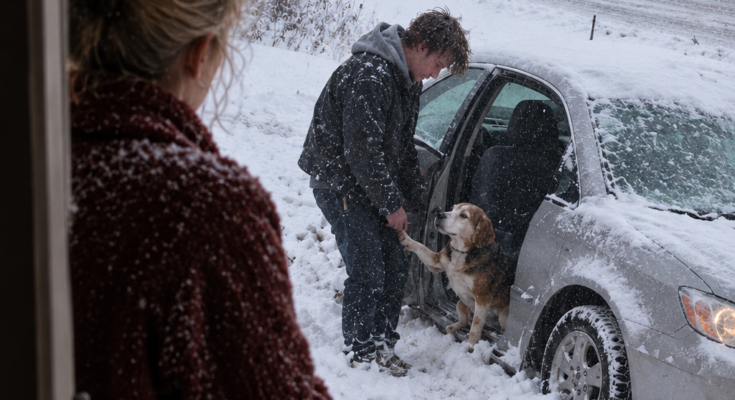
The dog was the reason I opened the door. I had been standing at my kitchen window, watching snow erase the road outside my house, when I saw a small delivery car slide sideways and sink nose-first into the ditch.
A teenage boy climbed out. He tried pushing the car. He tried digging around the tires with his boots. Then he leaned against the driver’s door for a moment, shoulders rising and falling beneath a thin jacket that had no business being worn in a Minnesota blizzard.
I was seventy-one years old, recently widowed, and had spent most of that winter convincing myself that minding my own business was the same thing as being independent.
Then I saw the beagle.
He was sitting in the passenger seat, gray around the muzzle, staring through the windshield. The boy opened the door and said something to him. The dog didn’t move. Instead, he reached out one paw and kept scratching at the boy’s leg.
Again.
Again.
Again.
Something about it bothered me.
I taught middle school for thirty-eight years. You learn to recognize when a child says, “I’m fine,” and absolutely is not.
So I pulled on my late husband’s old boots, wrapped myself in the wool coat he’d bought me twenty Christmases earlier, and stepped outside. The wind nearly took my breath away.
“Young man!”
He turned toward me.
“I’m okay!” he yelled immediately.
Of course he did.
He couldn’t have been more than seventeen. His cheeks were bright red, his lips pale, and he was shivering so hard I could see it from twenty feet away.
“You don’t look okay.”
“My phone’s almost dead, but somebody will come.”
“When?”
He shrugged.
The beagle pawed him again.
“What’s your name?”
“Caleb.”
“I’m Mrs. Harlan.”
He gave me the tired half-smile teenagers give older women when they’re trying to be polite.
“Nice to meet you, ma’am.”
Then his knees buckled slightly.
That ended the discussion.
“Inside.”
“I’m really fine.”
“Caleb, I spent almost four decades telling thirteen-year-olds to sit down when they didn’t want to. You’re not going to win this one.”
For the first time, he almost laughed.
I pointed toward the house.
“Bring the dog.”
That convinced him.
The beagle’s name was Chester. He was twelve years old, arthritic, overweight, and apparently the only creature on earth whose opinion Caleb respected without argument. The moment we got inside, Chester shook snow across my entryway and waddled straight toward the heating vent.
Caleb apologized three times.
I told him snow melted and floors dried. People were harder to replace.
That stopped him.
I wrapped him in blankets and sat him at my kitchen table while I called for help. The roads were nearly impassable. Emergency crews were overwhelmed, and we were told to stay inside unless Caleb’s condition worsened.
That was when Chester left the heating vent.
He walked straight to Caleb.
Then he pawed his leg.
Once.
Twice.
Three times.
Caleb pushed him away weakly.
“Stop, Chester.”
The dog immediately returned.
This time he whined.
“What is he doing?” I asked.
“Nothing.”
“That is not nothing.”
Caleb wouldn’t look at me.
Chester scratched harder.
Then Caleb’s hand slipped from the mug I had given him.
It hit the table.
His eyes looked unfocused.
I stood.
“Caleb?”
He blinked slowly.
“I just need a minute.”
Chester began barking.
Not the bark of an excited dog.
A sharp, repetitive bark directed straight at me.
I grabbed the phone again.
While I spoke with the dispatcher, Caleb finally whispered the truth.
“I have diabetes.”
My stomach tightened.
“Does Chester do this when something is wrong?”
Caleb closed his eyes.
“He knows when my sugar drops.”
I looked at the old dog.
He barked again.
The dispatcher gave me instructions while help was sent. I followed them exactly. Within minutes, Caleb became more alert, but Chester stayed pressed against his leg.
When paramedics finally reached us, one of them checked Caleb and immediately became serious.
“He’s dangerously low.”
Caleb looked embarrassed.
“I’m okay now.”
The paramedic gave him the same look I had.
“No, son. You’re getting there.”
Chester sat beside the kitchen table watching every movement.
The paramedic glanced at him.
“That dog alert you?”
Caleb nodded.
“For years.”
That was when I learned Chester wasn’t merely an elderly family pet.
He had been doing this since Caleb was nine.
And the person who taught him to notice was Caleb’s mother.
“She trained him?” I asked later.
Caleb looked toward Chester.
“Sort of.”
“What does that mean?”
“My mom noticed he acted weird whenever my blood sugar got low. So she started rewarding him when he pawed me.”
He rubbed Chester’s gray head.
“Eventually he figured it out.”
“And where is your mother?”
Caleb’s face changed.
“She died last year.”
The kitchen went quiet.
Suddenly I understood why a seventeen-year-old boy was out making deliveries during a blizzard with an old arthritic beagle riding beside him.
But I hadn’t yet understood the worst part.
Caleb wasn’t delivering because he wanted spending money.
He was trying to keep the apartment where Chester was allowed to live.
━━━━━━━━━━━━━━━━━━━━
Part Two — Why Caleb Was Out in the Storm
Caleb lived with his older sister, Marissa, who was twenty-three and working full time while finishing nursing school. Their mother had died after a short illness, and their father had been gone from their lives for years.
After the funeral, almost everything changed at once. Rent increased. Medical bills arrived. Marissa took custody of Caleb, and together they tried to keep the little apartment their mother had rented for almost a decade.
Chester was the complication.
Most cheaper apartments they found either wouldn’t accept him or wanted deposits they couldn’t afford. Caleb refused to leave him behind.
“He was Mom’s dog,” he told me. “And he knows when I’m in trouble.”
So Caleb worked evenings and weekends for a local restaurant that still used its own delivery drivers. He wasn’t supposed to be out once the weather became severe, but the storm had worsened much faster than expected.
“Why didn’t you turn around?”
He stared at his hands.
“I needed the shift.”
That answer made me angrier than I expected.
Not at him.
At how easily a child can start believing survival is the same thing as responsibility.
“You nearly froze trying to earn one night’s pay.”
“I’m seventeen.”
“Yes.”
“That’s basically an adult.”
I looked at him.
“No seventeen-year-old has ever said that unless they’re doing something they shouldn’t have to do.”
He smiled reluctantly.
Chester rested his chin across Caleb’s shoe.
I understood then that the dog wasn’t just protecting Caleb’s health.
He was the last living piece of the home Caleb had lost.
And Caleb was working himself sick trying to make sure he didn’t lose that too.
━━━━━━━━━━━━━━━━━━━━
Part Three — Chester’s Last Job
The snow did not let up until morning.
Caleb slept on my couch.
Chester slept on the floor beneath him, though “slept” may be generous. Every time Caleb shifted, one old beagle eye opened.
I barely slept at all.
Not because of them.
Because my house sounded different.
For eleven months after my husband, Robert, died, I had complained about silence while doing everything possible to preserve it. I stopped attending church breakfasts. Declined invitations. Let neighbors leave casseroles on the porch instead of opening the door.
I called it independence.
Robert would have called it stubbornness.
By morning, the plows had finally cleared enough road for Marissa to reach us.
She came through my door still wearing hospital scrubs beneath her winter coat.
Caleb stood.
She crossed the room in three steps and wrapped both arms around him.
Then she smacked the back of his head.
“What were you thinking?”
“I’m fine.”
“You drove into a blizzard.”
“I didn’t know it was going to—”
“You never know anything!”
She started crying before she finished.
Caleb stopped defending himself.
He hugged her.
Chester stood beneath them, tail wagging slowly.
Marissa apologized to me repeatedly. I told her I had a rule against unnecessary apologies before breakfast.
Then she saw Chester’s bowl.
“You fed him?”
“Yes.”
“He’s on a diet.”
Chester looked personally betrayed.
“I didn’t know.”
“He tells everyone that.”
“I fed him dog food.”
“He considers all food medically necessary.”
That was the first time we all laughed.
Then Marissa noticed something on the kitchen counter.
A photograph of Robert.
He was standing beside our old pickup truck, grinning with one arm around a black Labrador we had years earlier.
“You had a dog?”
“Robert did.”
“What happened?”
“Daisy died five years ago.”
“Did you ever get another?”
“No.”
“Why?”
I looked at Robert’s photograph.
Because losing one creature you loved felt like enough warning.
I didn’t say that.
Instead, I made more coffee.
Before Caleb left, I wrote my phone number on a piece of paper.
“If you’re ever driving this road again and the weather turns, you stop here.”
“Yes, ma’am.”
“I mean before you’re in a ditch.”
“Yes, ma’am.”
“And keep food with you.”
He smiled.
“Yes, ma’am.”
I pointed at Chester.
“And listen to him.”
Caleb looked down at the old dog.
“I always do.”
I watched them leave.
Then my house became quiet again.
This time, I hated it.
Three days later, there was a knock on my door.
Caleb stood outside holding a pie.
“This is from Marissa.”
“What kind?”
“Apple.”
“You may enter.”
That became the beginning.
At first, Caleb stopped by only when he was delivering nearby.
Then Marissa started coming too.
Sometimes they brought Chester.
Mostly they brought noise.
Caleb complained about school.
Marissa studied at my kitchen table between shifts.
I corrected Caleb’s essays because apparently thirty-eight years of teaching follows you into retirement whether you like it or not.
One afternoon, I learned they were still looking for a cheaper apartment.
That night, I called a former colleague whose brother managed several rental properties.
I did not ask for charity.
I asked whether he had anything modest, pet-friendly, and affordable.
He did.
Two bedrooms above a retired couple’s garage, ten minutes from Marissa’s hospital and close enough for Caleb to remain in his school district.
The rent was less than they were paying.
Chester was welcome.
When I told Caleb, he stared at me.
“Why are you helping us?”
I almost said, Because you need help.
Instead I said, “Because I knew someone who might know someone.”
He frowned.
“That sounds suspiciously like teacher behavior.”
“You’ll survive.”
They moved six weeks later.
Chester supervised from a blanket.
He contributed nothing.
By spring, Caleb stopped delivery driving on school nights. Marissa picked up a better hospital position after completing another stage of her training. Things were not easy, but they were less desperate.
Then Chester began slowing down.
At first, Caleb blamed arthritis.
Then the old dog stopped finishing meals.
A veterinary examination found several problems common in an elderly dog, but one was more serious than the rest.
His heart was failing.
Caleb called me that night.
He didn’t say hello.
“How do you know when you’re keeping somebody because they need you and when you’re keeping them because you need them?”
I sat down.
That was not really a question about veterinary medicine.
“I don’t know,” I said.
“I thought adults knew.”
“Terrible rumor.”
He laughed once.
Then started crying.
I drove over.
Chester was lying beside Caleb’s bed.
Still watching him.
Still working.
That was the cruelest part.
His own body was giving up, but every time Caleb moved, Chester lifted his head.
“Mom made me promise I’d take care of him,” Caleb whispered.
I sat beside him.
“Maybe you did.”
“It doesn’t feel finished.”
“Love rarely does.”
Over the next several weeks, they worked with their veterinarian to keep Chester comfortable and judge his quality of life.
Then one Saturday morning, Marissa called.
“It’s time.”
I went over.
Chester couldn’t stand without help.
Caleb sat on the floor beside him.
His hands were shaking.
The veterinarian came to the apartment.
Before she began, Caleb leaned down until his forehead touched Chester’s.
“You don’t have to watch me anymore.”
Chester’s cloudy eyes stayed on him.
“I know how to take care of myself.”
His voice broke.
“Mostly.”
Marissa laughed through her tears.
Caleb continued.
“You did good.”
Chester’s tail moved once.
Then Caleb said the words that destroyed all of us.
“Mom would be proud of you.”
The old dog died with his head in Caleb’s lap.
For a long time afterward, nobody moved.
Then Caleb’s phone buzzed.
He looked at it automatically.
It was the alert from the glucose monitor he had started using more consistently.
His blood sugar was dropping.
For one awful second, all three of us looked toward the empty place where Chester had been.
Caleb started crying again.
“He would’ve pawed me.”
“Yes,” I said.
He handled it.
By himself.
That mattered.
A month later, Caleb showed up at my house carrying something wrapped in newspaper.
It was Chester’s old collar.
“I don’t want to throw it away.”
“Then don’t.”
He looked toward the photograph of Robert and Daisy on my counter.
“Can it stay here?”
I understood immediately.
I found a small hook beside the kitchen door.
Chester’s collar still hangs there.
Caleb graduated the following year.
At the ceremony, Marissa sat on one side of me.
An empty folding chair sat on the other until Caleb’s name was called.
When he crossed the stage, I screamed louder than either of his relatives.
He pretended to be embarrassed.
Later he handed me an envelope.
Inside was a photograph.
Caleb at seventeen, sitting at my kitchen table beneath two blankets.
Chester was pressed against his leg.
I had forgotten Marissa took it the morning after the storm.
On the back, Caleb had written:
You opened the door because Chester told you something was wrong. Thank you for listening to him.
I framed it.
Caleb is twenty-four now.
He works as a respiratory therapist at the same hospital where Marissa is a nurse.
Sometimes I think that’s funny.
The boy who nearly froze because he wouldn’t admit he needed help now spends his days helping people breathe.
He visits me often.
Too often, according to him, because apparently I am “getting old.”
I remind him that I met him seven years ago when I was already seventy-one.
His answer is always the same.
“Exactly.”
Last winter, during the first heavy snow of the season, Caleb came over before the roads became bad.
He carried groceries.
Checked my furnace.
Salted the steps.
Then he stood beside the little hook where Chester’s collar hangs.
“You remember that night?”
“I remember you arguing with me in a ditch.”
“I was very independent.”
“You were an idiot.”
“Also true.”
He touched the collar.
Then he said, “I always thought Chester was keeping me alive.”
I looked at him.
“He was.”
Caleb shook his head.
“No. I think he was keeping us connected long enough for me to learn how to let other people help.”
That stayed with me.
Because Chester had done the same thing to me.
The afternoon I saw that car in the ditch, I believed I was rescuing a freezing teenager.
But if Chester had simply curled up beside the heater and gone to sleep, I might have sent Caleb home the moment the road cleared and returned to my quiet life.
Instead, that old beagle kept pawing.
Kept insisting.
Kept telling anyone willing to notice:
Something is wrong. Stay.
That’s what good dogs do.
Sometimes that’s what good people do too.
They notice the thing beneath I’m fine.
They stay a few minutes longer.
They open the door.
And occasionally, without realizing it, the person they save is not the one standing outside in the snow.