Part One: The Empty Chair
“You don’t have to explain, Grandma. I know you’ve got work.”
My grandson said it while folding his graduation gown across our kitchen table, careful to keep it away from the spot where the wood always felt sticky, no matter how hard I scrubbed.
Then he smiled at me.
That smile hurt worse than if he’d gotten angry.
“Those ceremonies go on forever anyway,” I said, pulling yesterday’s mail into a stack. “All that sitting around just to hear somebody call your name. We can celebrate when I get home.”
“Sure,” he said. “I’ll pick something up.”
He was eighteen years old, and he was already making disappointment easier on me.
My name is Patrice Landry. I’m sixty-four, and I’ve spent most of my life cooking in a little restaurant in southern Louisiana where the back door swells shut when it rains.
My daughter, Celeste, died when her boy was seven.
After that, our house became a place with a booster seat I didn’t know when to throw away, spelling words taped to the refrigerator, and a child who sometimes called for his mama in his sleep.
I couldn’t fix that last part.
I could make breakfast. I could wash his uniforms. I could sit on the edge of his bed until he stopped listening for a car that wasn’t coming.
So that’s what I did.
By graduation week, Caleb was taller than his grandfather had been. He could reach the good platter without a step stool and change the porch bulb without making a production out of it.
But when he was worried, he still rubbed the seam of his shirt between two fingers.
He did that when he handed me the graduation information.
Friday. Eleven o’clock.
Right in the middle of my lunch shift.
I’d already lost two days that month when my old car needed a water pump. The electric bill sat beneath the sugar bowl, and one of my prescriptions was waiting at the pharmacy.
I asked about switching shifts. Two people were already out, and the others had their own obligations.
So I told myself I would watch whatever somebody recorded.
Then I told Caleb something worse.
I told him it didn’t matter much.
Thursday night, I found two tickets on the kitchen counter beside a note.
*In case something changes.*
He hadn’t mentioned them. Just left them where I would find them.
I put both in my purse.
Friday morning, I was stirring a pot of gravy when my supervisor, Doreen, came through the kitchen carrying a folded apron.
“Turn that burner down,” she said. “You need to go home and get dressed.”
I looked at the clock.
“For what?”
She stared at me until I looked away.
“Your shift’s covered, Patrice.”
“By who?”
“Bennett.”
Across the kitchen, our dishwasher stood at the sink with his sleeves rolled up. He was a quiet man in his early thirties who always arrived early and kept an extra pair of dry socks in his truck.
On Fridays, he washed dishes until ten, then went to another job cleaning floors.
“He can’t work the line,” I said.
“He’s taking dishes through lunch. I’m taking your station.”
I lowered my voice. “Doreen, I need the hours.”
“You’re getting them. I approved paid personal time.”
We had a little allowance for that, but I’d always thought of it as something for emergencies. I’d never asked whether raising a boy long enough to see him graduate might count.
I stood there holding the spoon.
“What about Bennett’s other job?”
“He’s handled it,” she said gently. “Let him tell you.”
Bennett shut off the sprayer when I walked over.
“You don’t need to do this,” I told him. “You’ll lose your afternoon pay.”
“I called them. They’ve got somebody.”
“That’s not what I said.”
He looked down at his wet shoes, then back at me.
“You remember those suppers you used to leave in the little refrigerator?”
For nearly three years, Bennett had gone straight from our kitchen to evening classes. Most nights, he didn’t finish until after nine.
I’d save him whatever we had. Chicken and rice. Meat loaf. Sometimes just a biscuit wrapped separately so it wouldn’t get soggy.
I wrote his name on the containers because otherwise somebody would eat them.
“You were hungry,” I said.
“Yeah. I was.”
He pulled a dish towel through his hands.
“I finished that program last spring. They had a graduation on a Saturday.”
I waited.
“My dad couldn’t get off work. My sister was living out of state. I didn’t tell anybody here.”
“Oh, Bennett.”
“It wasn’t a big thing.”
I recognized the words before he finished saying them.
They were almost mine.
“Did you go?”
He nodded. “They took a picture of me with my certificate. I meant to show you.”
I thought of every morning I’d asked whether we had enough clean pans. Whether he’d taken out the cardboard. Whether somebody had seen my glasses.
Somehow, I’d never asked how school had ended.
“I would’ve come,” I said.
“I know.”
He said it without blame, which made my eyes sting.
“Those dinners helped me finish, Miss Patrice. Sometimes I’d get to class and realize I hadn’t eaten since breakfast.”
He glanced at the clock above the sink.
“Go on. You’ve still got time.”
—
Part Two: The Chair He Kept
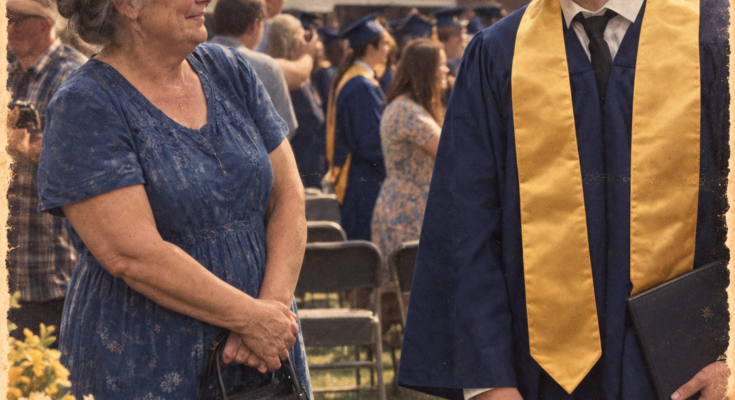
At home, I washed my face over the bathroom sink and changed into the blue dress Caleb had picked out for me two birthdays earlier.
The zipper caught halfway up. I fought with it until I laughed, then cried, then told my reflection to get a hold of itself.
I tucked a small photograph of Celeste into my purse beside the tickets.
The school gym smelled like floor polish and warm folding chairs. A woman at the entrance handed me a program, and I told her my grandson’s name.
“Oh,” she said, smiling. “He asked us to watch for you.”
She led me down the side aisle.
In the second row, Caleb’s friend’s mother had her hand resting on an empty chair. She lifted it when she saw me.
“He was very particular about keeping this one,” she whispered.
The graduates were already seated across the floor.
For a moment, I couldn’t find him among all those matching caps.
Then one head turned.
Caleb saw me, and his whole face changed.
Not a surprised grin. Not the polite smile he’d given me in our kitchen.
His mouth trembled.
He pressed his lips together and nodded once, like he couldn’t trust himself to do anything else.
I sat down before my knees could embarrass us both.
When they called his name, I stood. My hands were shaking so badly that the picture I took came out crooked, with half a stranger’s head in the corner.
I still have it.
—
Part Three: The Picture on the Fridge
Outside afterward, Caleb wrapped his arms around me and held on.
“I’m sorry,” I told him against his shoulder. “About what I said.”
“I know you didn’t mean it.”
“You kept me a chair.”
He stepped back, rubbing the edge of his gown between two fingers.
“I knew you wanted to come,” he said. “I just didn’t know if you could.”
We brought lunch to the restaurant that afternoon, which made Doreen laugh because we were delivering food to people who cooked for a living.
Caleb shook Bennett’s hand. Then he hugged him, awkwardly, knocking his paper cap against Bennett’s shoulder.
The next week, Bennett finally showed me his graduation picture.
I made him send it to my phone. Now it’s on our refrigerator, right beside Caleb’s crooked one.
For years, I thought taking care of someone meant making sure they had enough to eat and a roof that didn’t leak.
It does mean that.
But sometimes it means showing up.
Sometimes it means letting someone cover your shift so you can sit in a folding chair and watch your grandson cross a stage.
Sometimes it means accepting that the people you’ve fed along the way remember what you gave them—and they want to give something back.
Bennett didn’t just give up his wages that Friday.
He gave me a chance to be in the room when my boy heard his name called.
And Caleb didn’t just keep a chair.
He kept believing I would fill it.
That night, I sat at the kitchen table and looked at the two pictures side by side on the refrigerator.
Caleb in his cap and gown, grinning at the camera.
Bennett in his certificate photo, looking surprised that someone had bothered to take it.
Two boys who grew up too fast.
Two boys who needed somebody to feed them.
Two boys who reminded me that showing up is its own kind of cooking.
It’s the kind that feeds something deeper than hunger.
And it never stops mattering.
—