Part One: The Refusal
“Everything but that acre.”
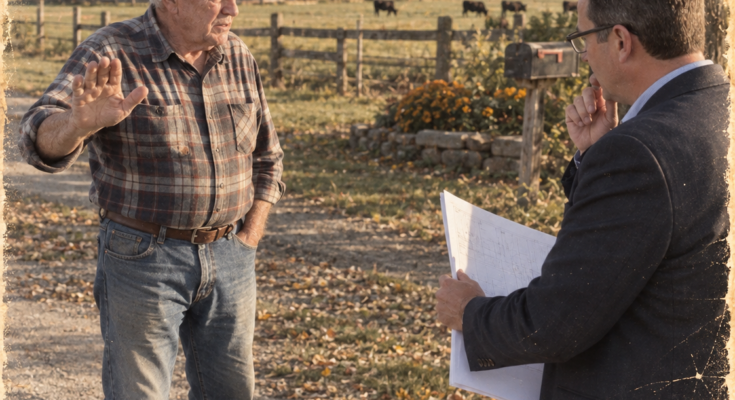
Calvin Reed tapped one weathered finger on the survey map spread across his kitchen table.
The developer looked up from his paperwork.
“Mr. Reed, that strip is right along the county road. We need it for the entrance.”
Calvin shook his head.
“Then you’ll need another entrance.”
At 72, Calvin had spent most of his life working the same Nebraska soil his great-grandfather had broken with horses.
But the farm was slipping away.
The year before, Calvin had suffered a heart attack during harvest. He survived, but between medical bills, a bad crop, equipment repairs, and debts he had spent years pretending weren’t getting heavier, survival had come with a price.
He was going to lose most of the farm.
A developer wanted the western fields for a small housing project. The offer was enough to pay Calvin’s debts and let him keep the farmhouse, the barn, and about forty acres around them.
It wasn’t the future Calvin had imagined.
But it was a future.
There was just one problem.
One acre.
A narrow patch beside the county road where nothing profitable grew except twelve tall trees, some prairie grass, and an old wooden bench silvered by years of Nebraska winters.
The developer offered more money for it.
Calvin refused.
Then he offered more again.
Calvin still refused.
Word traveled fast in a farming community.
At the feed store, men shook their heads.
At the diner, people whispered that Calvin had become too sentimental for his own good.
“He could lose everything over a patch of trees.”
“His family worked too hard for him to throw it away over pride.”
“Sometimes old men just get stubborn.”
Calvin heard most of it.
He never argued.
He simply drank his coffee, left a dollar beneath the mug, and drove home in the same dented pickup he’d owned for nearly twenty years.
His daughter, Jenna, worried too.
She drove out from Lincoln one Sunday and found him sitting on the porch, staring across the fields.
“Dad,” she said gently, “I’m not asking you to forget Grandpa or Great-Grandpa. But it’s one acre.”
Calvin looked toward the road.
“No,” he said.
“It isn’t.”
Jenna waited.
Calvin rubbed both hands over his faded jeans.
Then he said, “Come with me.”
They walked across the yard and down the gravel shoulder toward the twelve trees.
Jenna had seen them all her life.
As a girl, she had climbed one of the older ones.
She had sat on the bench with her brother.
She had watched her father mow around those trunks every summer, even when the rest of the farm was busy enough to keep him working after dark.
But she had never really asked why.
Calvin stopped beside the first tree.
At its base was a small brass plate, dulled by weather.
Jenna bent down.
It held a name.
*Emily Carter. 1981–1987.*
Jenna stared at it.
Calvin pointed toward another tree.
“Matthew Collins. Tractor accident. He was sixteen.”
Another.
“Rachel Turner. Leukemia. Nine years old.”
Another.
“Danny Hale. Twelve.”
Jenna walked slowly from tree to tree.
Every trunk had a name.
Every name belonged to a child from a farm family in the county.
Some had died from illness.
Some from accidents.
One had been lost in a winter storm decades earlier.
And beneath the largest cottonwood was a plate Jenna knew before she even reached it.
*Thomas Reed. 1978–1995.*
Her brother.
Jenna stopped breathing for a second.
Tommy had been seventeen when a car slid off an icy road one January morning.
Calvin and his wife, Mary, had buried their only son three days later.
Jenna had been twelve.
She remembered the funeral.
She remembered casseroles covering every kitchen counter.
She remembered grown men standing in the yard because there wasn’t enough room inside.
What she didn’t remember was the tree.
Calvin rested his palm against its bark.
“After Tommy died, your mother said she couldn’t stand the thought of driving past the cemetery every day.”
His voice grew quiet.
“She wanted someplace that felt alive.”
So Calvin planted a cottonwood by the road.
A neighbor whose daughter had died years earlier asked if Calvin might plant one for her too.
Then another family asked.
And another.
Nobody advertised it.
Nobody put up a sign.
Whenever a local farming family lost a child, Calvin quietly offered them a tree.
Sometimes they planted it together.
Sometimes the parents couldn’t bear to come, so Calvin planted it alone.
The bench came later.
Mary suggested it after finding one mother sitting in the grass beside her son’s tree.
“She said grief shouldn’t have to stand up all the time,” Calvin told Jenna.
Mary had died six years before Calvin’s heart attack.
But Calvin kept mowing the acre.
Kept replacing the brass plates when they weathered.
Kept clearing fallen branches after storms.
And every spring, he checked the trees before he checked his fields.
Jenna wiped her cheek.
“Why didn’t you ever tell anyone?”
Calvin shrugged.
“Wasn’t mine to tell.”
—
Part Two: The Apology
The following week, the developer returned.
His name was Daniel Mercer, a man in his forties who had grown up two counties away.
He arrived expecting another argument.
Instead, Jenna asked him to walk the acre.
Calvin said very little.
He didn’t need to.
Daniel read the plates.
All twelve of them.
At the last tree, he stood silently for a long time.
“My sister died when she was eleven,” he finally said.
Calvin looked at him.
Daniel swallowed.
“Cancer.”
Nothing else was said for several minutes.
The wind moved through the cottonwoods.
Somewhere across the road, a grain truck rumbled toward town.
A week later, Daniel called Calvin.
“We redrew the plan.”
Calvin didn’t understand.
Daniel explained that the entrance road would be moved several hundred yards west.
It would cost the development more money.
It would complicate drainage.
It would require a new survey.
“But the acre stays,” Daniel said.
Not only that.
Daniel’s attorney had prepared documents that would permanently protect the memorial area from future construction.
Calvin sat silently at his kitchen table.
“You don’t have to do that,” he finally said.
“I know,” Daniel replied.
“That’s why I want to.”
When the revised plans became public, the story spread through the county.
The same people who had called Calvin foolish began stopping by.
Some brought flowers.
Some brought fresh boards to repair the bench.
One retired carpenter replaced a broken armrest without telling anyone.
A high school agriculture class volunteered to clean the brass markers.
And one Saturday morning, nearly thirty people showed up with rakes, shovels, mulch, and coffee.
Calvin stood near the road watching them work.
A neighbor named Earl, who had once joked at the diner that Calvin had “finally lost his mind,” walked over and handed him a cup.
“I owe you an apology.”
Calvin looked at him.
“For what?”
“For thinking I knew what that acre was worth.”
Calvin stared toward the twelve trees.
“No harm done.”
Earl shook his head.
“That’s the problem with us sometimes. We look at land and see dollars.”
Calvin smiled faintly.
“Farmers ought to know better.”
—
Part Three: The Spring
By sunset, the acre looked better than it had in years.
The bench had been repaired.
Wildflowers had been planted near the fence.
The plaques had been polished.
Someone had left a small wind chime in the largest cottonwood. It sang softly as the evening breeze moved through the branches.
Calvin stood at the edge of the road, watching the last volunteers pack up their tools.
Jenna came to stand beside him.
“You know,” she said, “I always thought you kept this acre because you couldn’t let go.”
Calvin nodded slowly.
“I did.”
She looked at him.
“But that’s not why you kept it.”
He turned toward her.
“No.”
“I kept it because other people needed somewhere to put their grief. Somewhere that wasn’t a cemetery. Somewhere that felt like it was still growing.”
Jenna put her arm through his.
“Mom would be proud.”
Calvin’s eyes glistened.
“She’s the one who thought of the bench.”
They stood there until the sun dipped below the fields.
The following spring, a young couple from the new housing development knocked on Calvin’s door.
They had lost a child the year before. A little girl named Sophie.
They had heard about the trees.
Calvin didn’t ask questions.
He simply walked with them to the acre, handed them a small cottonwood sapling, and showed them where to plant it.
“Take your time,” he said. “There’s no rush.”
The mother cried.
The father shook Calvin’s hand and couldn’t let go.
When they left, Calvin stood alone beneath the trees.
Thirteen now.
He looked at the names on the plates.
Emily. Matthew. Rachel. Danny. Tommy.
And now Sophie.
He thought about all the years he had mowed this acre. All the winters he had cleared snow from the bench. All the mornings he had walked here before dawn, just to make sure everything was still standing.
He had never thought of it as a monument.
It was just a place where grief could grow into something living.
When Calvin passed away three years later, the whole county came to his funeral.
They buried him beside Mary and Tommy in the cemetery he had avoided for so long.
But they didn’t leave the acre alone.
Jenna took over the mowing.
The high school agriculture class kept clearing branches.
The brass plates stayed polished.
And every spring, when the cottonwoods leafed out, people came.
They sat on the bench.
They read the names.
They remembered.
The acre was never sold.
It never would be.
Because some things aren’t measured in dollars.
Some things are measured in love.
And love, planted carefully, grows into something that shelters everyone.
—