Part One: The Sunday She Kept
“Tell her I’ll pay double.”
The man stood at my mother’s counter with his wallet open. Behind him, a bucket caught the slow drip from a ceiling tile she hadn’t been able to replace.
Mama slid his order form back across the counter.
“I can have it ready Saturday afternoon. But I don’t deliver on Sundays.”
He stared at her. “Must be nice to turn down money.”
She smoothed the corner of the paper with her thumb. “It isn’t.”
I waited until the bell above the door stopped rattling.
“Mama. Double.”
“I heard him, Beth.”
“Then why did you say no?”
She picked up her clippers and trimmed the bottom of a white rose. “Because I meant what I said.”
My mother, Mavis Calder, was sixty-three years old, and until that spring, I had never known her to turn away work.
She had opened her little flower shop in rural Georgia when I was nine. I grew up doing homework beside ribbon spools and eating crackers from a drawer that always smelled faintly of eucalyptus.
Mama made funeral arrangements on Christmas Eve. She delivered anniversary roses during thunderstorms. Once, she drove twenty miles with a wedding bouquet held upright in a soup pot because the bride’s sister had forgotten it.
People called her dependable.
Then she stopped delivering on Sundays, and suddenly they called her difficult.
“She’s getting set in her ways,” one woman told me outside the grocery store.
I should have defended her. Instead, I said, “I’m trying to talk to her.”
That sentence still bothers me.
My father had been living with dementia for almost four years.
Some days, Daddy knew every turn between their house and the old feed store. Other days, he stood in the hallway asking Mama when his mother was coming to get him.
He had once been the kind of man who could hear a loose belt in an engine from across a driveway. Now he sometimes needed help finding the sleeve of his shirt.
Mama never pretended it was easy.
She got tired. She snapped once in a while. When I asked how she was doing, she usually answered with something practical: the washing machine was making a noise, or Daddy needed new slippers.
A neighbor stayed with him during some of her shop hours. I helped when I could, though looking back, “when I could” covered a lot of time I might have made.
Then the unpaid invoices started gathering beneath the register.
I found Mama studying one on a Thursday afternoon, her lunch untouched beside her.
“Let me go over the numbers,” I said.
She handed me the envelope without arguing. That frightened me more than an argument would have.
For the next week, I decided Sunday was the answer.
There were birthday lunches, family reunions, arrangements people wanted delivered before Sunday dinner. I made a list. I even figured out how many orders it would take to cover the cooler repair.
When I showed her, she listened.
Then she said, “Saturday pickup. Put that on there.”
“You can’t fix everything by telling people to come Saturday.”
“No,” she said. “I expect I can’t.”
I thought she was giving up.
I thought all those years of remembering for Daddy had worn down the part of her that knew how to keep going.
So the following Sunday, I drove to their house with a grocery bag and a speech.
I was going to tell her we needed to be realistic. Maybe it was time to sell the shop. Maybe she couldn’t manage everything anymore.
I let myself in through the back door at a quarter past two.
And heard music.
Not the television Daddy watched with the sound too loud. A record, with that soft little crackle before the singing started.
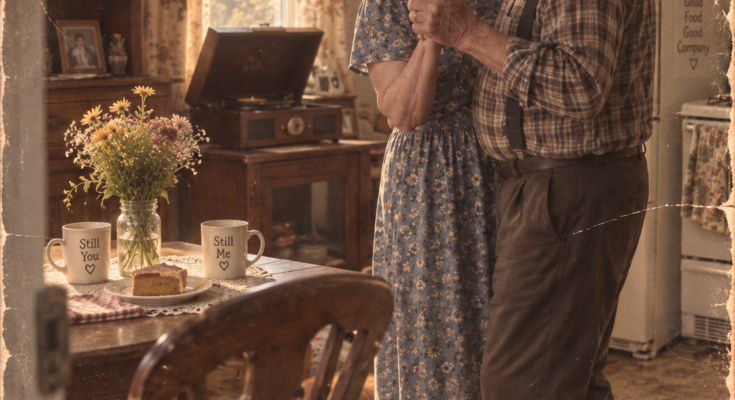
Their kitchen table had been set for two.
There were the yellow plates from my childhood, two glasses of iced tea, and a chipped jelly jar holding flowers I recognized from the shop: three short carnations, a bent snapdragon, and a rose too open to sell.
Mama was standing by the stove in her blue Sunday dress.
Daddy sat at the table, watching her.
I stayed in the doorway.
“You waiting for somebody?” he asked.
“No,” Mama said. “Everybody’s here.”
He looked down at his shirt, the good one with the tiny checks. She had missed a button near the bottom.
Then he looked up again.
“Does your husband dance?”
Mama rested her hand on the back of a chair.
“He used to dance with me right here.”
Daddy considered that. “Foolish man if he stopped.”
For a second, her face changed.
Then he pushed back his chair and held out his hand.
“Well,” he said, “would you like to?”
She went to him.
They moved slowly between the table and the refrigerator. Daddy’s slippers barely left the floor. Mama held one of his hands against her chest and kept her other arm steady around him.
She didn’t ask whether he knew her. She didn’t remind him whose kitchen it was.
When he stepped on her foot, she laughed.
“There it is,” she said.
“What?”
“Your signature move.”
He laughed too, because she was laughing.
I set the grocery bag down so carefully the paper hardly made a sound.
Later, while Daddy dozed in his chair, I stood beside Mama at the sink.
“How long have you been doing this?”
She rinsed the jelly jar.
“A few months.”
“Every Sunday?”
“Most. Sometimes he’s restless. Sometimes we just eat.”
I looked at the blue dress.
It was the one she used to wear when Daddy took her out for catfish on their anniversary.
“Why didn’t you tell me?”
She turned off the faucet.
“I told you I wanted Sundays home.”
She had. More than once.
I had been so busy deciding whether that was a good enough reason that I hadn’t heard it.
Mama dried her hands on a dish towel.
“He asked me to dance one afternoon while I was making lunch. I had a delivery in the car, and I told him, ‘When I get back.'”
Her thumb worried a loose thread in the towel.
“When I got back, he didn’t want me near him. He thought I was a woman who’d come to clean.”
I reached for her hand.
“I know he couldn’t help it,” she said. “But I kept thinking about that record playing while I put my coat on.”
From the living room, Daddy coughed in his sleep.
“Some Sundays he knows I’m Mavis,” she said. “Some Sundays he just seems glad I came.”
We stood there a while.
Then I put my carefully prepared speech where it belonged.
“Mama, what time do you usually finish cleaning the shop on Saturdays?”
She glanced at me. “Five. Sometimes six.”
“Show me what needs doing.”
—
Part Two: The Saturday Shift
The next Saturday, I scrubbed buckets until my fingers wrinkled. I swept stems from under the counter and learned that ribbon scraps somehow travel into rooms where no ribbon has ever been cut.
Mama left at three-thirty.
She didn’t say thank you. She didn’t need to. She just squeezed my shoulder once, picked up her purse, and walked out the door with the bell jingling behind her.
I stayed until six.
The shop still had bills. We still had decisions to make.
But we started making them around one afternoon she was allowed to keep.
The following week, I came back. And the week after that.
I learned which customers wanted small talk and which ones just wanted their flowers. I learned how to make a bow that didn’t collapse. I learned that the cooler made a rattling sound every forty minutes and that Mama had been meaning to fix it for two years.
One Saturday, a woman came in wanting a last-minute anniversary arrangement.
“I need it delivered tonight,” she said. “It’s our thirtieth.”
I looked at the clock. It was already past four.
“We close at five,” I said. “But if you can come back by then, I’ll have it ready.”
She frowned. “Can’t you just drop it on your way home?”
I thought about Mama, already at the house by now, already in her blue dress.
“No,” I said. “I can’t.”
The woman left without ordering anything.
I finished sweeping and locked up at five-fifteen. When I got to Mama’s house, Daddy was sitting at the kitchen table, and Mama was humming along to the record player.
She looked up when I came in.
“You’re late.”
“I know.” I set down the grocery bag. “But I’m here.”
—
Part Three: The Plate in the Cabinet
On Sundays, I brought supper.
At first, I left it in the refrigerator and tried to slip away. Mama caught me one evening with my hand on the door.
“There’s another plate in the cabinet, Beth.”
So I stayed.
Sometimes Daddy called me by my name. Sometimes he asked whether I lived nearby. I learned to pull up a chair without making every visit a test he might fail.
Last Sunday, the flowers on the table were two daisies and a crooked pink carnation.
Daddy pointed at them.
“Somebody bring you those?”
Mama tucked her napkin into her lap.
“I brought them home.”
He nodded, pleased, then reached across the table and laid his hand over hers.
I used to think the most important flowers in my mother’s shop were the ones people paid the most to send.
Now I watch her sort through the leftovers on Saturday, choosing something bright enough for the kitchen.
The shop is still struggling. The cooler still rattles. There are still invoices we haven’t figured out how to pay.
But on Sundays, the table is set for three now.
And when Daddy asks Mama to dance, I clear the plates and step into the hallway so they have room.
I listen to the record crackle. I hear Mama laugh when he steps on her foot. I hear him laugh because she is laughing.
And I think about all the Sundays I almost missed.
The people we love deserve more than the time we have left over.
—