Part One
The School Bus Driver Refused to Leave a 9-Year-Old at His Empty House—Then an Entire Kentucky Community Changed Its Routine
“Miss Marlene, you can go. I’m okay.”
Nine-year-old Cody said it with a smile that didn’t fool Marlene Webb for one second.
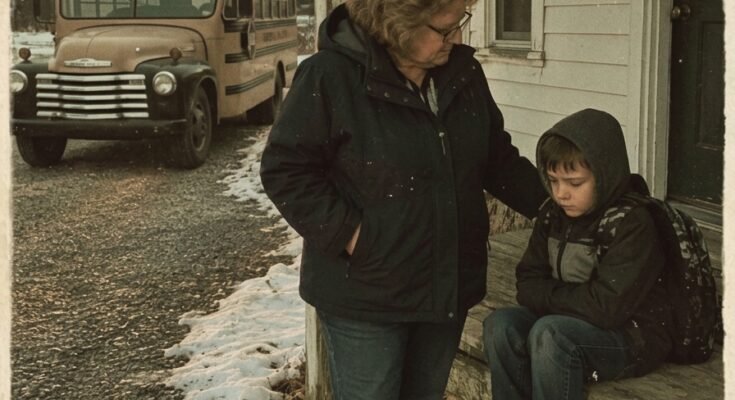
He was standing on the porch of a small rental house at the end of a gravel road in rural Kentucky, hugging his backpack against his chest while sleet tapped against the yellow school bus behind him.
The porch light was off.
No car sat in the driveway.
And the house was dark.
Marlene leaned toward the open bus door.
“Your grandma coming home soon?”
Cody shrugged.
“She usually does.”
Usually.
Marlene had learned to pay attention to words like that.
At 67, she had been driving a school bus long enough to know which children ran toward their houses, which ones dragged their feet, and which ones smiled too quickly when an adult asked if everything was all right.
Cody was one of the quick smilers.
Every afternoon, he climbed down at stop number nineteen, waved at Marlene, and walked toward that same quiet porch.
Sometimes his grandmother’s old sedan was there.
Sometimes it wasn’t.
When it wasn’t, Cody would sit on the top step with his backpack beside him and wait.
Marlene noticed because Marlene noticed everything.
She noticed the child who stopped wearing a coat before winter was over.
She noticed the girl who suddenly started bringing extra crackers home from school.
She noticed when brothers who normally argued sat silently together.
Children rarely announced when life had become difficult.
They just adjusted.
Marlene knew something about that.
Six years earlier, her daughter had died unexpectedly, leaving behind two children who were now living in Marlene’s little house outside town.
Her grandson had been eight at the time.
For months after the funeral, he had answered every question the same way.
“I’m fine.”
He would say it while staring at untouched pancakes.
He would say it while sleeping with the hallway light on.
He would say it while wearing his mother’s old sweatshirt because it still smelled faintly like her laundry soap.
So when Cody stood on that porch and said, “I’m okay,” Marlene heard what other people might have missed.
She heard a child trying not to cause trouble.
She checked the mirror.
Seven students were still on the bus.
They were restless and ready to get home.
Marlene picked up the radio.
“I’m going to be delayed at stop nineteen.”
A voice crackled back.
“Everything all right?”
Marlene looked at Cody standing in the cold.
“Not sure yet.”
She put on the parking brake.
Then she stepped off the bus.
“You mind if I wait with you?”
Cody’s face changed immediately.
Not much.
Just enough.
Relief.
Then embarrassment.
“You don’t have to.”
“I know.”
Marlene zipped her old navy coat to her chin.
“That’s why I’m doing it.”
They stood beneath the shallow porch awning while sleet bounced off the railing.
Ten minutes passed.
Then fifteen.
Marlene called the emergency number listed for Cody.
No answer.
She called again.
Still nothing.
From inside the bus, a few students began pressing their faces against the windows.
One parent called the transportation office asking why the route was late.
Then another.
Marlene knew exactly what the complaints would sound like.
People had dinner waiting.
Homework.
Appointments.
Lives arranged around the bus arriving at the same time every afternoon.
She understood.
But she also knew there was a nine-year-old boy standing beside her in temperatures dropping toward freezing.
So she stayed.
Twenty-five minutes became forty.
Cody tried the doorknob even though he already knew it was locked.
Then he sat on the porch step.
Marlene sat beside him.
“You hungry?”
He hesitated.
“A little.”
She went back to the bus and returned with the peanut butter crackers she kept in her bag for long afternoons.
Cody ate them slowly.
Then he said something that made Marlene’s chest tighten.
“Grandma’s been working extra.”
He stared down at his shoes.
“She says the electric bill got real bad.”
Marlene didn’t ask questions he shouldn’t have to answer.
She simply said, “Your grandma sounds like she’s working hard.”
Cody nodded.
“She is.”
Another fifteen minutes passed.
Finally, headlights appeared at the end of the gravel road.
An aging sedan pulled into the driveway.
Before the engine had fully stopped, a woman hurried out wearing a grocery-store apron beneath an unbuttoned winter coat.
She looked terrified.
“Cody!”
He ran toward her.
She wrapped both arms around him.
Then she looked at Marlene.
“I am so sorry.”
Her voice broke.
“My relief didn’t show up. My phone died. I thought I’d be ten minutes late.”
Marlene shook her head.
“He’s fine.”
The grandmother covered her mouth.
“I keep telling him to go inside the neighbor’s shed if I’m late, just to get out of the wind.”
Marlene glanced at Cody.
He had never mentioned that part.
The grandmother lowered her voice.
“His mom’s been gone a while. His dad isn’t around. It’s just us.”
Marlene looked at that tired woman still wearing her name tag from work and understood more than she needed to.
Sometimes families aren’t careless.
Sometimes they are simply stretched so thin that one delayed shift, one dead phone, or one missed paycheck can turn an ordinary afternoon into something frightening.
The next morning, Marlene expected trouble.
And she got it.
Two parents had complained formally about the route running nearly an hour late.
One wrote that the delay was “unacceptable.”
Another wanted to know why one child’s situation should affect everybody else.
Marlene read the complaints quietly.
Then she went back to work.
But small towns have a way of carrying the whole story faster than the first rumor.
By Friday, parents knew why the bus had been late.
A mother from stop six called the transportation office.
She said, “Tell Marlene if that ever happens again, she can drop the child at my house.”
A retired couple near stop eleven offered the same thing.
Then a farmer whose three children rode the route called.
His wife was home most afternoons.
They could take any child who needed somewhere warm to wait.
By Monday, someone had created a phone list.
By Wednesday, nearly every family on Marlene’s route had joined it.
The idea was simple.
If a parent or grandparent was delayed, they called one number.
If a child arrived home unexpectedly alone, Marlene had permission to take them to one of several approved homes nearby.
No more children sitting on dark porches.
No more guessing.
No more pretending that struggling families had to manage everything alone.
The same parent who had called the delay “unacceptable” eventually pulled Marlene aside at a school event.
He looked uncomfortable.
“I owe you an apology.”
Marlene smiled.
“You were worried about your kid.”
He shook his head.
“I was thinking about my schedule.”
He glanced toward his daughter playing nearby.
“You were thinking about somebody’s child.”
A few weeks later, Cody climbed onto the bus carrying a folded piece of notebook paper.
He handed it to Marlene without saying anything.
She opened it after the route.
His handwriting wandered across the page.
**Thank you for not leaving me when you could have.**
Marlene sat alone behind the wheel and cried.
Not because she thought she had done something extraordinary.
That was the part people kept getting wrong.
She hadn’t rescued anyone.
She hadn’t fixed Cody’s family.
She hadn’t written a check or made a speech.
She had simply refused to drive away.
And sometimes that is where community begins.
Not in committees.
Not in big announcements.
Not in perfect families with plenty of time and money.
It begins when one person notices somebody vulnerable and decides that being inconvenienced is better than being indifferent.
Marlene still drives that route.
She still watches porches.
She still keeps crackers in her bag.
And now, when one child’s parent is late, five other families already know they are not alone.
Because an old school bus driver reminded an entire community of something many of us were once raised to believe:
A child may belong to one family, but making sure they get home safely belongs to all of us.
—
Part Two
The phone list started as a single sheet of notebook paper taped inside the bus barn. By the end of the month, it had grown into a laminated sheet with thirty-one names, each one a promise.
Marlene kept a copy clipped to her visor. She never had to use it again that winter, but she liked knowing it was there. Some mornings, just seeing those names made her feel like the route was shorter.
Cody’s grandmother, Darlene, was the third name on the list. She had called the transportation office herself, apologizing for the trouble and asking to be added. “I don’t have much,” she told them, “but I’ve got a porch and a pot of coffee, and if any child needs to wait somewhere warm, I’ll be home.”
The office secretary had tears in her eyes when she took down the information.
Other things changed too.
The mother from stop six started sending extra snacks on the bus—individually wrapped granola bars, little bags of pretzels—things Marlene could hand to a kid who looked hungry without making it a scene. The farmer near stop eleven fixed up an old shed on his property, insulated it, added a space heater and two folding chairs. He told Marlene, “If a child ever needs to wait, they don’t have to do it in the cold.”
Nobody made a big deal about any of it. That was the point.
Small towns don’t always announce their kindness. Sometimes they just quietly rearrange themselves around a need.
Marlene noticed the change in Cody too. He still smiled too quickly. He still hugged his backpack like it might disappear. But some afternoons, when the bus pulled up to stop nineteen and his grandmother’s sedan wasn’t there yet, he didn’t sit alone on the step. He walked to the neighbor’s porch instead, where a light was always on now.
Darlene had started leaving it on. Just in case.
—
Part Three
Spring came slowly that year. The sleet turned to rain, the gravel road turned to mud, and the school year crept toward its end.
Marlene was scheduled to retire in June. Sixty-seven was old enough, her doctor said. Her knees agreed. But she hadn’t told the families on her route yet. She wasn’t sure how.
The news got out anyway. Small towns have a way.
On the last Friday of the school year, Marlene pulled up to stop nineteen and found something she hadn’t expected.
Cody was waiting on the porch, like always. But behind him, standing on the steps, were his grandmother and four other adults—parents from different stops, neighbors she recognized but had never spoken to at length, the farmer and his wife, the retired couple from stop eleven.
They were holding a cake.
Marlene opened the bus door and just sat there for a moment, her hands still on the wheel.
“What’s this?” she asked.
Cody walked up the steps first. He was carrying a folded piece of paper, same as before, but this one was bigger. Construction paper. Crayon drawings around the edges—a bus, a porch, a house with a light on.
“We made you something,” he said.
She unfolded it.
At the top, in Cody’s handwriting, it said: **To Miss Marlene. From all of us.**
Below that were signatures. Dozens of them. Children’s names in wobbly letters. Parents’ names in careful cursive. Darlene’s name in the middle, circled twice.
And underneath all of it, one sentence, written by someone with better handwriting than the rest:
**You didn’t just drive us home. You showed us how to take care of each other.**
Marlene read it three times.
Then she looked up at the porch full of people, at Cody smiling for real this time, at Darlene wiping her eyes with the back of her hand, at the farmer holding a cake he’d probably baked himself because his wife did the cooking and he did the baking and that was just how they worked.
“I was going to tell you all I’m retiring,” Marlene said.
“We know,” Darlene said. “That’s why we’re here.”
They ate cake on the porch. The bus sat empty at the curb, engine off, door open. Nobody was in a hurry. Nobody had anywhere else to be.
A few weeks later, on her last official day, Marlene drove the route one final time. Same stops. Same kids. Same porches.
When she reached stop nineteen, Cody was waiting. His grandmother’s car was in the driveway this time. The porch light was on.
He climbed down the steps, turned around, and waved.
Not the quick wave he used to give. The real kind.
Marlene waved back.
Then she pulled the door closed, put the bus in gear, and drove on.
The phone list still hangs in the bus barn. A new driver took over the route, and Marlene made sure she had a copy before she left. “You might need this,” she said.
The driver looked at the thirty-one names, at the phone numbers and the little notes beside each one.
“What is it?” she asked.
Marlene smiled.
“It’s a promise,” she said. “That no child on this route waits alone.”
She handed over the keys, climbed into her own car, and drove home.
The porch lights were on all along the gravel road.
They stayed on for years.
—
Title: The List