Part One: The Busiest Day
“Don’t come by today, honey. Wednesdays are still my busiest.”
That was the message my mother left at 8:12 a.m. At 9:05, I stood outside her kitchen window holding a bag of cinnamon rolls, watching her sit alone in her black salon apron.
Her appointment book was open. There wasn’t a customer in sight.
I almost went back to my car. There’s something terrible about catching someone you love trying to protect you from their sadness.
Then she looked up.
For a second, she smiled the way she used to when the bell above her salon door rang. Then she saw the bag in my hand, remembered where she was, and reached to close the book.
“You should be at work,” she said when she let me in.
“So should you, apparently.”
It came out sharper than I meant it to. Her hand stayed on the doorknob.
I set the rolls down. “Mom. I’m sorry.”
Patrice Wynn, my mother, was sixty-two years old. For twenty years, she’d cut hair in a narrow Wisconsin storefront with a stubborn front door and a radiator that knocked all winter.
She knew who liked the water almost hot enough to complain about. She knew which women said “just a trim” when what they really needed was forty-five minutes away from home.
She kept crackers in a drawer for customers who came straight from work. When somebody’s husband died, she turned their chair away from the mirror so they wouldn’t have to watch themselves cry.
Then the rent went up. Two styling chairs sat empty, and the bills kept coming.
By the time she told me how bad things were, she had used her savings trying to stay open. Bankruptcy followed, and the little shop became a room with pale rectangles where the mirrors used to hang.
That had been eleven weeks earlier.
Every time I asked how she was doing, she said she still had a few customers. Nothing regular. Enough to stay busy.
Especially Wednesdays.
Now I could see her work shoes underneath the kitchen table, polished and neatly tied.
“Who’s coming today?” I asked gently.
“Nobody this morning.”
I glanced at the book. “You said you were booked.”
She pulled out a chair for me, as if sitting down might make this easier.
“I know what I said.”
The kitchen smelled like coffee that had been warming too long. Beside her cup sat a single cinnamon toast crust.
I opened the bag between us. She took out plates.
For a while, we talked about the weather.
Then she went to get napkins, and I saw the names.
At ten: Darlene.
At eleven-thirty: June.
At one: Bev.
There were notes beside them, written in the small, tidy handwriting I remembered from school permission slips.
*Darlene—70. Doesn’t like a fuss.*
*June—ask about grandson’s first week.*
*Bev—anniversary. Hard day.*
“Mom?”
She followed my eyes.
“They’re not appointments,” she said.
I waited.
“Darlene’s birthday is today. June’s grandson started at a new school Monday. Beverly would’ve been married forty-three years tomorrow.”
She sat down slowly.
“I used to remember to ask when they came in. Now I write it down so I don’t forget.”
I turned back one page. Then another.
Birthdays. A retirement. A daughter’s due date. A little star beside someone’s name with the words *call if brave*.
That was the one that got me.
“Why wouldn’t you call?”
She rubbed a crumb off the table with her thumb.
“What if they think I’m trying to get work?”
“They know you.”
“They know their hairdresser.”
I started to argue, but she looked so tired that I stopped.
After a minute, she said, “I don’t know what to say when somebody asks what I’ve been doing.”
I looked around her spotless kitchen. At the apron she had ironed. At the appointment book she still had a reason to open.
I had spent eleven weeks asking whether she needed groceries, whether she’d sorted out the bills, whether she was sleeping.
I hadn’t asked what Wednesdays felt like.
Before I left, I hugged her longer than usual. She patted my back and told me not to worry, which made me worry more.
—
Part Two: The Calls
That afternoon, I contacted three women I’d known since I was a kid sweeping hair after school.
I didn’t photograph the book. I didn’t tell them about the apron.
I just said, “I think Mom misses you. Would you ask her out for coffee?”
Darlene answered first.
“Oh, thank goodness,” she said. “I’ve been wanting to call. I didn’t want to make her talk about the shop.”
June said almost the same thing.
Beverly was quiet for a moment.
“Your mother sat with me for an hour after my husband’s funeral,” she said. “Wouldn’t let me drive home until I’d eaten something.”
Then she asked which Wednesday would work.
Mom called me the following Tuesday.
“The girls invited me over to Darlene’s.”
“That sounds nice.”
“I wonder if she needs her hair done. Her birthday was last week.”
“Maybe she just wants to see you.”
“Maybe,” Mom said, in a voice that meant she didn’t believe it.
Darlene asked me to come too. When Mom arrived, she had put on lipstick and the blue blouse she used to save for Saturdays at the salon.
She was also carrying her black scissors bag.
I watched her set it beside her chair.
“I brought everything,” she told Darlene. “We can do you before we eat, if you’d like.”
Darlene looked at the bag, then at June.
“Oh, Patrice,” she said softly. “Put that away.”
Mom’s smile faltered.
“I don’t mind. Really.”
“We know you don’t,” Beverly said. “But nobody’s getting a haircut today.”
There were four cups on the table, a chipped sugar bowl, and enough coffee cake for twice as many people. Mom remained standing, one hand on the strap.
June pulled out the chair beside her.
“We realized something,” she said. “You know all our grandchildren’s names. I don’t even know where you grew up.”
“Outside Eau Claire.”
“Well, sit down. Was it nice?”
—
Part Three: The Answer
Mom glanced at me, confused.
I took a cup to the counter and gave her a little space.
At first, she answered like somebody filling out a form. A small house. Two sisters. Her father worked nights.
Then Beverly asked what her mother had been like.
Mom laughed.
“Convinced a baked potato could fix nearly anything.”
I had never heard that before.
Neither had they.
She told them about sharing a bedroom with her sisters, about wanting to sing on the radio, about practicing hairstyles on a neighbor who paid her in tomatoes.
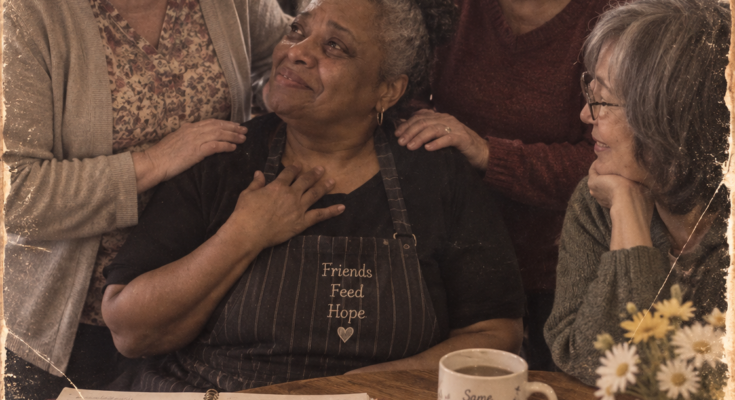
When Darlene asked whether she missed the salon, Mom reached for her coffee.
“I miss knowing where to be,” she said.
Nobody hurried to cheer her up.
“I still wake up at six on Wednesdays. I get dressed. Then there’s this whole day.”
Her face crumpled, and she looked embarrassed before the tears even came.
June slid the napkins toward her. Beverly rested a hand on her arm.
We stayed until the coffee was cold.
They didn’t solve what came next. But when Mom stood to leave, Darlene asked whether she could come the following Wednesday.
Mom looked down at her untouched scissors bag.
“Should I bring anything?”
“That potato recipe,” June said.
That evening, Mom called me. I could hear pages turning.
“I need to change something in my book.”
“What’s that?”
“Next Wednesday. I’m putting down coffee.”
She paused.
“And I told them my birthday. Can you believe they asked?”
I could, now. I just wished we’d all asked sooner.
The woman who remembered everybody finally had people making room to remember her.
Sometimes the person who has listened to everyone is waiting for someone to ask her a question—and stay for the answer.
—